
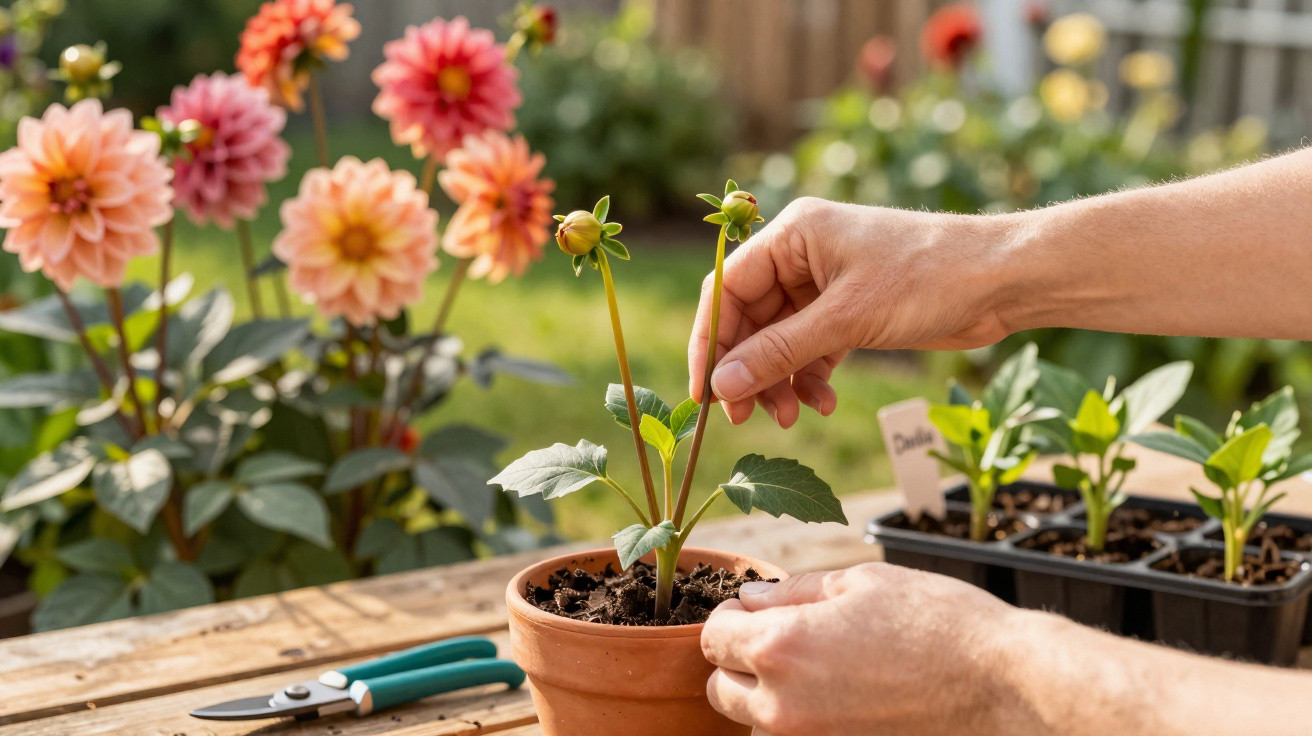
Many dahlias shoot upwards yet produce only a handful of flowers – one small, bold cut can change that completely.
Anyone who loves dahlias will know the problem: long, slender stems, lush foliage and only the occasional bloom. Professional growers use a remarkably simple remedy. It can seem almost ruthless, but it delivers many more flowers and sturdier plants. Timing is crucial – as is having the confidence to take secateurs to an apparently perfect young plant.
What pinching out young dahlias really does
Every dahlia follows the same basic pattern: one main shoot takes the lead, growing upwards, drawing strength and suppressing side shoots. The plant puts much of its energy into height and foliage rather than a wealth of flowers. Removing the tip of this shoot early disrupts that internal hierarchy.
This is precisely the technique used by experienced gardeners: they remove the growing tip from the main stem of a young dahlia. It compels the plant to produce several side shoots. Research, including work by the Royal Horticultural Society and the French research institute INRAE, shows that this creates substantially more flowering shoots – often four to six instead of just one.
Pinching out the main growing tip early turns a tall, unsteady dahlia into a compact, flower-filled bush.
The result is easy to see: the plant remains shorter, branches more freely and has a more compact, robust form overall. Rather than toppling over in the first strong gust, it stands up far better.
More flowers rather than one display: the direct benefits of pinching dahlias
Many amateur gardeners are puzzled when their dahlias grow vigorously but flower very little. Pinching them out early helps the plant distribute its energy more widely:
- More side shoots instead of one dominant main stem
- Four to six flowering shoots can develop instead of only one
- A considerably greater number of blooms throughout the season
- A sturdier plant that is less likely to snap in the wind
- Better suited to cut flowers and colourful borders
One aspect puts many people off at first: the first main flush of flowers arrives slightly later. After pinching out, flowering usually begins around ten to fifteen days later. In return, the dahlia flowers much more profusely afterwards – its overall flower count can rise three- to fourfold over the course of the season.
Professionals use this response very deliberately, depending on the intended result. Those aiming for exceptionally large blooms, such as on so-called Dinner-Plate varieties, often leave the main stem intact and remove side shoots. In a home garden, the opposite is generally more desirable: plenty of medium-sized flowers to fill borders and vases. This is where early pinching is at its best.
How to identify the ideal time to pinch out dahlias
Choosing the right moment determines whether the technique succeeds or causes harm. As a rule of thumb, the dahlia should still be young but already look sturdy.
| Criterion | Ideal condition |
|---|---|
| Plant height | About 20 to 30 centimetres |
| Number of true leaf pairs | Four to five clearly formed pairs |
| Stem thickness | Still fairly slim, solid and not hollow |
| Time after planting | Usually three to four weeks, depending on the weather |
Ideally, pick a dry day. The cut will dry more quickly, reducing the risk of rot.
Step by step: how to pinch out young dahlias correctly
The procedure itself is straightforward if you follow a few basic rules:
- Check the plant: It should be about 25 centimetres high, have four to five leaf pairs, and its stem should not yet be thick and hollow.
- Prepare your tool: Use a fingernail or small, sharp hand pruners. Clean the tool with alcohol (around 70 per cent).
- Find the main shoot: Choose the central, strongest stem rather than cutting the weaker side shoots.
- Select the cutting point: Make the cut just above the node of the second or third well-developed pair of leaves.
- Make a clean cut: Remove the tip with one decisive cut; do not crush or tear it away.
The height is important: remove only the growing tip above the node of the second or third leaf pair, and do not cut lower down.
This cut removes the terminal bud area, which produces a plant hormone called auxin. Normally, this hormone keeps the side buds “held back” – a process known as apical dominance, meaning that the tip dominates growth. Once it is removed, the side buds awaken and begin to grow.
Common mistakes and how to avoid them
The method is not difficult in itself; it becomes risky mainly when it is used too late. As the dahlia stem thickens, it develops a hollow centre. Cutting at that stage creates a small hollow where rainwater or watering water can collect.
From there, moisture has a direct route down to the tubers. This can cause rot within a few days, making the plant collapse or die altogether.
Mistakes you should definitely avoid with dahlias
- Cutting too late: Do not pinch out stems that are more than about one centimetre in diameter.
- Cutting too low: Never cut below the node of the second leaf pair, as this weakens all new growth.
- Wet weather: Do not cut during prolonged rain or immediately before heavy watering.
- Blunt tools: Bruised cut surfaces provide ideal entry points for fungi.
- Plants that are already weakened: Allow unhealthy dahlias to recover before placing them under additional stress.
If your dahlias have already developed very sturdy, slightly hollow stems, it is better not to cut them. At this stage, a firm support cane will help far more than a late cut. Tie the plants in loosely and remove only faded flowers and damaged shoots.
Why the technique is worth the risk
Deliberately cutting back a healthy young plant can feel wrong at first. Many amateur gardeners need one or two seasons to become comfortable with it. However, those who take the step are usually rewarded with more flowers, stronger plants and, above all, an evenly filled border instead of isolated “flowering sticks”.
The method is especially appealing for anyone who enjoys cutting bouquets. More shoots naturally mean more cut flowers without leaving the plant looking bare. Regularly allowing blooms to open while also harvesting them encourages the dahlia to produce additional buds.
A few extra professional tips for even better flowers
To ensure the cut delivers its full potential, it is worth considering care and position as well:
- Position: Choose a sunny, sheltered site with loose soil. Heavy, wet soils increase the risk of tuber rot.
- Feeding: Feed moderately but regularly. Fertilisers slightly higher in phosphorus and potassium encourage flowering and sturdiness, while excess nitrogen only promotes foliage.
- Watering: Aim for consistently moist soil rather than permanent wetness. It is better to water less often but thoroughly.
- Flower care: Remove spent blooms regularly, so the plant directs less energy into seed production.
If you grow several varieties, you can also use different approaches: leave some plants uncut for very large individual flowers, and pinch others out early for lots of medium-sized blooms. This creates an interesting mix in the border that is visually effective too.
Another often overlooked point is that pinching is not suitable only for huge decorative varieties. Shorter bedding and patio dahlias benefit as well. Specimens grown in containers become noticeably more compact after cutting and are less prone to toppling, which is a real advantage on balconies or patios.
Anyone wanting to try this approach cautiously can begin with just a few plants. A direct comparison between pinched and unpinched dahlias in the same border will show very clearly, after only a few weeks, how much this single early cut affects growth habit and flower abundance.

Comments
No comments yet. Be the first to comment!
Leave a Comment