
While shop displays packed with seed packets tempt gardeners and online retailers brim with new varieties, British gardening expert Monty Don draws attention to a frequently overlooked group of plants: woody shrubs. He regards them as a long-term investment that shapes beds for years, rather than simply providing colour for one season.
Why Monty Don chooses shrubs rather than seeds in March
Spring is under way, daylight is increasing and the soil is gradually thawing: this is precisely the window Monty Don uses to plant shrubs. While many gardeners are still focused on tomato seeds and summer flowers, he is already considering structure, longevity and resilience in the garden.
“A single shrub can achieve more than ten packets of seeds, because it gives the garden shape, height and permanence.”
In March, the ground is beginning to warm up, but summer heat is still some way off. These conditions suit newly planted woody plants perfectly: they can establish roots calmly before putting on strong growth in late spring and summer. Frost damage is usually only a risk in exceptional cases, while the moisture already in the soil helps them settle in.
Monty Don particularly highlights what are known as woody shrubs. Their shoots become woody over time, rather than having to grow completely afresh each year like annual summer flowers. This is exactly what makes them a kind of backbone for a garden, whether it is a compact terraced-house plot or a large landscape.
The overlooked value of shrubs in the home garden
Many private gardens have the same common weakness: there are pots and colourful perennials everywhere, yet no clear framework or structure. Shrubs address precisely that issue.
- Privacy: Shrubs can create hedges, informal screens or green filters between neighbouring properties.
- Focal points: A single specimen can draw attention to an entrance, patio or path.
- Seasonal character: Spring flowers, summer berries and autumn colour bring interest through the year.
- Habitat: Birds, insects and small animals gain food and shelter.
- Less work: Once established, many shrubs demand less maintenance than beds filled with annuals.
A single planting session in March can therefore become a decision with an impact lasting for years. Rather than covering the same bare corner with summer bedding every year, a thoughtfully positioned shrub creates a permanent frame there.
Why Monty Don particularly recommends bare-root shrubs
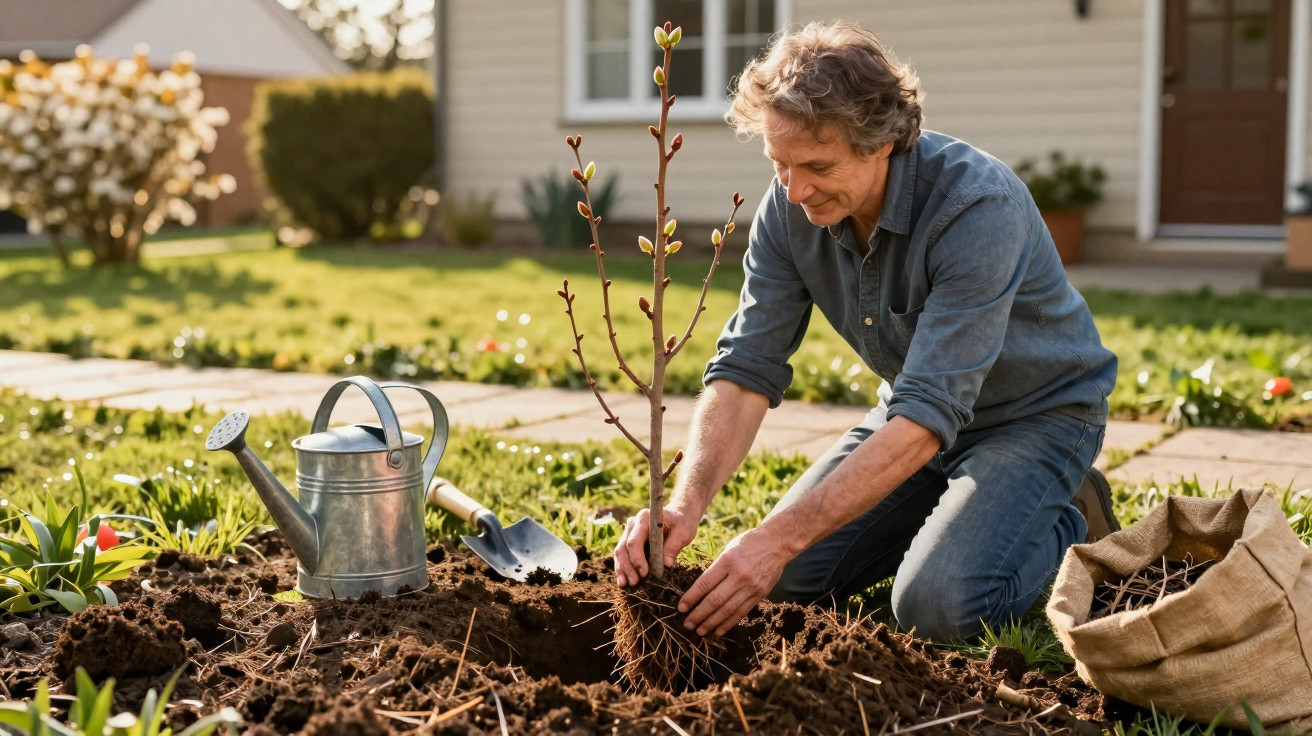
The television gardener specifically recommends bare-root shrubs. These are plants sold without a pot or soil around their roots. They are lifted directly from the field, then supplied or offered for sale during their dormant period.
Their advantage is that, after planting, the roots can spread more freely into the surrounding soil rather than circling as they may in a pot. March offers excellent conditions for this, as the soil is cool and generally still moist.
“Planting a bare-root shrub in March gives it a head start before the season properly begins.”
Bare-root plants are particularly appealing to gardeners on a limited budget. They are often considerably cheaper than large container-grown specimens, yet with correct handling they establish just as well, if not better.
Monty Don’s planting method: how to plant shrubs properly
What is especially interesting is the level of detail Monty Don gives for the planting process itself. It is not simply a matter of digging a hole and putting the shrub in; several key steps make a difference.
A step-by-step guide to planting a shrub well
- Remove weeds: First, thoroughly dig out all perennial root weeds from the surrounding area. If couch grass or ground elder remains in the soil, it will later compete fiercely for water and nutrients.
- Dig a wide, shallow planting hole: Make the hole wider rather than deeper, around 20–25 cm deep but substantially broader than the root system. This encourages roots to grow sideways into the surrounding ground.
- Loosen the base: Gently break up the soil at the bottom without compacting it. This makes it easier for roots to penetrate deeper layers.
- Do not add compost to the hole: Monty Don expressly advises against filling the planting hole with rich compost or “super soil”. Otherwise, roots may remain in this comfortable, nutrient-rich cushion and barely extend into ordinary garden soil.
- Prepare the roots: For bare-root shrubs, trim any damaged root tips and, if necessary, soak the roots for a few minutes.
- Optional: mycorrhiza: If desired, dust the roots with a mycorrhizal preparation. These fungi form a symbiotic relationship with the plant and improve nutrient and water uptake.
- Plant slightly higher: Position the shrub a little above the surrounding soil level, then firm the soil so that it forms a gentle mound. This prevents water from collecting in a dip around the stem.
- Water thoroughly: Give the shrub a generous watering after planting, so the soil settles around the roots and air pockets disappear.
- Apply a mulch layer: Finally, spread a thick layer of compost or bark mulch over the soil surface. This retains moisture, suppresses weeds and supports soil life.
This combination of a broad planting hole, minimal “luxury soil” below ground and mulch on top ensures that the shrub adapts to real garden soil from day one, rather than becoming stuck in its planting hole.
Shrubs that will support your garden for many years
Monty Don names several classic shrubs that have performed reliably for decades and are not particularly demanding. Many of them are also ideal for British gardens.
| Shrub | Strengths | Suitable for |
|---|---|---|
| Hydrangeas | Large, lavish flower heads, a long flowering period, and some tolerance of shade | Partial shade, front gardens, beds against the house |
| Shrub roses | Romantic blooms, fragrance, and often very hardy | Mixed borders, rose hedges, sunny borders |
| Viburnum | Scented flowers, some winter-flowering varieties, and attractive autumn colour | Features beside paths, informal hedges |
| Mock orange (Philadelphus) | Intensely fragrant flowers, easy-going and tolerant of pruning | Fragrant hedges, areas near seating, cottage-garden style |
Those with limited space can choose more compact cultivars bred specifically for smaller gardens. Many modern hydrangeas and mock oranges remain far smaller than their traditional relatives while still producing plenty of flowers.
One shrub can transform an entire garden
Monty Don stresses that even one carefully selected shrub can noticeably alter the feel of a garden. For example, in a bare patio corner, even the most attractive collection of containers can appear disjointed in summer. Add a fragrant mock orange or a compact hydrangea, and it creates a fixed anchor around which pots, perennials and decorative items can later be arranged.
“Anyone who consciously chooses just one shrub in March is often unknowingly laying the foundation for an entirely new feeling in the garden.”
This approach is helpful for beginners, too. Rather than becoming overwhelmed by dozens of seed packets, they can focus on one plant that will remain for many years. The learning curve is manageable, while the effect can be all the greater.
What new gardeners should also know about shrubs
“Woody shrub” may sound technical, but it simply means plants whose shoots mature into solid branches. Unlike herbaceous perennials, they do not die back completely in winter; instead, they retain their framework and send out new growth from it each year. This provides stability, both visually and in terms of maintenance.
Naturally, there are risks: an unsuitable position, waterlogging or periods of extreme dryness during the first year can weaken newly planted shrubs. Anyone with very heavy clay soil should loosen it especially carefully and, where needed, improve the wider area with sand and compost, rather than adding them to the planting hole. On very sandy ground, a thick mulch layer helps retain moisture.
One practical suggestion for anyone with little time in March is this: it is better to plant one shrub thoroughly, water it regularly and mulch it well than to squeeze three into holes that are too small with only half-hearted preparation. The success rate increases significantly, and the garden benefits more in the end.
The effect becomes particularly interesting when shrubs are combined with perennials and bulbs. Tulips and daffodils can flower beneath a shrub rose in spring, followed by perennials such as lady’s mantle or lavender in summer, while the shrub itself supplies height. The result is a layered planting scheme that feels lively while requiring relatively little maintenance.


Comments
No comments yet. Be the first to comment!
Leave a Comment