
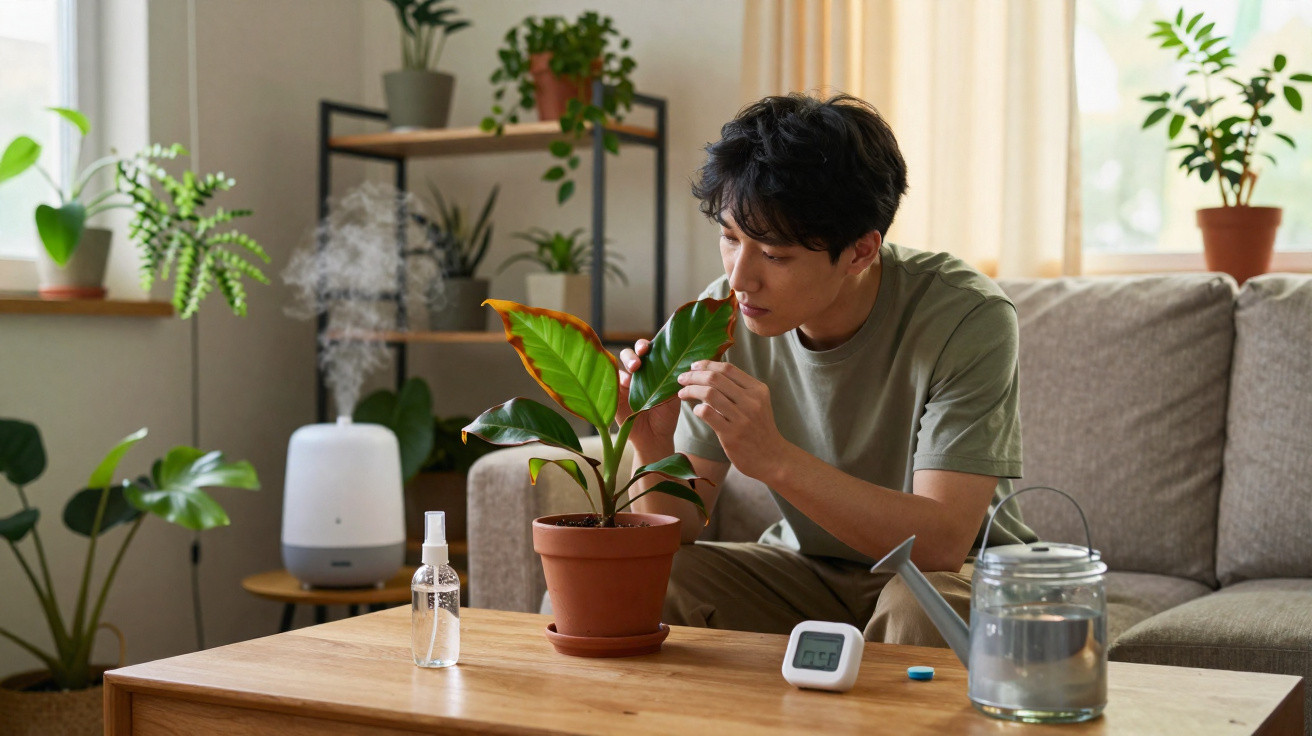
Your once-thriving living-room jungle has suddenly begun to look worn out.
For plenty of plant owners, dry, brown tips can feel like a silent rebuke: something is clearly wrong, but what? The solution is seldom as simple as watering more or watering less. These small areas of dead tissue are often the earliest visible clue that your plant’s surroundings are unbalanced, and they can reveal a great deal about conditions in your home.
What brown tips are really telling you
When a leaf tip turns brown, think of it as a plant’s distress call. Because the tips are the final parts of a leaf to receive water and nutrients, problems such as stress, low humidity or mineral accumulation tend to show there first.
One brown edge on an older leaf is not usually cause for alarm. As they age, plants naturally lose foliage. The more meaningful warning sign is several leaves crisping at once, including newer growth, or a brown area gradually advancing further across the leaf.
Brown tips are not a cosmetic flaw. They are often your first, best chance to spot a problem early.
Pay attention to the pattern. Thin, unchanged brown edges on a handful of old leaves are likely to be normal ageing. Patches that spread, particularly alongside drooping, yellow leaves or slower growth, suggest continuing stress that needs addressing.
Dry indoor air: the hidden culprit in modern homes
At the first sight of brown tips, many plant parents automatically reach for the watering can. Yet in many situations, dry air rather than dry compost is the real cause.
During winter, central heating can regularly reduce indoor humidity to below 40%, while air conditioning can do the same in summer. A large proportion of popular houseplants are tropical species, adapted to woodland habitats where humidity is often 70% or higher. Compared with that, a typical modern living room may feel like a desert.
Plants that suffer first from low humidity
Certain plants make their displeasure apparent particularly fast:
- Patterned-leaf plants, including calatheas and prayer plants (marantas)
- Ferns, particularly Boston and maidenhair varieties
- Alocasias with broad, thin foliage
- Mature Monstera deliciosa as it grows larger
- Fine-leaved ficus, such as Ficus benjamina
When these plants are kept in a heated space, close to a radiator, or directly in the path of a fan or AC unit, brown tips will almost inevitably develop eventually.
Low humidity dries out leaf edges faster than the plant can move water to them, so the outermost cells simply die off.
Water quality: when tap water slowly sabotages your plants
In areas with hard tap water, mineral build-up is another likely culprit. Chlorine and fluoride may upset sensitive plants, but for many houseplants the main long-term issue is limescale caused by calcium-rich water.
Minerals gradually collect in the potting mix. A white coating on the surface of the compost or around the pot rim is an obvious indicator. Such deposits can disrupt root performance and alter the substrate’s pH. As roots become less able to take up water consistently, leaf tips are often the first areas to show the resulting shortage.
Simple checks to see if your water is to blame
- Check the compost and pot for white, chalk-like deposits.
- Consider whether sensitive plants develop brown tips despite sensible watering and reasonable humidity.
- Try a small test: for one month, water half your plants with rainwater or filtered water, keep the rest on tap water, then compare their new growth.
If fresh leaves remain unmarked on the “filtered water group” while the others develop brown tips, your tap water is probably contributing to the issue.
Pots and potting mix: the underestimated duo
Even where humidity is ideal and water quality is acceptable, brown tips can still appear if a plant’s roots are cramped or starved of air. Both an undersized pot and compost that has degraded into a dense, muddy material restrict the movement of oxygen and water.
Roots that circle tightly inside the pot, push through drainage holes, or create a firm block when the plant is removed are familiar signs of a rootbound plant. In this condition, the compost dries very quickly after watering, while the plant finds it difficult to move enough moisture towards its leaf tips.
When to repot and what to look for
| Sign | What it suggests |
|---|---|
| Roots through drainage holes | Pot is too small, growth restricted |
| Water runs straight through | Mix is exhausted and hydrophobic |
| Plant wilts a day after watering | Not enough substrate to hold moisture |
| Hard, compact root ball | Time for a bigger pot and fresh mix |
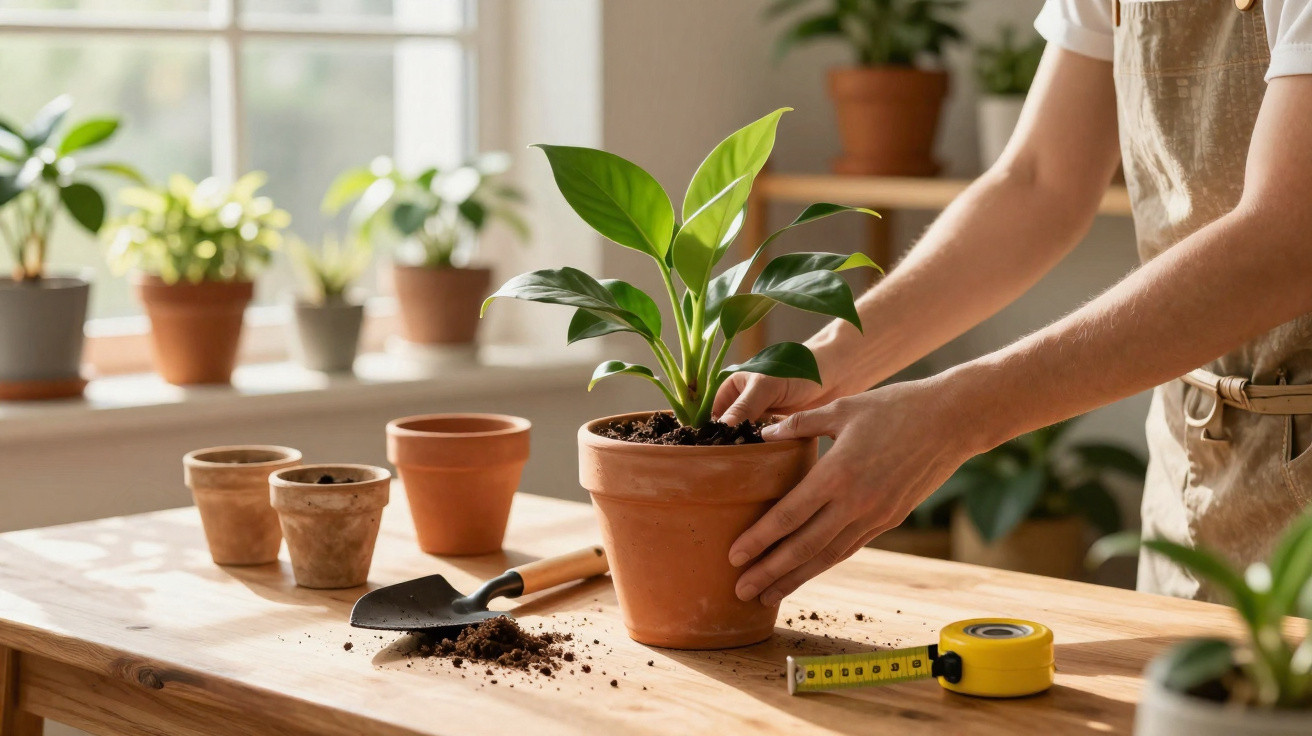
Increasing the diameter by only 2–3 cm is generally sufficient. Pots that are too large remain wet for excessive periods, potentially causing root rot and, once again, those recognisable brown tips.
Light levels: between shade and sunburn
Light is not often blamed for crisp leaf tips, but it has an important influence. Plants kept in very dim conditions produce weak growth, leaving them more exposed to dry air, pests and overwatering. At the other end of the scale, foliage facing intense midday sun may scorch around the edges and become brown and papery.
Weak light does not directly “brown” a leaf, but it leaves the plant too sluggish to cope with every other type of stress.
A plant that leans strongly towards a window or produces long, sparse stems needs more light. If leaves nearest the glass become bleached, curled or marked with brown, scorched areas, the light is excessively strong and direct, especially through south- or west-facing windows.
Adjusting exposure without shocking your plant
Bring plants that need more light nearer to a bright window, while filtering harsh midday sun with a sheer curtain. For plants suited to shade, aim for “bright, indirect” conditions rather than a dark corner. Moving a plant a little closer each week helps prevent shock and additional damage.
Watering routines: the fine line between drought and drowning
Brown tips caused by watering errors can look much the same whether the plant receives too little water or too much. Underwatering dries the outer cells first. Overwatering, meanwhile, deprives roots of oxygen, leaving them unable to send water up to the leaves and causing the same dehydrated appearance around their edges.
Building a plant-by-plant watering rhythm
A universal watering timetable rarely succeeds. Instead, approach every plant individually:
- Pick up the pot: if it feels unusually light, the compost is often dry.
- Test the top 2–3 cm of soil with a finger instead of relying on the date.
- Observe leaf texture: soft, limp leaves can indicate either drought or waterlogged roots, so always check the compost as well.
Think of your watering routine as a conversation with each plant, not a fixed timetable pinned to the fridge.
Requirements shift with the seasons too. Many houseplants grow more slowly during winter and need much less water, even in a heated flat.
Practical fixes to stop brown tips in their tracks
Raising humidity where it counts
In homes full of moisture-loving plants, placing a small electric humidifier near the group is among the most effective options. Target humidity of 50–60% for tropical plants, and slightly lower levels for succulents and cacti.
For a more affordable approach, place plants close together on trays containing pebbles and a shallow amount of water, ensuring that the pots sit above the waterline. As water evaporates around the stones, it forms a more humid pocket around the leaves.
Misting may seem satisfying, but the benefit disappears quickly. Unless it is done several times daily, it rarely raises the room’s overall humidity for long.
Improving water quality without overcomplicating things
Where tap water is particularly hard, consider:
- Gathering rainwater in a clean container
- Leaving tap water to stand for 24 hours before watering, allowing chlorine to dissipate
- Using a simple filter jug for the water
Use water that is close to room temperature at all times. Very cold water poured onto warm roots can shock a plant, creating stress symptoms that may later become visible at the leaf tips.
Dealing with tips that are already brown
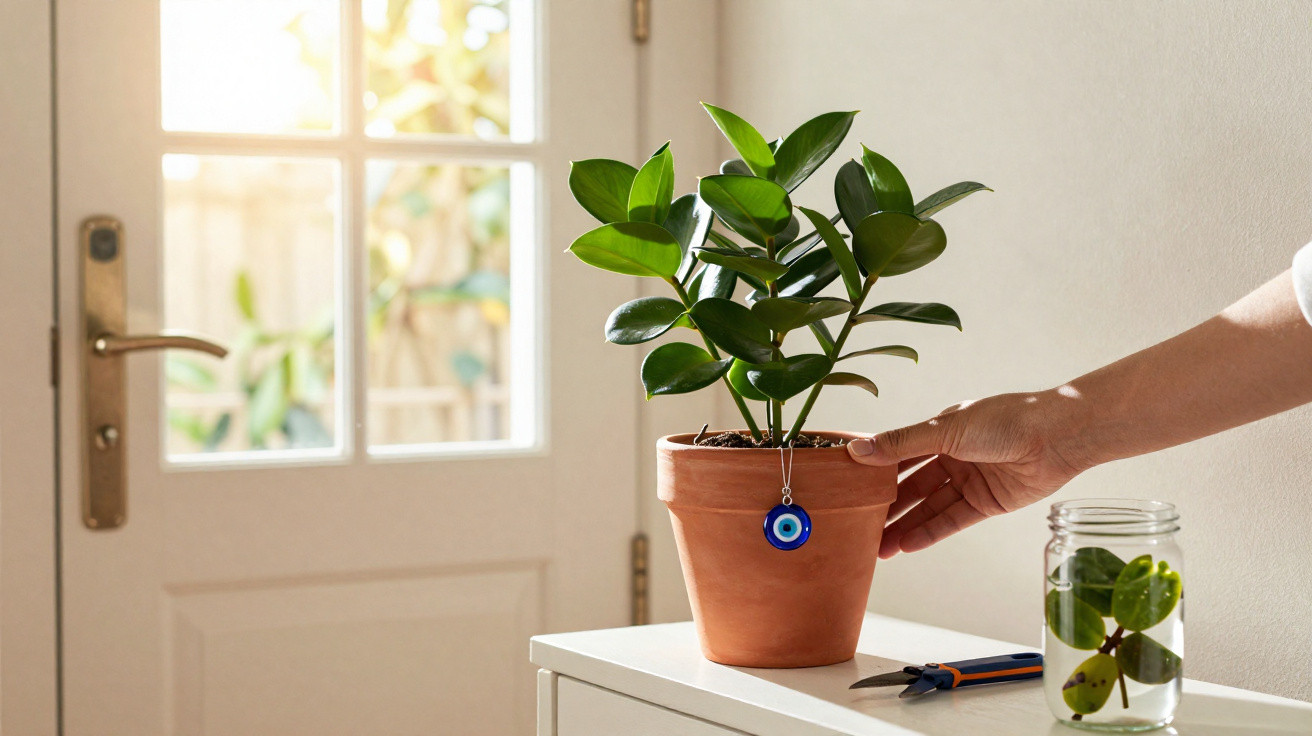
Dead leaf tissue cannot become green again. However, you can neaten it without damaging the plant. With sharp, disinfected scissors, cut along the leaf’s natural outline and leave a slim brown border, avoiding cuts into healthy green tissue.
Never remove a whole leaf if only the edge is damaged. Any remaining green area still feeds the plant.
Building a routine that prevents future damage
Rather than relying on dramatic rescue measures, many seasoned plant owners use simple regular habits. Keep plants with comparable needs together, so you do not have to remember five separate watering routines on a busy Tuesday evening.
Why a simple plant log can change everything
A quick note on your phone, or a notebook kept on the windowsill, can record when each plant is watered, repotted or fertilised. Within a few months, useful patterns become clear: the peace lily that droops every six days in summer, the monstera that dislikes fertiliser in winter, or the fern affected whenever the heating is switched on.
Keeping records also makes it easier to connect cause and effect. When brown tips arrive a week after every heavy feed, your fertiliser may be too concentrated or applied too often, lightly scorching the roots and delicate leaf tips.
Reading stress signals before they escalate
Whenever you water, spend a few seconds checking every plant: look beneath its leaves, at the compost surface and at its overall stance. Fine webs, sticky residue or sudden pale markings can indicate pests or sun stress, both of which often occur with brown tips.
Catching these signs early lets you move the plant, rinse its leaves or alter humidity before half the foliage is affected. Treat it as preventive care, rather than emergency treatment.
Extra insight: why some species will always be “drama queens”
Even with almost perfect care, plants such as calatheas and maidenhair ferns may develop brown edges after every minor disruption: moving to another room, a cold draught or one missed watering. Their thin, highly active leaves react quickly to changes in their environment.
That does not mean you are failing as a plant parent. It simply reflects the severe difference between a rainforest floor and a winter flat with radiators and double glazing. Keeping expectations realistic and concentrating on healthy new growth, rather than perfect old leaves, makes the hobby far less stressful.
When to worry that brown tips mean something bigger
The occasional brown tip on an older leaf is a normal part of plant life. It becomes more concerning when fresh leaves emerge already damaged, large areas of foliage brown simultaneously, or the plant stops growing for months.
In these circumstances, bring together all the checks above: inspect the roots, replace depleted compost, reconsider the light level, measure humidity and assess your tap water. A brief, systematic inspection will often reveal a clear sequence of causes behind those weary brown leaf edges, giving the plant a real opportunity to recover instead of merely survive.
Comments
No comments yet. Be the first to comment!
Leave a Comment