
Across North America and Europe, councils and householders are seeking ways to make pavements safer without damaging soil, scorching pets’ paws or causing cars to rust. A newer range of de-icers, alongside practical low-tech measures, is beginning to reshape how ice is managed outside homes.
Why rock salt is falling out of favour
Conventional road salt, generally sodium chloride, is inexpensive and acts quickly, yet it carries a lengthy list of drawbacks. It can enter groundwater, dehydrate vegetation, corrode concrete and metal, and aggravate skin and paws. In built-up areas, these effects become significant.
Across a single winter, a typical city can spread tens of thousands of tonnes of salt, much of which ends up in rivers and garden soil.
That environmental cost is encouraging both councils and residents to consider alternatives that still reduce the risk of falls. The aim is not to stop de-icing completely, but to apply lower quantities of more effective products, alongside improved timing and straightforward traction aids.
Two strategies: melt ice or improve grip
Most methods for winter safety fit into two main categories. One is designed to melt ice or prevent it from adhering to the surface. The other increases traction, allowing footwear, pram wheels and bicycle tyres to hold the ground even where ice is still present.
Think of it as a toolkit: a melting product for thin, stubborn ice, and a grippy material for brutal cold or sensitive areas.
A third approach is frequently missed: preventing ice from sticking from the outset. Applying a liquid treatment before snow lands can make subsequent shovelling considerably easier and sharply reduce the quantity of product required.
Gentler de-icers: calcium chloride, magnesium chloride and CMA
A number of salt-based treatments function at lower temperatures and, when applied properly, are less aggressive than ordinary rock salt.
Calcium chloride for severe cold
Calcium chloride (CaCl₂) is a widely used step up from rock salt. It draws moisture from the air and produces heat as it dissolves, enabling it to break down ice rapidly.
- Effective down to around -32 °C (-25 °F)
- Acts quickly on steps, confined corners and shaded spots
- Commonly available for domestic use as pellets or flakes
Applied in modest quantities, it may reduce the total amount of de-icer required. Excessive use can nevertheless harm nearby soil and plants, so experts often recommend saving it for the most troublesome patches instead of treating the full driveway.
Magnesium chloride for pets and plants
Magnesium chloride (MgCl₂) is another common choice for homes with dogs or garden beds alongside the path. It generally remains effective to roughly -23 °C (-10 °F) and usually produces less gritty residue than sodium chloride.
Veterinary organisations often identify it as less irritating to paws than rock salt, although any de-icer may cause issues when animals consume large quantities. Many products marketed as pet-friendly use magnesium chloride mixed with a traction material.
CMA: the anti-adhesion option
Calcium magnesium acetate (CMA) works differently. It is not a chloride. Rather than tackling heavy ice directly, it is intended to prevent snow and thin ice from firmly attaching to a surface.
| Product | Main role | Typical use |
|---|---|---|
| Calcium chloride | Rapid melting in severe cold | Steps, steep drives, shaded paths |
| Magnesium chloride | Milder melting | Places used by pets and close to plants |
| CMA | Prevention and anti-adhesion | Before snow, on pavements and car parks |
Because CMA is usually more costly, it is often sprayed preventively on higher-risk surfaces, including areas outside hospital entrances and rail stations. It degrades into substances considered generally less harmful to soil structure.
Beet brine and homemade mixes
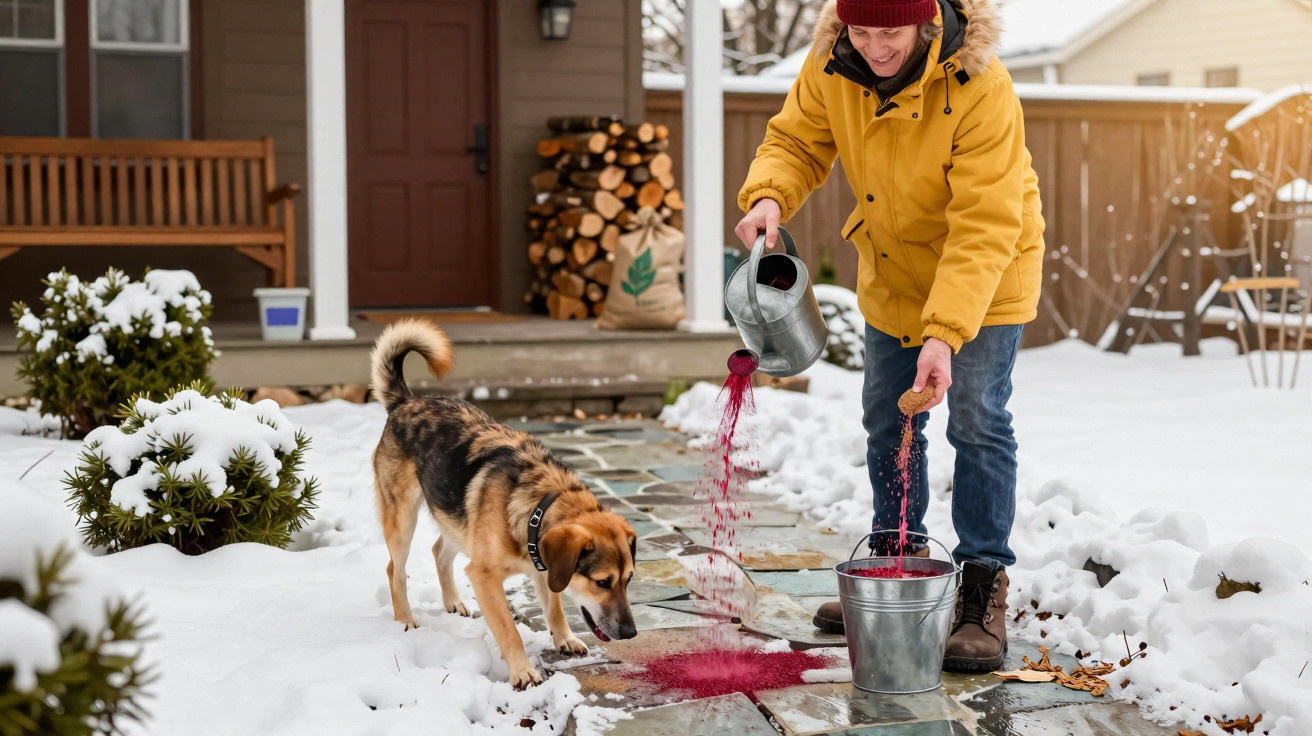
Beet brine has been among the more striking alternatives used in recent winters. This dark, treacle-like liquid is produced during sugar beet processing and blended with a small quantity of salt. Some North American councils already apply it to roads before snow arrives.
By helping salt stick to the road and slowing refreezing, beet brine can cut total salt use while keeping surfaces workable.
For household use, beet brine is normally used lightly on established tarmac or concrete rather than fresh concrete or fragile planting beds. It performs best as a preventive treatment or while snow is falling, rather than as a solution for thick, highly polished ice.
At a far smaller scale, some households prepare their own treatment for a porch or front step using lukewarm water, a little washing-up liquid and some rubbing alcohol. The washing-up liquid limits how firmly ice attaches to the surface, while the alcohol reduces the freezing point.
This homemade mixture should only be used on very thin ice films, and slush must always be swept away afterwards to prevent it freezing again into a glass-like layer.
Traction without melting: sand, ash and grit
Traction products are particularly useful when temperatures are extremely low or when additional moisture should be avoided, such as near planted areas.
Sand and wood ash for immediate grip
Ordinary sand remains a popular option. It provides immediate grip, while its darker tone can absorb a small amount of solar warmth on sunnier days. However, it may block drains and should be swept away after the thaw.
Wood ash from a clean-burning stove has a comparable effect for virtually no expense. A light dusting on an icy path can noticeably improve footing. Minerals and residual warmth also give ash a mild de-icing quality, although it can create mess and should not be applied in deep layers.
Wood chips and crushed stone
Coarser materials, including fine wood chips, are better able to remain in place during freeze-thaw periods, so they can be useful on inclines or gravel driveways. They are also less likely to be carried indoors, which is an advantage for many homes.
In some rural locations, people use “chicken grit” or “traction grit”, which is essentially crushed granite or comparable stone sold for poultry. Its sharp, angular particles dig into ice and create reliable grip without dissolving into the soil. A thin spread is sufficient, and much of the material can be collected and used again.
Heated mats and high-tech driveways
Technology can minimise, or even eliminate, the use of chemicals for those with limited mobility or particularly steep steps.
Electric heated mats can be placed across the upper few steps or along a narrow path, clearing a light covering of snow and frost at the flick of a switch. They operate only when necessary and can be rolled up when spring arrives.
At the most expensive end are fully heated paths and driveways. Pipes or electrical cables beneath the surface provide warmth from below. Such systems consume substantial energy and are only suitable in particular settings, such as exposed slopes or shared paths at busy apartment blocks.
How to select the right option for your pavement
The most appropriate method will depend on your location and whether your priority is protecting people, pets, plants or all three.
- Mild winters, lots of pets: choose magnesium-based products and traction materials, and do not overuse chlorides near lawns.
- Very cold climates: retain a small tub of calcium chloride for the worst areas, using sand or grit across the remaining surfaces.
- Gardens close to paths: rely more on abrasives, CMA as a preventive treatment, and rapid shovelling instead of heavy de-icing.
- Small urban balconies or steps: heated mats and very small quantities of liquid de-icer may be sufficient.
Thinking ahead – clearing early, using preventive sprays and targeting only high-risk areas – can cut your chemical use by half or more.
Key terms and real-world scenarios
Winter safety advice often treats “anti-icing” and “de-icing” as interchangeable terms, but they describe different actions. Anti-icing means acting before or during snowfall to prevent the first layer from bonding tightly to the ground. De-icing happens afterwards, once compacted snow or hard ice has already formed.
Take a standard suburban pavement as an example. Spreading a thin coating of CMA or a light brine ahead of an expected freeze means any snow that falls overnight will be simpler to shovel in the morning. One quick shovel may then be enough, followed by sand on any remaining slippery sections. Without that early treatment, you could be forced to chip at the surface with a metal scraper and use considerably more chemicals to achieve much the same outcome.
The school run offers another realistic example. Parents may be concerned about children sliding on steps, while also considering what could get onto their dog’s paws. In this situation, many opt for a more pet-friendly de-icer on the steps, with crushed stone or grit on the pavement beside areas where plants are growing.
These decisions need not be all-or-nothing. Minor changes, such as replacing pure rock salt with a blended product, applying beet brine solely as a pre-treatment, or keeping strong de-icers for essential areas, can limit environmental damage while ensuring winter streets remain walkable.





Comments
No comments yet. Be the first to comment!
Leave a Comment