
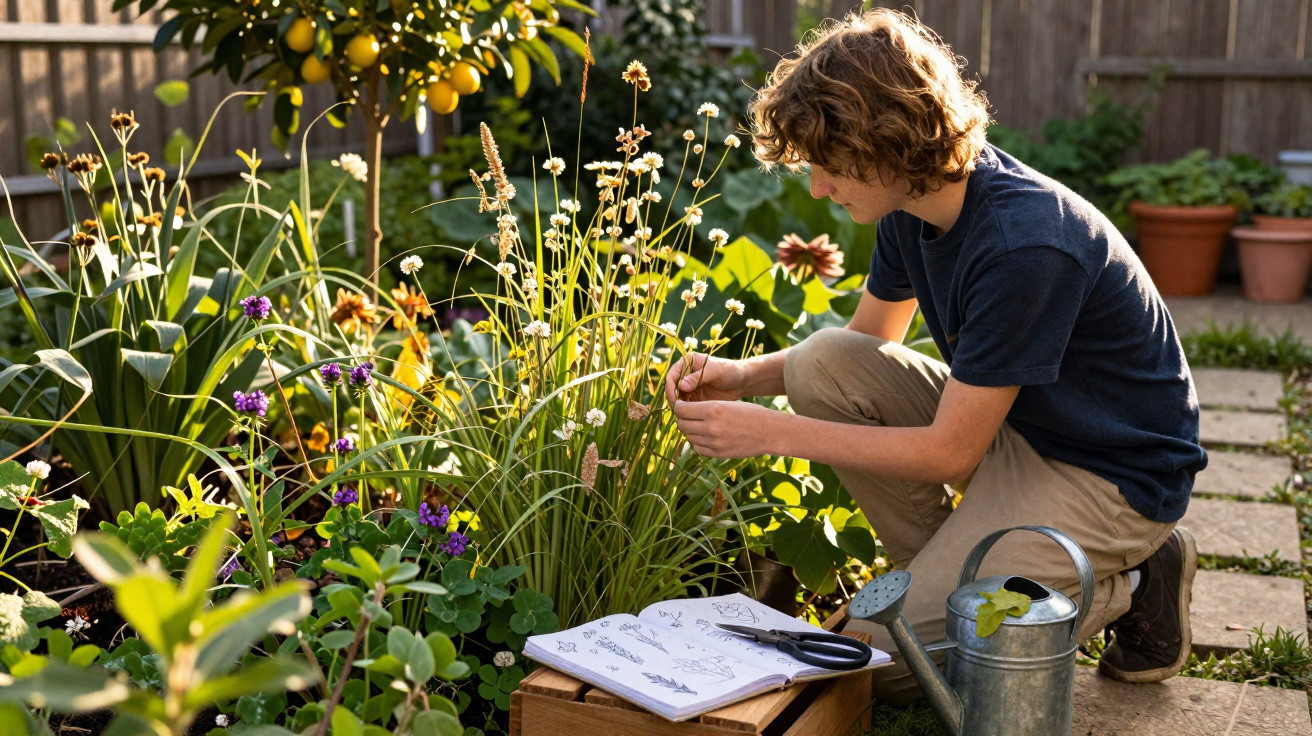
The lawn was technically “perfect”, yet nothing ever took place on it. There were no bees or birds, only a level green stillness that seemed closer to plastic than to life. Then, one spring, the owner stopped battling the clover and allowed one corner to grow wild. Within a few weeks, butterflies had arrived. A wren began pecking at dry seed heads. At dusk, a hedgehog started calling by, like a small spiny tenant paying its rent in snails.
The garden suddenly looked untidy: slightly unruly. Plants flopped wherever they pleased, mushrooms emerged after rain, and volunteer seedlings appeared far from the places promised on their seed packets. But something quieter had changed. The space felt alive, as though the garden possessed a gentle will of its own.
That is often when worried gardeners start to ask whether they have got it wrong.
When a “messy” garden is really a living one
You tend to spot it first around the margins. The orderly border planted last year begins to relax, like carefully combed hair after a long windy walk. A foxglove turns up where none was planted. Seedlings emerge beneath the roses, a fern grows from a crack beside the shed, and moss spreads over the path. With a trowel in hand, you pause, caught between clearing away the chaos and seeing what happens next.
This is the curious tension of a living garden: it will not remain within its boundaries for long. It changes, spreads, reseeds and tries new things, almost as if it is bargaining with the weather every day. The more life it holds, the less it resembles a catalogue photograph.
Imagine two neighbouring gardens on a June morning. One has an immaculate lawn, edged with six matching box balls and a line of annuals delivered in plastic trays. It is clean, coordinated in colour and somehow… silent. Next door, the grass is a little longer and scattered with daisies. Comfrey leans over a path, marigolds have self-seeded, and a tangle of herbs hums with hoverflies.
Research from the University of Sheffield found that small urban gardens can support remarkably high biodiversity, at times matching nature reserves. Perfection was not the key. Variety, layers and, yes, a degree of visible disorder made the difference. Gardens that appeared “finished” were often those with the least life in them.
What seems unpredictable is frequently ecology working quickly. Seeds arrive on the wind, in bird droppings and on the soles of your shoes. Fungi emerge once the soil contains enough organic matter to sustain them. Aphids gather on soft new growth, then attract ladybirds and lacewings. This exchange is the unseen framework of a healthy garden.
A strictly controlled garden provides no space for these conversations among species. A living garden, on the other hand, contains countless small compromises. You take something out here, make room there, and the garden answers. However messy it may appear, that feedback loop shows the system is functioning.
How to guide garden chaos without losing the magic
A straightforward but effective approach is to stop tending every part of the garden at the same time. Think of the space as two zones: an “orchestra” and a “jam session”. In orchestra areas, plant in purposeful drifts, prune, edit and shape the overall appearance. In the jam-session corners, step back. Allow self-seeders to perform, postpone mowing and leave some fallen leaves where they land.
Begin on a modest scale: a one-metre strip beside a fence, one raised bed, or a distant lawn corner left uncut until late summer. Watch what emerges. It may be yarrow, vetch or simply taller grass that unexpectedly shelters crickets at night. You are not neglecting the garden; you are making room for places where you are not the sole designer.
This is when the worry often starts. You may wonder whether neighbours think you have abandoned the garden. You may fear it is “getting out of hand”. You pull out one plant, then feel oddly guilty when you notice the number of bees using its flowers. We have all experienced that pause with secateurs in hand, unable to choose between neatness and life.
The answer is to shift from policing to editing. Rather than removing every unexpected arrival, learn to retain harmless volunteers and take out only what obstructs a path, overwhelms another plant or creates a genuine problem. Honestly, nobody manages this every day. Gardening in bursts, followed by quiet observation, is entirely enough.
Eventually, you notice that unpredictability has a rhythm of its own. Birds arrive after the first rain. Slugs multiply during warm, wet periods. Ladybirds appear three weeks later. You begin to recognise the pattern, and feel less like a failure and more like a participant.
“A garden only feels out of control when we expect it not to be alive,” an old landscape designer told me once, leaning on his shovel. “The trick isn’t to dominate nature. It’s to set the stage and let the play unfold.”
- Leave one area semi-wild for an entire season, and simply observe what arrives.
- Cut paths through longer grass rather than mowing every part to an identical height.
- Keep a small “nursery bed” where self-seeded surprises can be relocated and tested.
- Choose light pruning over severe cutting, allowing plants to show what they are trying to do.
- Let a few plants set seed, then watch where their offspring decide to grow.
Living with a garden that talks back
Once you accept that a responsive garden will always bring surprises, the experience changes completely. A plant flopping after a storm no longer feels like failure, but like a weather report written in stems and petals. Cracks between paving slabs become a record of what the soil quietly wants to grow. Uninvited “wrong” plants become clues rather than enemies.
You start to see that control was never the true aim. What you wanted was connection: to the seasons, to the creatures sharing your space, and to the quieter part of yourself that settles while you weed. A predictable garden is easy on the eyes, but a slightly unruly one is easier on the soul.
Perhaps your garden already feels alive, but rather unpredictable. Maybe that makes you uneasy. Or perhaps, deep down, it is exactly what you had hoped for: a space that responds, changes and occasionally does something you did not plan but secretly needed. You are not doing it wrong. Your garden is finally beginning to breathe.
| Key point | Detail | Value for the reader |
|---|---|---|
| Embrace partial “wild zones” | Set aside corners or strips where plants can reseed and wildlife can establish itself | Cuts maintenance, boosts biodiversity and brings more life into view |
| Edit instead of control | Remove only what genuinely conflicts or causes damage, while keeping harmless surprises | Less stress, less work and a more resilient, self-balancing garden |
| Read the garden’s signals | Treat unexpected plants, insects and changes as information rather than failure | Helps you adjust your gardening approach and become more confident over time |
FAQ:
- Question 1 Is a “messy” garden really better for wildlife?
- Question 2 How do I stop a wilder garden from annoying my neighbours?
- Question 3 Will letting plants self-seed make my garden unmanageable?
- Question 4 Can I still grow vegetables in a more unpredictable garden?
- Question 5 What if I just prefer a very tidy, controlled look?





Comments
No comments yet. Be the first to comment!
Leave a Comment