
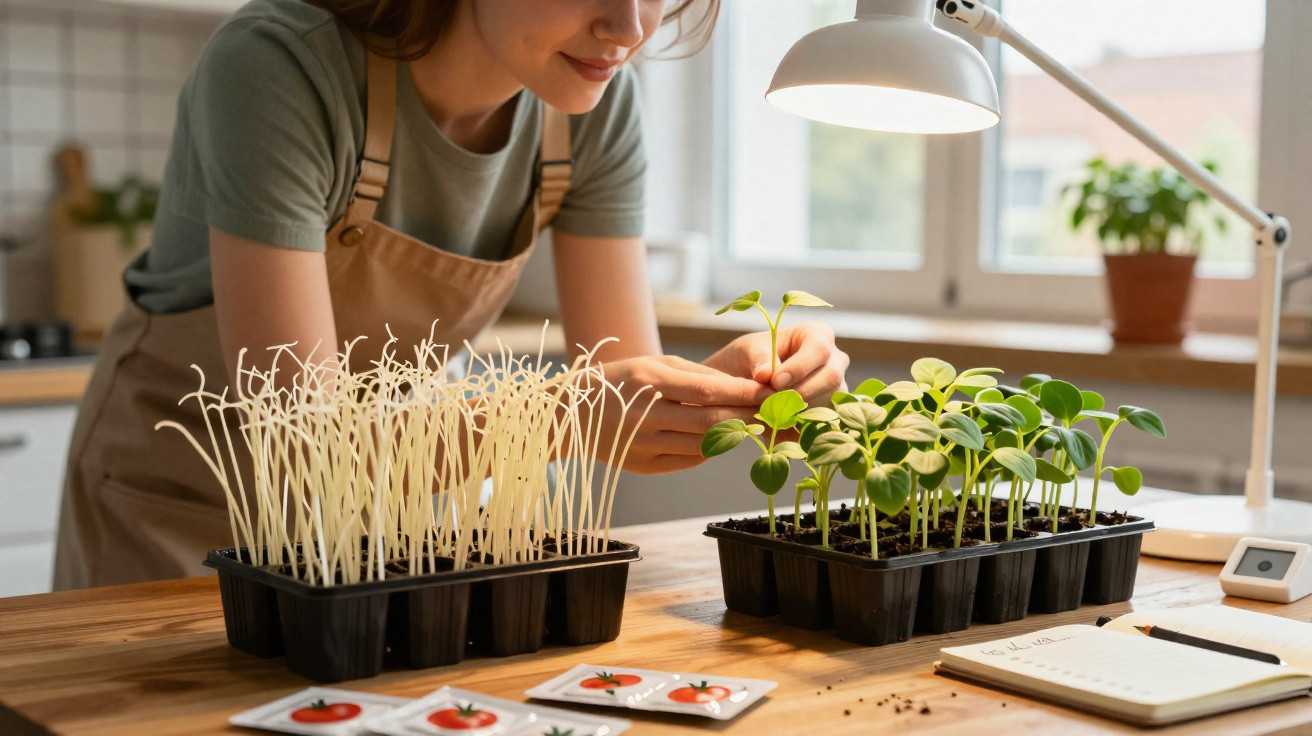
You notice them on the windowsill while having your morning coffee, and your stomach immediately drops. Only yesterday, the seedlings seemed upright and full of promise. This morning, they are tall, pale and angled sharply towards the glass, like weary teenagers after an all-nighter. Some have already keeled over, their stems no thicker than sewing thread. You lightly touch one and it simply… buckles.
You go over everything you did “right”: decent compost, sanitised trays, costly seeds and careful watering. You may even have spoken to them once or twice for good luck. Yet they continue to stretch, collapse and die.
Something in that room is not working.
Why seedlings become weak and leggy
When seedlings become stretched and topple over, most gardeners immediately blame themselves. Perhaps they did not care enough, lack green fingers or even started at the wrong lunar phase. But the real explanation is much simpler, and more frustrating: the seedlings are starved of light and racing towards it like alarmed marathon runners.
Without powerful, direct light coming from above, a young plant switches into survival mode. It extends its stem as quickly as possible in pursuit of the nearest brightness. That is why it leans towards a window and becomes taller, thinner and more fragile each day. Rather than investing energy in strength, it puts everything into reaching.
Imagine a tray of tomato seedlings sitting on a north-facing windowsill in early March. Beyond the pane, the sky is a faded grey and the short daylight barely brightens the kitchen. The seeds germinate, bringing that little surge of triumph, then… they rocket upwards. Every day they are taller, but not in a pleasing way. Their stems appear drawn out, their leaves remain small and their colour looks slightly unwell.
Within a week, the tallest seedlings begin to bow. By the tenth day, even a gentle touch can make them fall. You might blame your watering routine, the compost maker or perhaps the seed supplier. Put exactly the same tray beneath a bright grow light, however, and the stems would become thicker. The leaves would broaden. The drama would fade away.
The process inside the plant is harsh but entirely logical. In dim conditions, the seedling makes more of a hormone called auxin. This gathers on the shaded side of its stem, where cells lengthen more rapidly, causing the stem to bend and grow towards the light. It is a survival response, not a “mistake.”
Yet that stretching consumes resources without creating strength. The stem grows high but feels hollow, unable to carry its own weight. Roots remain poorly developed because the plant cannot photosynthesise efficiently. The result resembles growth, while actually being a collapse in slow motion. That’s the unexpected twist: your seedlings don’t fall over because they’re growing badly, they fall over because they’re trying too hard to live.
How to prevent leggy seedlings from the start
The single most useful step is remarkably straightforward: provide strong overhead light as soon as seedlings emerge. A “fairly bright” room or a position near a window is not enough; they need direct light aimed down at them. In many homes, that means a basic LED grow light positioned 10–20 cm above the leaves and run for 14–16 hours daily.
If a window is your only option, use the brightest south-facing one available and set the trays as near to the glass as possible. Turn them every day to prevent them leaning in one direction. You want short, robust stems and tight spacing between leaves. That compact form shows the plant does not feel compelled to stretch.
There is another subtle, very human habit that makes matters worse. Keen to get ahead of the season, we sow too early and then attempt to raise seedlings through weak winter light. By the time the sun becomes properly strong, the young plants are already worn out. We have all had that moment of looking at floppy tomatoes and thinking quietly, “Maybe I should just buy plants this year.”
A better approach is to work backwards from the intended planting date. Tomatoes, for instance, generally require 6–8 weeks indoors before they can be planted outside. Peppers may need more time. Sow them so that their early weeks coincide with strengthening spring light rather than the dreary days of late winter. If your home is truly dark, it is better to raise a few varieties properly than dozens badly. Let’s be honest: nobody really does this every single day.
There is also a rescue method that can feel almost like cheating, but works brilliantly after seedlings have already stretched: plant them deeper when potting them on. Tomatoes, for example, produce additional roots along stems that are buried. Setting a leggy stem almost up to its first leaves can therefore turn a near-disaster into an unexpectedly solid plant.
“Most ‘bad seedlings’ are really just ‘bad lighting situations,’” says a small-scale market gardener I met in early spring. “Once I fixed my light, the seedlings basically started raising themselves.”
- Give seedlings strong overhead light from day one.
- Sow closer to the planting date instead of far too early.
- Rotate trays on windowsills each day to stop leaning.
- Pot on stretch-prone seedlings more deeply, particularly tomatoes.
- Raise fewer varieties successfully rather than many in poor light.
What leggy seedlings can teach you
Seeing seedlings stretch and collapse can feel like a small personal failure, but it is also a clear lesson about limits. Daylight cannot be bargained with, and you cannot reassure a plant into growing sturdy. Every time, light - or its absence - has the final say.
There is something oddly grounding in that reality. Gardening breaks the illusion that effort alone always produces results. You can be loving, attentive and even obsessive, yet still lose a tray because the room was too dim. That disappointment is genuine, but so is the pleasure of changing one simple factor and witnessing an immediate difference: sturdier stems, deeper green leaves and plants capable of standing independently.
The next time you pass your windowsill and look at the seedlings, you might see them another way. They are not delicate casualties of your inexperience, but truthful indicators of the light in your home, quietly revealing what they require and what you can alter.
| Key point | Detail | Value for the reader |
|---|---|---|
| Light, rather than love, determines stem strength | Seedlings become stretched when light is too weak or comes from the side | Prevents self-blame and identifies a straightforward, solvable cause |
| Timing is as important as the growing setup | Sowing nearer to planting time prevents prolonged weeks in poor light | Fewer leggy seedlings and stronger survival outdoors |
| Straightforward methods can save “lost” seedlings | Deeper planting, rotation and overhead light can change their development | Converts near-failures into healthy, useful plants |
FAQ:
- Why are my seedlings tall, thin, and falling over? They are “leggy” because they are reaching towards weak or side-on light. The stem grows too quickly and becomes too long to support itself.
- Can leggy seedlings be saved? Frequently, yes. Put them beneath stronger overhead light, lower the temperature slightly and, when repotting, bury stems deeper - especially tomato stems - to encourage extra roots.
- Is my window not enough light for seedlings? It can be sufficient, but many homes, particularly in late winter, do not receive strong direct sunshine for long enough. If plants lean markedly towards the glass and stretch fast, a grow light is probably needed.
- Should I fertilize leggy seedlings to fix them? No. Additional fertiliser encourages further weak growth. Improve the lighting and make temperatures slightly cooler first; gentle feeding can help once the plants are stronger.
- What’s the best light schedule for strong seedlings? Most seedlings thrive with 14–16 hours of bright overhead light each day, followed by darkness at night. A consistent routine is more effective than occasional bursts of intense light.
Comments
No comments yet. Be the first to comment!
Leave a Comment