
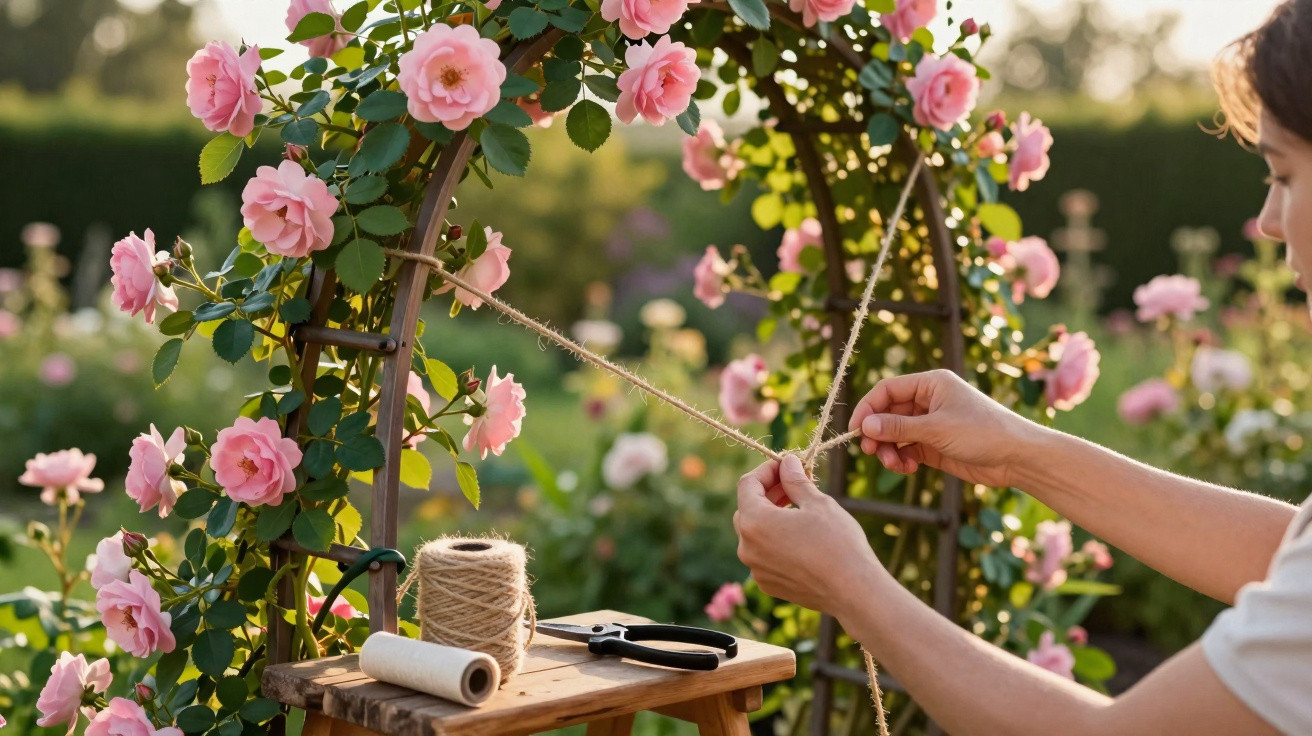
For many home gardeners, the hoped-for arch remains frustratingly bare or uneven. Creating a tunnel of colour rather than growing a few isolated stems is seldom just about the rose variety; it depends on training every cane gradually and precisely over time.
Why rose arches are fashionable again
Garden centres throughout the UK and US are seeing increased sales of arches and climbing roses, driven by social media enthusiasm for cottage-core settings and “walk-through” gardens. Yet an arch that looks ready for photographs is achieved through technique, not a filter.
Traditional guidance often goes no further than “tie stems to the support.” The more recent “soft tie & diagonal lash” method, which has been quietly shared by designers and dedicated amateurs, takes the process much further. It regards every stem as a line that can be drawn through space, determining exactly where the flowers will emerge.
Handled the right way, a basic metal or wooden arch can carry hundreds of flowers along its frame, instead of a few blooms stranded near the top.
No costly equipment is required. Success comes down to timing, angle and the gentle persuasion needed to bend woody canes without breaking them.
Choosing the right climbing rose for an arch
Before using a single tie, choose an appropriate plant. Roses sold as “climbing” varieties do not all perform equally well on an arch.
- Growth habit: Choose flexible, arching canes instead of especially rigid, upright growth.
- Height: Look for a mature height of 2.4–3.5 m (8–12 ft), allowing the rose to reach the crest and trail downwards.
- Repeat flowering: For impact throughout the season, select remontant varieties that flower repeatedly.
- Disease resistance: Healthy foliage is vital when leaves are positioned at eye level on a narrow frame.
Common options in British and North American nurseries include pliable varieties such as ‘New Dawn’, ‘Eden’, ‘Iceberg Climber’, and newer disease-resistant hybrids developed particularly for compact spaces.
What the “soft tie & diagonal lash” method involves
This technique brings together two main principles: shielding the bark with soft, supple ties, and arranging canes along purposeful diagonal routes rather than sending them directly upwards over the arch.
| Step | Soft tie focus | Diagonal lash focus |
|---|---|---|
| Early training | Choose padded or stretchy ties that will not cut into fresh canes. | Position young stems at 30–45° rather than vertically. |
| Building structure | Make loose loops and allow space for stems to thicken. | Cross canes over to fill “blank” areas of the arch. |
| Bloom maximisation | Replace ties annually instead of pulling old fastenings tighter. | Curve long canes into broad diagonals or semi-horizontal sweeps. |
Roses flower most heavily on side shoots that arise from a bent or angled main cane. Angle the structure, and you angle where the color appears.
Soft ties: discreet protection for canes
Gardeners who reach for any available wire can end up with a costly result: damaged bark, constricted canes and abrupt dieback precisely where they had expected masses of flowers.
Soft ties behave differently. They give slightly, move in the wind and distribute pressure over a broader section of the stem. Straightforward choices include:
- Rubberised garden ties resembling thin bungee cord
- Reusable Velcro tape cut into short strips
- Pieces of old T-shirt or fleece as an inexpensive alternative
Make each tie into a loose figure-of-eight: one loop should encircle the arch and the other the cane, with the loops crossing at the centre. This minor twist prevents abrasion and stops the stem rubbing back and forth against metal or timber during windy nights.
The diagonal lash: creating more flowers at eye level
Conventional training takes canes vertically up either side of an arch, often producing a small number of blooms overhead and very little around the entrance. With the diagonal lash approach, every long cane is treated as a rope to be “lashed” across the framework from one side towards the other.
Beginning near the bottom, guide fresh canes diagonally-commonly at 30–60°-from one leg of the arch towards the curve on the opposite side. Secure each diagonal at several points with soft ties to form an open lattice.
Where a vertical cane might throw flowers only near its tip, a diagonally lashed cane tends to break bud all along its length, pushing clusters of blooms right where people walk under and through.
This arrangement also allows light to penetrate the plant’s centre, helping foliage to remain dry and lowering disease pressure.
A season-by-season strategy for a picture-perfect rose arch
Planting and the first year: roots before romance
Across the UK and much of the US, bare-root roses are planted from late autumn until early spring. Container-grown plants can be planted whenever the soil remains workable.
- Set one rose on each side of the arch, 30–45 cm (12–18 in) from its base, avoiding the dry ground beneath the structure.
- Position young plants at a slight angle towards the arch legs.
- Neatly trim damaged roots and soak bare-root roses before planting.
During the first year, root establishment is the plant’s priority. Avoid hard pruning. Instead, gently attach any vigorous new canes to the arch legs, already setting them on shallow diagonals that indicate their eventual direction.
Years two and three: forming the framework
These years determine whether the result is a thinly covered gateway or a tunnel filled with petals.
In late winter, after the harshest frosts but before bud break, select several of each plant’s strongest and most flexible canes as “framework canes.” They will provide the main structure for many years.
Bend every framework cane slowly into a broad arc or gentle diagonal, then secure it at three or more points with soft ties. Short lateral shoots growing from these primary canes can be cut back to a few buds, encouraging compact flowering spurs.
The aim is not to cover every inch at once, but to create a skeleton of well-placed canes that future growth can build on.
Throughout the growing season, weave new long shoots arising lower down into the lattice, once again placing them diagonally rather than vertically. A cane that breaks during bending is often less disastrous than gardeners assume: a clean cut back to a strong bud can generate fresh, better-sited growth within a few months.
Common errors that undermine the flower display
Specialists in rose displays repeatedly encounter the same issues when asked to “rescue” neglected arches.
- Over-pruning the long canes: Cutting all growth back severely each winter removes the wood that would otherwise bear flowers.
- Vertical obsession: Directing every stem straight upwards produces few side shoots and therefore fewer flowers at walking height.
- Harsh wire or cable ties: These may slice into the cambium layer and constrict a cane just as it reaches maturity.
- Neglecting the base: Weedy, overcrowded soil around the roots causes stress and weak, tasteless growth.
Putting these problems right often begins with an uncompromising assessment: which canes genuinely form the structure, and which merely create clutter? Clearing dead or congested growth makes room for fresh, correctly positioned canes that can immediately be directed using soft ties.
Care, feeding and small risks to monitor
Even perfectly trained climbers give a poor display if they are hungry or stressed. Roses trained over arches work hard, producing extensive woody growth and leaf area from a comparatively restricted root zone.
A balanced care routine generally includes:
- Mulching around the base with compost or well-rotted manure in early spring.
- Applying slow-release granular feed formulated for roses in spring, followed by a lighter application after the first flush.
- Deadheading regularly to direct energy into repeat flowering on remontant varieties.
There are still risks. High winds can pull unsecured stems like sails, while heavy rain-soaked blooms put extra pressure on inadequate fixings. Soft ties offer support, but the arch should still be inspected after storms; tighten ties where needed and remove damaged material before disease develops.
A few minutes of inspection after wild weather can save years of careful training from breaking at a single weak point.
Beyond roses: applying the method to other climbers
The soft tie & diagonal lash approach is not limited to roses. Many climbing plants flower more heavily along their stems when trained at an angle. Clematis, vigorous honeysuckles and certain fruiting plants, including loganberries and tayberries, can all benefit from the same principle: protect the bark, bend the cane and encourage side shoots.
For arches close to front doors or patios, some gardeners now combine a principal climbing rose with a lighter companion, such as a late-flowering clematis. Train both diagonally using separate tie points to extend the season of interest without placing too much weight on the frame.
There is a modest ergonomic benefit, too. Keeping plants at head height or slightly below reduces the need for ladders and the related risk of falling, particularly for older gardeners. Diagonal lashing brings much of the flowering within easy reach, making pruning, tying and simply enjoying the fragrance considerably easier.
For anyone installing an arch this year, the most useful investment may not be a larger frame or a more unusual variety. It may be a roll of soft ties in a pocket, the confidence to bend canes slightly further than seems natural, and ten patient minutes every week spent directing each stem along a deliberate diagonal route towards the future photograph that everyone will presume appeared by magic.




Comments
No comments yet. Be the first to comment!
Leave a Comment