
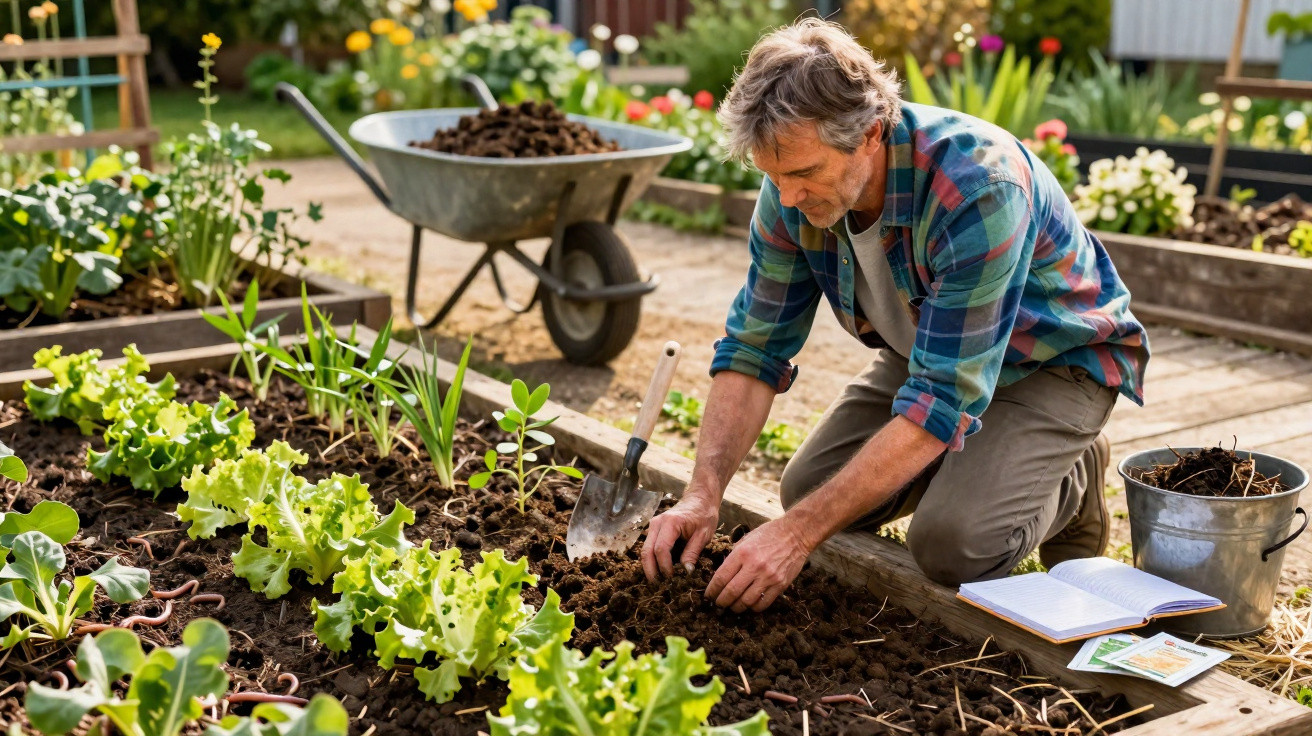
The first spring I chose not to dig my vegetable beds felt deeply unnatural, almost like I was cutting corners.
My fork and spade remained leaning against the shed as I stood in the centre of the garden with my hands in my pockets, looking at soil I had always approached as though it were an exercise session. There were no blisters, no sore back and no pleasing lines of newly turned earth. All I could see was last year’s mulch, several persistent weeds and the unsettling sense that I was failing to honour an essential gardening ritual.
But as the weeks passed, the garden did not descend into disorder. The soil did not set hard like concrete. Seeds emerged, worms increased, and I began to see that the less I disturbed things, the more effectively the garden appeared to arrange itself.
Something was clearly taking place beneath the surface.
Putting down the spade transformed my garden
For years, my early-spring routine was always identical: bring out the tools, double-dig each bed and turn the soil until it resembled the chocolate-cake earth shown in seed catalogues. I believed this was simply what a “serious” gardener did. The aim was tidy, bare, freshly cultivated rows: the sort that look good in photographs and impress neighbours walking past.
The difficulty came after that attractive first impression. A hard surface crust appeared after the first rainfall. Weeds quickly formed a carpet over the exposed ground they were eager to reclaim. By the second weekend, my back and shoulders were aching. I never challenged the process; I assumed gardening was supposed to be painful.
Everything changed one March when work became hectic, the children were ill and the chance to dig disappeared. When I finally had a day free, the ground had dried further and I had very little energy. More from idleness than intention, I decided to pull aside the old mulch and sow directly into the bed.
I expected a disappointing result. Instead, the reverse happened. My carrots germinated more consistently. During a dry spell, the lettuce bed retained its moisture while my neighbour’s freshly tilled plot split open like a desert. He was watering it every day, whereas I was standing there with a coffee, thinking, “Did I just accidentally hack gardening?”
That prompted me to read about no-dig, or no-till, gardening. I soon discovered that my supposedly lazy spring matched what soil scientists have repeatedly explained. Turning soil destroys its natural structure, tears apart fungal networks and raises weed seeds to the surface, where exposure to light prompts them to germinate. It also accelerates the loss of organic matter, leaving the soil less fertile over time.
Once I understood that, the recurring problems in my former garden became obvious: the hard crust, the sudden weed growth and the ongoing dependence on fertiliser. I had not been making my soil better over those years - I had been resetting it every single spring.
How I garden without digging now
During my first proper no-dig spring, I approached the garden as if I were gently rearranging a living room rather than managing a building site. In late winter, I inspected the beds, removed larger perennial weeds and left their finer roots where they were. I then covered everything with a substantial layer of compost: two to three centimetres on beds that were already in reasonable condition, and more on the exhausted ones.
There was no turning and no mixing, only spreading. Worms and other small creatures took care of the rest. To plant seedlings, I made small openings through the compost layer, while seeds were sown straight into the soft surface. The ground stayed covered for the most part, much like a woodland floor. The reduction in physical effort was extraordinary.
A few pitfalls nearly pushed me back towards my old ways. Impatience was one of them. In spring, bare soil can look untidy beneath old mulch and partly decomposed leaves, making it tempting to “tidy up” with a fork. Another was the belief that dense clay or compacted ground can be improved only through dramatic digging sessions.
What made the difference was seeing the first year as a period of transition. I did use a fork once in areas that were genuinely compacted, carefully pushing in the tines and rocking them back slightly rather than turning over large sections. Then I stopped. Over successive years, the soil became easier to handle as roots, worms and time achieved what I had previously expected my spade to accomplish in one day. Let’s be honest: nobody really does this every single day.
One seasoned gardener told me over the fence, “The hardest part of no-dig isn’t the soil. It’s your brain letting go of the need to see everything turned over.” That stuck with me, because it was exactly the battle going on in my head.
What I still do in spring
I lightly rake away larger debris, add compost as a top dressing, plant or sow, and cover exposed soil with mulch again as soon as seedlings are robust enough.Common mistakes to avoid
Avoid digging “just a little” each year, leaving large areas of soil uncovered, placing thick woody mulch directly where seeds will be sown, and expecting neglected ground to improve immediately.Small details that change everything
Use fine compost in areas intended for seeds, water thoroughly but less frequently, keep paths clearly marked, and apply a fresh organic layer every year, even when it is only a thin one.
The unexpected relief of doing less and observing more
The greatest surprise was not only the healthier soil, but also the changed relationship I had with the garden once I stopped battling it every March. The routine moved from “attack the ground” to “see what is happening”. Rather than dragging out heavy equipment, I began walking around the beds with a mug of tea, lifting a little mulch, watching worms and pressing a finger into the soil to check its moisture.
That small adjustment altered the mood of my entire spring. The garden started to feel like somewhere I shared rather than a task I needed to control. We have all experienced the point at which a hobby quietly becomes a chore we dread; for me, no-dig gardening offered a way out of that trap.
| Key point | Detail | Value for the reader |
|---|---|---|
| Less digging, less work | Replace annual turning with a simple compost layer | Fewer hours of hard labour, more time actually enjoying the garden |
| Soil life does the “hidden” job | Roots, fungi, and worms restructure soil naturally | Healthier plants, better resilience to drought and heavy rain |
| Gardening becomes calmer | From aggressive spring tilling to light, regular care | Lower stress, more satisfaction, and a garden that feels manageable |
FAQ:
- Question 1 Will my soil become compacted if I never dig it?
- Answer 1
- Question 2 Can no-dig work in heavy clay soils?
- Answer 2
- Question 3 What do I do with weeds if I stop turning the soil?
- Answer 3
- Question 4 Do I still need fertiliser with a no-dig system?
- Answer 4
- Question 5 Is no-dig gardening only for vegetables?
- Answer 5

Comments
No comments yet. Be the first to comment!
Leave a Comment