
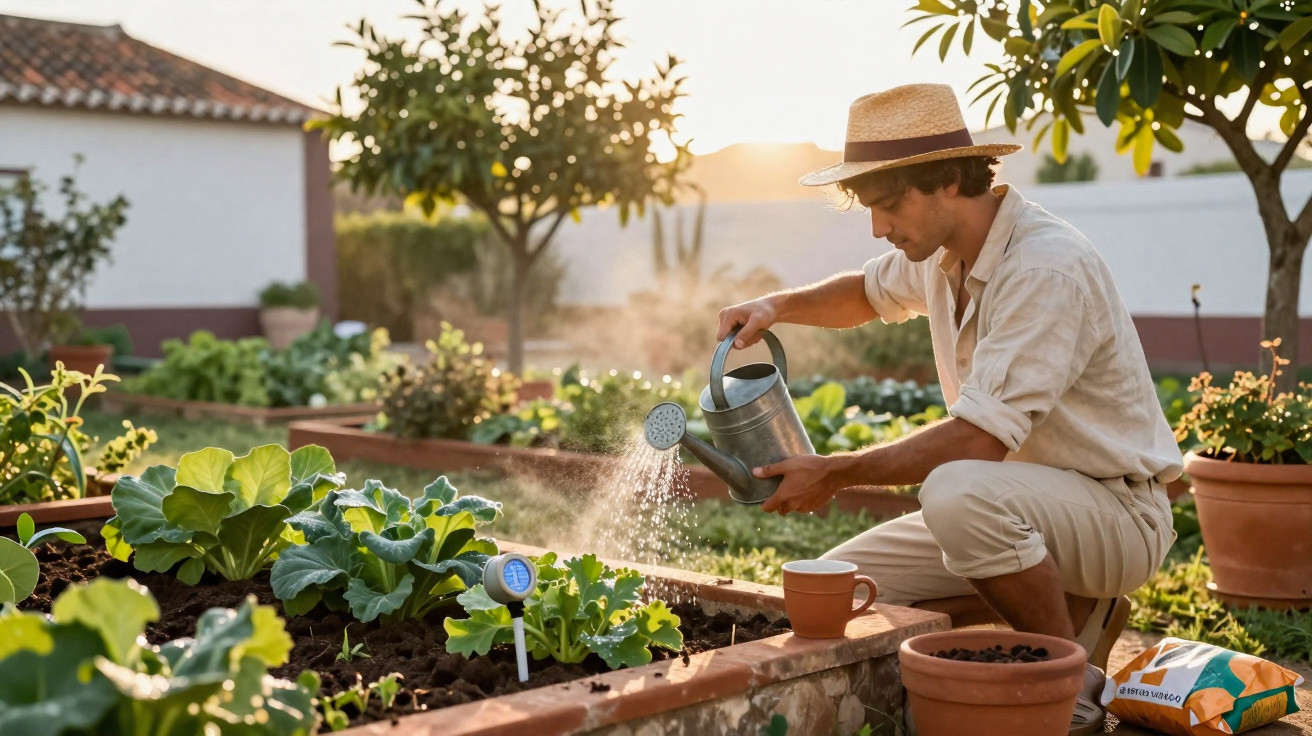
The morning still lay grey over the gardens, with damp air and a few sleepy blackbirds. Behind the chain-link fence, Mr Krüger was already standing there with his large green watering can, still in his dressing gown and with his slippers slightly soaked. “This is the best time, believe me,” he murmured as water fell in gentle arcs onto the tomatoes. Two gardens away, a patio door opened and a young family wandered outside with mugs of coffee, sleepily eyeing the beds that remained in shade. Nobody said anything, yet everyone was doing much the same thing: watering before the sun properly begins to blaze. There is more behind it than simple habit. It is a quiet gardening ritual with very real consequences for soil, foliage and harvests. The more closely you look, the more interesting this seemingly ordinary question becomes: water in the morning or evening?
Why early-morning watering feels like a spa treatment for plants
Anyone walking through an allotment site at dawn soon notices that the sound of water is as much part of the backdrop as birdsong. The air is cool, the soil has recovered overnight, and water sinks almost silently into the ground. You can practically watch the leaves breathe out, with tomato plants lifting themselves ever so slightly as though they have just finished a brief gardening yoga session. Many gardeners swear that plants fall ill less often and grow more vigorously this way. This routine is based on a kind of unspoken knowledge, passed from neighbour to neighbour and rarely questioned.
Picture a typical terraced-house garden. In her first year, Sandra, who has an office job and two children, always waters in the evening. It is after work, when things are finally calm. In the second year, powdery mildew appears on her courgettes, her roses develop brown spots, and the tomatoes seem permanently stressed. “I don’t understand it, I water so much,” she says. By the third season, she follows the advice of her older neighbour, who has “been out with her watering can at six in the morning for 30 years”. Suddenly, the leaves stay healthy for longer, the soil dries nicely during the day, and slugs seem less interested in the garden. It is not a scientific study, of course. But you hear stories like this on every other gardening round.
Watering in the morning combines physics, plant biology and a little healthy laziness. Cooler air limits evaporation, meaning more water reaches the roots instead of simply disappearing in the heat. Plants then have the entire day to absorb moisture, produce sugars and calmly carry out their internal processes. Leaves that become wet early can dry during daylight hours, which fungal spores do not like at all. In the evening, by contrast, dampness often lingers for hours, especially in densely planted beds. A quiet, humid micro-jungle develops: ideal for fungal diseases and, sometimes, slug parties. The difference may be subtle, but it becomes noticeable over weeks and months.
How to water in the morning without reorganising your entire life
An ideal morning watering routine begins while the air is still fresh and the sun is only just peeping above the fence. In practical terms, that means sometime between sunrise and perhaps 9 am, depending on the summer heat. Rather than turning it into a marathon, work through the beds one at a time and focus on the root area. Apply water directly to the soil rather than the leaves, and do it slowly so that it can genuinely soak in. A straightforward rule of thumb is to water less frequently but deeply, rather than dampening the surface a little every day. Plants do not want the drama of permanent drizzle; they want a proper, unhurried drink.
For many people, the problem is not a lack of knowledge but everyday life. Children, work, traffic jams: where exactly is “watering at sunrise” meant to fit in? Let us be honest: nobody truly manages it every single day. Feeling guilty about that only makes gardening unnecessarily difficult. A better approach is to choose two or three fixed mornings each week for a more thorough watering session. Between those times, the top of the soil can look dry provided it remains moist deeper down. A finger or a small plant stick pushed into the earth tells you more than any app. And if you arrive home in the evening to find the basil already drooping, naturally rescue it anyway – just do so selectively instead of automatically watering everything every night.
Some gardeners put it almost poetically, although the reasoning is perfectly practical.
“I water in the morning so the plants can work. In the evening, you are often only watering your guilty conscience,” an old allotment holder with one of those modest-looking dream vegetable plots once told me.
- Watering in the morning means more water reaches the roots and less is lost as vapour.
- Damp leaves dry in daylight, making fungal infection far more difficult.
- The soil begins a hot day well supplied, so plants are less likely to become stressed.
- Constant evening watering encourages slugs and fungi without providing any real extra benefit.
- A clear routine saves water, time and nerves, while making the garden more predictable.
What morning watering in the garden has to do with our own pace
Watch people water their gardens for long enough and it becomes clear that this is not just about technique; it is also about a way of life. For many, the early walk with a watering can is the only part of the day when nobody needs anything from them. No ringing phone, no messages, just the soft sound of water and perhaps a greeting from a neighbour over the fence. It is when you notice fresh buds opening, a leaf turning yellow or a slug hiding away. People who water in the morning truly see their garden – not as a task to tick off, but as a quiet companion.
There is another side to it, though. Some people feel almost guilty because they “cannot manage” to get up early, so their watering cans only come out after sunset. Perhaps that is the most honest part of the whole discussion: perfection does not fit every life. You can take inspiration from the morning-watering camp while still finding your own rhythm. It may be enough to move your evening watering round a little earlier, or to add a brief early trip on genuinely hot days. A garden is not a competition; it is a long-term conversation with a patch of earth.
Every summer eventually becomes a testing ground. Those who switch to morning watering often suddenly find that they use less water and that their plants react less sensitively when a heatwave arrives. Others discover that a combination suits them: sprinklers for the lawn in the morning, and hand watering for delicate container plants in the shade during the evening. These small adjustments may sound ordinary, but they change the relationship you have with your own green corner. That is precisely where the appeal lies: between dew, the smell of coffee and quietly rustling leaves, a routine emerges that is practical and a little restorative at the same time. Perhaps that is the real reason so many gardeners distribute their water in the early hours.
| Key point | Detail | Benefit for the reader |
|---|---|---|
| Watering in the morning reduces evaporation | Cool air, less direct sunshine, and water sinks deeper into the soil | Lower water consumption, more consistent soil moisture, stronger roots |
| Early moisture slows disease | Wet leaves can dry during the day, leaving fungi with poorer conditions | Less powdery mildew, fewer brown spots, healthier plants without chemicals |
| Ritual rather than stress | Set morning times; water deeply rather than little and often | A more manageable routine, less guilt and greater enjoyment of the garden |
FAQ:
- Question 1 I cannot water early on weekdays – is morning watering still worthwhile?
- Question 2 Is it really bad to water in the evening if the day has been very hot?
- Question 3 Do wet leaves burn in the sun because droplets create a “magnifying-glass effect”?
- Question 4 How often should I water in the morning during summer heat?
- Question 5 Is an automatic irrigation controller enough, or do I still need to go out with a watering can?
Comments
No comments yet. Be the first to comment!
Leave a Comment