
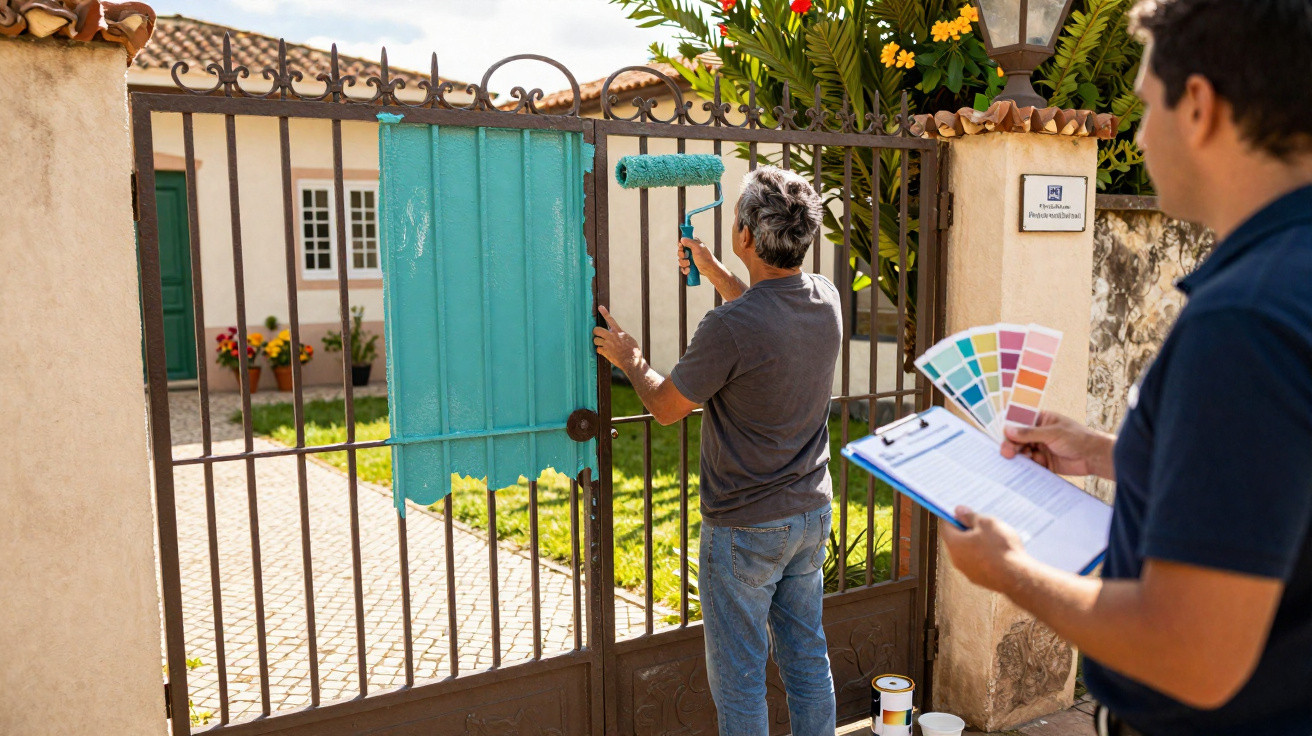
A spontaneous coat of paint on your garden gate could prove remarkably expensive.
When spring arrives and homeowners start smartening up their outdoor space, flowers, hedges and patios usually come first. The gate at the edge of the property may also get a fresh coat of paint: an easy, quick and seemingly inexpensive job. What many people do not realise is that, in certain residential locations, building and planning rules apply. Under the law, an ill-considered change of colour may be treated as an alteration to the structure. The resulting penalties can far exceed the cost of a new tin of paint.
Why painting a garden gate is not always merely “cosmetic”
It may seem harmless at first: a metal gate has faded, or a wooden gate looks grey and dull, so it is repainted. Where you are simply refreshing the existing shade, authorities will generally regard this as routine maintenance. Normally, no approval is required for that.
“It becomes problematic as soon as the gate’s character is visibly changed – for example, through a markedly different colour or an entirely new model.”
Once a gate affects the appearance of the street from outside the property, local authorities may impose requirements. These stem from the local development plan or similar rules governing the design of towns and villages. Cities and municipalities use these rules to determine how houses, roofs, façades, windows and, indeed, gates may look.
When approval is not required
In many residential areas, no notification is needed if you are only carrying out repairs or maintenance. Common examples that do not create an additional requirement include:
- Repainting the gate in the same shade.
- Treating rust patches and then repainting the gate in its existing colour.
- Replacing minor components, such as hinges or fittings, without changing its appearance.
- Cleaning, oiling or applying a protective stain to an existing wooden surface.
This is considered ordinary upkeep. Authorities generally take an interest only when the overall appearance visible from public space is affected.
The rule many overlook: a colour change may require approval
The position can become more difficult as soon as you want to do more than refresh the finish. In many municipalities, changing the colour of an element-especially one directly bordering the street-is viewed as an alteration to its external appearance. That is precisely the issue addressed by local by-laws and development plans.
“Anyone who paints their gate substantially darker, brighter or fundamentally differently coloured may, in case of doubt, be undertaking work that requires approval.”
Authorities are often particularly strict where one of the following applies:
- The property is within a historic town or village centre.
- Listed buildings are nearby.
- The street falls within a conservation or preservation area.
- The municipality has set out specific colour palettes for façades and gates.
In such areas, the permitted shades may be prescribed in detail-for instance, only muted earth colours, particular reds or exclusively traditional wood tones. Neon colours, very stark black and glaring contrasts are often expressly prohibited.
How local authorities regulate the appearance of garden gates
In Germany, the principal legal basis is provided by development plans, design by-laws and preservation by-laws. They set out how an area should develop and how its characteristic appearance is to be protected.
| Regulatory framework | Typical rules for gates and fences |
|---|---|
| Development plan | Height, material, distance from the street and basic visual requirements |
| Design by-law | Colour requirements, prohibited materials, and rules on form and style |
| Preservation by-law | Protection of the historic streetscape and strict consultation for alterations |
The closer you live to a sensitive location-such as an old town or a prominent historic building-the more likely it is that these restrictions will apply. In some coastal towns or well-known holiday regions, the local appearance is considered an important part of the tourist offering. Authorities there are especially careful to ensure that individual private properties do not look out of place.
What can happen if you paint without permission
Anyone who simply opens a tin of paint and breaches local rules risks more than a stern letter from the authorities. A single unhappy neighbour may be enough to turn the matter into an official case.
“The range of sanctions extends from an obligation to reverse the work to five- or even six-figure fines.”
If a breach comes to light, the authority may require you to restore the previous condition. In practical terms, the gate must be returned to its former shade or, in an extreme case, replaced altogether. If you fail to act, coercive fines may follow.
More serious cases can also result in administrative fines. Depending on the state law and the seriousness of the breach, the penalty may amount to several thousand euros. In tightly regulated areas, fines of around €1,200 to €300,000 are possible where someone persistently disregards the applicable rules or has made further structural alterations.
Who reports the matter
The initial report does not always come from an authority. It is often made by:
- neighbours who feel disturbed by the new appearance;
- the owners’ association in a residential development; or
- the property manager, who notices the deviation.
Once a case has been formally recorded, the relevant bodies will examine whether approval should have been obtained and whether the new condition complies with the law.
How to proceed lawfully before painting your garden gate
To avoid problems, it is worth checking a few points before making the first brushstroke. The effort is modest, while the potential cost of getting it wrong is wholly disproportionate.
- Check the property documents: The purchase contract, declaration of division or older approvals may already contain indications of design requirements.
- Ask the municipality: A brief call to the planning office or an appointment at the town hall is often enough to establish whether your area is subject to a design by-law.
- Review the development plan: Many municipalities publish these online, where you may find conditions affecting boundaries and gates.
- Agree the proposed colour in advance: In sensitive areas, it is sensible to take a colour swatch or photograph with you and obtain confirmation.
If you live in a condominium owners’ association, you must also consult the community rules. A gate on the property boundary will usually form part of the jointly owned property, meaning all owners have a say in its appearance.
Practical examples: where the risk is especially high
A few typical situations show how quickly you can enter a grey area:
- A homeowner in a historic town centre paints their previously dark-green steel gate a strong red. The new shade disrupts the uniform street scene, neighbours complain, and the town demands that the paintwork is reversed.
- A coastal village requires light pastel shades for homes close to the promenade. Despite this, an owner chooses deep-black metal panels. The municipality imposes a fine and sets a deadline by which the gate must be altered.
- In a terraced-house estate, the design by-law requires a consistent wood-effect appearance. One owner paints their gate bright blue, and the owners’ association takes action.
All three cases could have been avoided by briefly consulting the relevant rules or speaking to the planning office beforehand.
What many people do not know: time limits and long-term consequences
Breaches of building law do not become time-barred immediately. Authorities can often intervene for several years if they discover that a gate or another structure was altered without the appropriate approval. Even a change of owner offers no protection: anyone taking over a house also inherits the legal responsibility for alterations already made.
For that reason, with older properties it is worth asking whether all visible changes-including the gate and fence-were approved at the time, or at least did not breach any rule. Anyone carrying out further alterations or repainting should always check the existing position as their starting point.
Why municipalities are so strict about colours
Many owners initially see restrictions on colour and form as interference in private choices. Municipalities point to three reasons: protecting the local character, preserving property values and preventing streetscapes from becoming a “wild mix of colours”. A neighbourhood with a consistent appearance is generally easier to market and seen as more attractive.
There are benefits for owners, too. A clearly well-maintained and coherent setting can increase demand when a property is sold later. By complying with the requirements, owners also indirectly protect the value of their own property, as the surrounding area is not devalued by extreme visual outliers.
Ultimately, the advice is straightforward: regardless of springtime enthusiasm or the desire for a new colour, before radically transforming your garden gate, it is worth making a short visit to the town hall. The appointment often takes less than half an hour, while the possible saving can be equivalent to the price of a mid-range car.





Comments
No comments yet. Be the first to comment!
Leave a Comment