
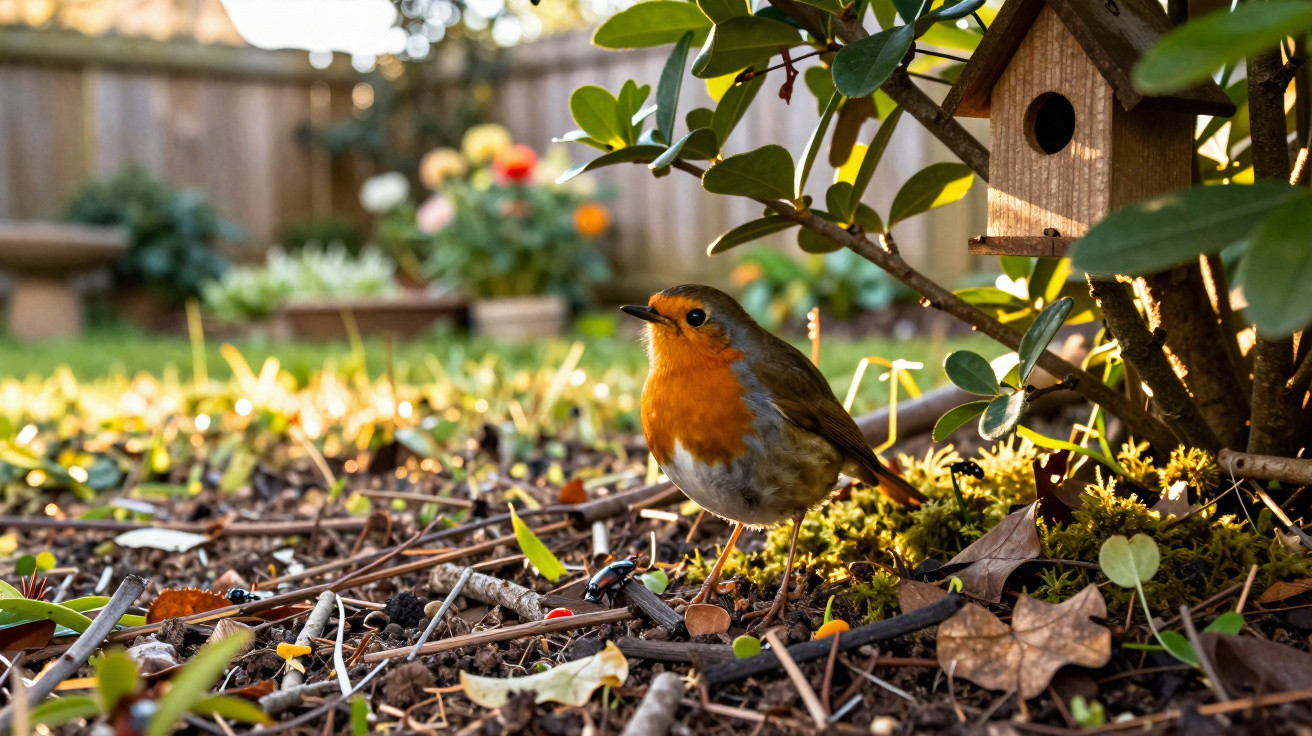
One small detail at the base of your shrubs determines whether the robin stays – or avoids your impeccably tidy garden.
Many gardeners put up feeders, buy costly fat balls and watch the hedge expectantly. Yet the robin rarely appears. The answer is not in the upper branches but at ground level: right around the base of shrubs and hedges, an area that is often the first to be “tidied”.
Why robins avoid your garden
The European robin (Erithacus rubecula) appears confiding, happily hops close to people and often follows gardeners as they dig. It is therefore easy to assume that a feeder alone will attract one for good. That is not the case.
This tiny bird, measuring just 12 to 14 centimetres and weighing around 20 grams, hunts almost entirely on the ground. It needs dense cover close to the soil where it can search for prey without disturbance. In spring, that prey consists almost exclusively of animal food.
“Robins are strict hunters of insects and small creatures in spring – seed alone will not keep them happy.”
Its diet includes:
- snails and small slugs
- young species that carry shells
- ants and their larvae
- caterpillars and other insect larvae
- millipedes and woodlice
- spiders and earwigs
- earthworms and other soil-dwelling creatures
Many young birds die during their first year because they cannot find enough energy-rich prey. Estimates suggest that around 70 per cent do not survive beyond their third year, even though they could theoretically live for up to 15 years. Anyone wanting to support robins in the garden must therefore improve their hunting area rather than simply hanging attractive feeders.
The overlooked secret: a miniature woodland floor beneath your shrubs
The key measure sounds simple, yet it is routinely prevented in many gardens: leave a “wild” layer of leaves and decaying wood directly beneath hedges and shrubs.
“A layer of leaves and dead wood 10 to 15 centimetres deep at the base of a shrub becomes a natural buffet for robins.”
The principle is straightforward. By leaving organic matter in place from late autumn until roughly mid-May, you create a small, damp habitat. Fungi and bacteria break down the leaves, while moisture remains in the soil for longer. This is precisely where the much-needed ground fauna gathers, providing the food robins require for themselves and their young.
To create this area properly:
- Choose a dense hedge or a robust shrub with some shade.
- Rake leaves from the lawn to the base of the woody plants.
- Lay the material down loosely rather than compacting it.
- Add several small branches or thin pieces of wood that have already started to rot.
- Leave the area alone: no raking, leaf blowing or weeding.
This is where robins spend most of their active time. Experts assume that they obtain around 90 per cent of their food from the ground. What looks like disorder therefore becomes the garden’s most important feeding zone.
Wild mulch rather than bare order: creating living soil
Gardeners who clear away every scrap of fallen leaf deprive themselves of a useful ally. Natural soil mulch acts like a free food store while also improving the condition of the garden soil.
Creating a robin magnet step by step
You do not need specialist products from a garden centre. A few straightforward actions are enough:
- Move fallen leaves: Rather than putting them into bags, rake leaves off the lawn towards the hedge or shrub border.
- Build up an airy layer: Form a light mound that allows air to circulate through it. This helps prevent mould and the smell of rot.
- Include dead wood: Place thin branches, small twigs or short pieces of wood among the leaves. Pale wood that has not yet decomposed heavily also works.
- Work in kitchen scraps: Lightly incorporate two or three apple cores or peelings from untreated vegetables. Their sugar speeds up decomposition and quickly attracts tiny organisms.
By doing this, you create a buffet that replenishes itself. Small creatures arrive naturally once the spot is damp and sheltered enough. For a robin, this means short journeys, plenty of food and little wasted energy.
Common mistakes that drive robins out of the garden
Several practices regarded as “low-maintenance” or “tidy” are actually off-putting to robins. Some habits are genuine sources of disruption.
| Mistake | Effect on the robin |
|---|---|
| Using a leaf blower in March/April | Removes the whole leaf layer, small creatures disappear and the hunting ground is lost. |
| Cutting hedges back hard to the base | Provides very little cover, increases stress from predators and leaves fewer perches for escape. |
| Keeping the soil completely bare and raked | Results in less moisture, hardly any earthworms and few insect larvae. |
| Numerous free-roaming cats in the hunting area | Creates a high risk for the bird, so it avoids the territory or stays only briefly. |
Once the ground beneath shrubs has been prepared, leave it untouched from early spring well into summer. Avoid motorised “spring cleaning” and do not weed it meticulously. The untidy appearance is misleading: for a robin, it is a perfectly arranged combination of larder and refuge.
How to supplement the natural buffet sensibly
The main priority is clearly living soil. However, you can offer a few additional forms of help without disrupting this system.
Water and food: what works and what does not?
A shallow dish of fresh water placed on the ground near shrubs or a hedge is ideal. A tree stump or wall about two metres away gives the bird a safe place to retreat to. It can then reach cover in an instant if danger appears.
In winter, when natural food becomes scarce, the following are helpful:
- high-quality fat balls without nets
- fine soft food or shelled sunflower seeds
- small amounts of oats lightly mixed with fat
As soon as spring arrives, let the robin return to hunting for itself. At that point, it particularly needs animal food for its young. Seed alone offers only limited support.
Offering a nesting site – the right way
A nest box can be appealing, but it must suit the robin’s requirements. A design with a larger opening, preferably semi-open rather than fully enclosed, better matches its natural preferences. Position the box somewhere quiet, slightly concealed and with a clear flight path to it.
Make sure cats cannot reach it easily. A thorny shrub immediately nearby or dense surrounding branches make the location less appealing to climbing predators. Once a robin has bred successfully, it often remains faithful to the same territory for years.
Supporting robins and the garden over the long term
Providing robins with suitable ground conditions brings a surprisingly effective form of pest control in return. Slugs, caterpillars and other irritating garden pests end up in their beaks before they can cause greater damage.
A few further measures help both the garden and its robins in the long run:
- Plant native shrubs such as hornbeam, hazel or privet; they support more insects than many non-native plants.
- Tolerate small “wild corners”, perhaps with nettles or weathered branches.
- Avoid insecticides and strong soil treatments, as these remove the robin’s food source.
- When digging, deliberately leave smaller areas untouched so that small creatures retain places to shelter.
When you shift your attention from the feeder down to the base of the shrub, the reason quickly becomes clear: it is not perfect neatness that attracts robins, but a planned, living “wild area”. Once established, it works largely by itself for years and ensures that an orange breast regularly darts through your garden.



Comments
No comments yet. Be the first to comment!
Leave a Comment