
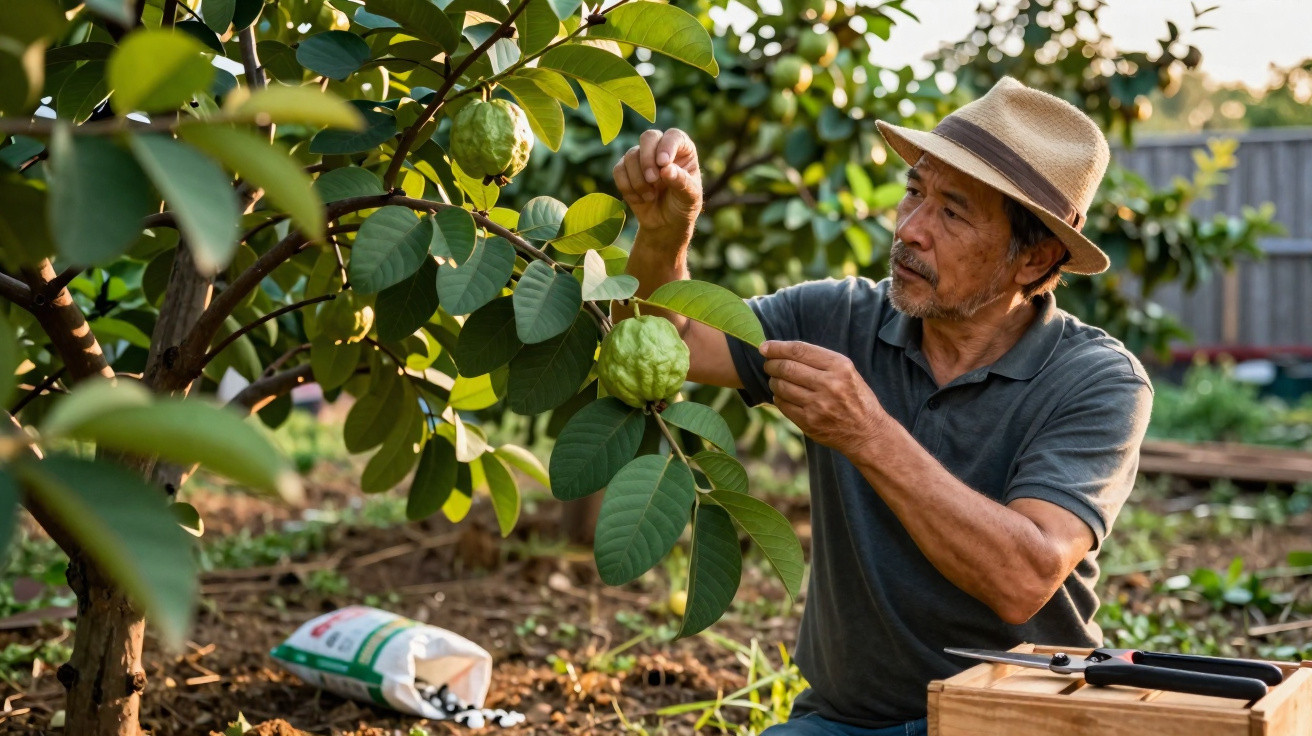
A guava tree with many leaves and few fruits may be growing strongly, yet allocating much of its resources to vegetative growth. Before applying more fertiliser, assess sunlight, watering, pruning and nutrients, as an excess or shortage of any of these can affect flowering and fruit production.
Why does a guava tree have lots of leaves but produce few fruits?
Leaves and branches form part of the tree’s vegetative growth, whereas flowers and fruits rely on different physiological conditions. A particularly vigorous canopy does not, therefore, necessarily mean that the plant is in the best condition to bear fruit.
Light exposure requires particular attention. A guava tree needs plenty of direct sunshine to photosynthesise effectively and support its growth. If the tree has begun receiving more shade, for instance, its yield may be affected even when the leaves remain green.
Can too much fertiliser cause excessive leaf growth?
Nitrogen contributes to the growth of leaves and branches. When this nutrient is present in excess, the plant may develop vigorous vegetative growth without a corresponding increase in flowering or fruit production.
This does not mean that all fertiliser should simply be stopped, or that phosphorus and potassium should be increased. Nutritional requirements differ according to the soil, the tree’s age and growing conditions. A soil test can be more useful than applying fertilisers by trial and error.
Adjusting guava tree care to encourage fruit production
Start by checking how much sunshine the guava tree receives throughout the day and whether anything has recently changed at the site. Check the soil too: extended dry periods can cause stress, while overwatering and poor drainage can damage the roots.
Pruning should also be kept moderate. Removing dead, diseased or poorly positioned branches can improve the canopy’s structure, but severe pruning may encourage fresh shoots. Management should be adapted to the tree variety and its stage of development.
When does a guava tree with many leaves and few fruits need attention?
A young tree may not yet have reached the maturity needed to produce regularly. An established guava tree that flowers very little or frequently drops flowers and fruits, however, calls for a more careful assessment of its growing conditions.
If the tree has good light levels and suitable watering but still produces many leaves, review its fertilising and pruning history before making further applications. In this way, a guava tree with many leaves and few fruits can be assessed according to the full range of conditions, rather than being given a single solution that may not address the cause.




Comments
No comments yet. Be the first to comment!
Leave a Comment