
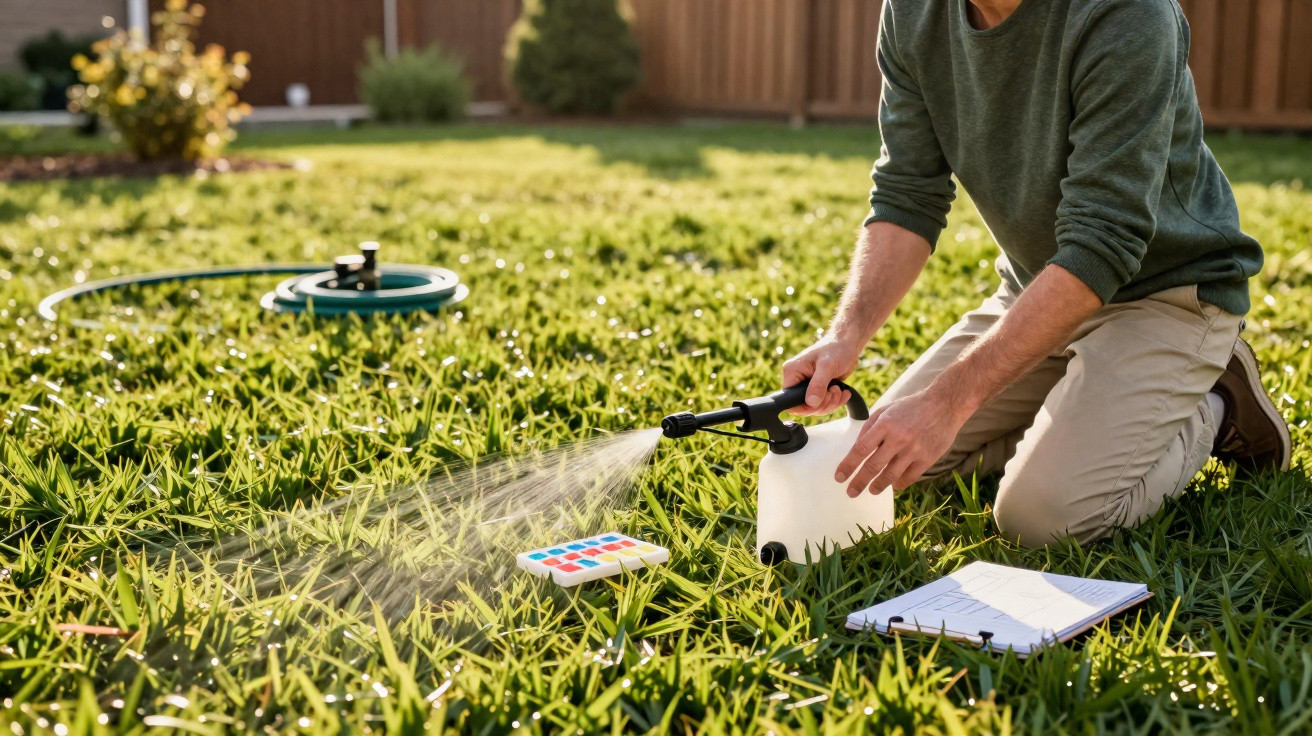
Your lawn is glistening with tiny droplets, yet the grass beside the patio is a rich, self-satisfied green while the section by the drain lies flat and turns yellow. With a half-used bag of fertiliser in hand, you may get the uneasy sense that much of it has just been rinsed straight towards the road.
You have probably noticed the pattern elsewhere in the neighbourhood: vivid emerald lawns beside washed-out, patchy areas, followed after rain by a faint chemical odour from the gutters. We fling out granules, hope they will do their job, and then ask why the lawn never greens up evenly – why certain blades race away while others seem to sulk.
The reality is that how you nourish a lawn is every bit as important as the product you choose. A lower dose, used properly, can make all the difference.
Why “less but smarter” feeding beats heavy fertilising
Take a walk through a British suburb in late spring and you will see a familiar sight: somebody in a hoodie shaking lawn feed from a box as if seasoning chips. The granules fall unevenly, with extra landing in some places and too little in others. A breeze sends a third towards the pavement, and the next shower completes the job by carrying nutrients across the surface and into the nearest drain.
From the pavement, the grass may appear “treated”. Look closely, however, and it is a patchwork: dense, dark-green clumps where fertiliser gathered, separated by thinner grass left wanting. That uneven, stop-start appearance is not simple bad fortune; it comes from applying feed too heavily.
At lawn level, the result is inconsistent growth. At a wider level, the nutrients that escape do not simply disappear: they move elsewhere, and not somewhere harmless.
In certain UK towns, councils have discreetly recorded rises in nitrogen and phosphate levels in surface water just after busy lawn-feeding weekends. This is not solely an issue caused by industrial agriculture. Household lawns, golf courses and sports pitches can all lose fertiliser when it remains on hard ground or is washed from compacted soil.
Runoff nourishes algae in ponds and rivers, reducing the oxygen available to wildlife. Meanwhile, your lawn misses out. You have bought fertiliser that ends up feeding only slime downstream. That is the frustrating part: there is a double loss. The environment suffers, and so does the grass.
Once that is clear, the case for “less but smarter” feeding becomes almost painfully straightforward. Grass does not need one annual banquet; it needs snacks that suit its growth pattern. Light, level applications of slow-release feed offer roots a consistent supply of nutrients they can use, delivered in step with their life cycle.
That is the key change in thinking: fertilising is not about forcing grass to grow more quickly. It is about allowing it to grow more consistently.
Practical methods for sparse, even fertilising
One of the most overlooked approaches is dividing the fertiliser dose. Rather than applying one large spring treatment, use half the amount on two occasions: once in early spring, then again in late spring or early summer. The overall quantity can be the same, or slightly less, but the lawn absorbs it more steadily. There is no sudden surge followed by a shortfall.
Use a spreader where possible, even an inexpensive handheld model. Move at a consistent speed in overlapping passes, much as you would when creating mowing stripes. If all you have is a bag and your hands, first divide the dose between each lawn area. Then scatter it slowly with a gentle arm movement rather than a frantic shake: one deliberate motion, in one direction.
Once the fertiliser has been applied, water the lawn lightly for 10–15 minutes. This should be enough to rinse granules from the blades into the topsoil – a soft shower rather than a deluge. Watering heavily straight away can send valuable nutrients beyond the root zone or into drains.
This is where ordinary life gets in the way. On a dull Saturday, it is tempting to “get it done” and let the predicted rain take care of the rest. A couple on a Leeds cul-de-sac did precisely that last year. That evening, an enormous storm arrived, with rain lashing the tarmac in sheets. By morning, a faint white layer of their fertiliser could be seen along the roadside, far from the lawn.
The grass closest to the house looked virtually unchanged, and the tired, thin strip beside the kerb remained the same. Their money had disappeared in one downpour. There was no villain or great drama – only poor timing.
Research from turf institutes consistently finds that fertiliser applied in fairly dry conditions and lightly watered in is absorbed dramatically better than feed left to rely on rain. Grass roots require time; they do not swallow nutrients like an energy drink. They draw them in gradually from the thin, moist upper layer of soil.
One straightforward adjustment therefore has a major effect: regard fertilising as a calm task in its own right, rather than an afterthought hurried through “before the rain comes”. Your lawn – and the river further down the road – will silently benefit.
Nutrients behave according to a few unyielding rules in a garden. Those attached to soil particles are likely to remain in place, while those suspended in water tend to travel. Where soil is compacted or sloping, water has fewer routes downwards, so it runs away across the surface with fertiliser in tow.
Aeration and thatch management are not merely jobs for lawn enthusiasts; they are quiet defences against runoff. Spiking or hollow-tining creates small vertical passages through which water and nutrients can move down and remain in the soil. Roots can then access them little by little instead of losing them sideways.
A denser, deeper root system also holds soil together and limits erosion after storms. The more active roots there are in each square metre, the more tiny mouths are available to capture every drop of nutrient-rich moisture. That is how you stop feeding the road and start feeding the soil beneath your feet.
Fine-tuning your lawn fertilising routine for even growth and low runoff
A remarkably useful approach is to divide the lawn into zones: front garden, back garden, shaded corner, compacted edge of a path, and slope leading to a drain. Each section can then receive slightly different care. The darkest, slowest-growing areas need less nitrogen, while the well-used route from gate to door may require more attention to its soil than extra fertiliser.
Choose slow-release or organic-based fertilisers whenever you can. Because they provide nutrients gradually, they are less likely to create a nutrient “flash flood” after rainfall. Used at a reduced rate, granular slow-release feeds are kinder to both the lawn and the local stream than one substantial application of highly soluble nitrogen.
Leave a narrow untreated buffer strip beside paths, driveways and gullies. At first, it can feel strange, like leaving part of a room unhoovered, but the space provides a safety margin. Grass in that area will still catch stray nutrients that drift across, while less fertiliser will be left on hard surfaces waiting for the next heavy shower.
Most keen gardeners feel a quiet sense of guilt. They would like a lush, magazine-cover green lawn, yet feel uneasy about chemicals reaching watercourses. That conflict can produce extremes: one year involves heavy feeding and numerous products, while the following year involves nothing at all because it all feels overwhelming.
Let us be honest: nobody genuinely does all of this every day. You are not going to measure soil pH every week or inspect grass clippings like a scientist. The routine must therefore be simple enough for you to maintain.
A frequent error is pursuing colour instead of health. A large dose of high-nitrogen fertiliser can create an immediate, neon-green burst that looks striking on Instagram, but it soon fades and leaves soft leaves vulnerable to disease. Genuine lawn health is less theatrical: an even medium green, strong roots and consistent density.
“Feed the soil more than you feed the leaves, and your lawn will quietly sort itself out,” a veteran groundskeeper in Kent told me, leaning on his fork. “The trouble starts when we try to force it into a fake calendar or a football pitch on telly.”
This soil-first approach also encourages lighter, more considered measures. Compost teas, a light topdressing of fine compost or loam, and leaving short clippings on the lawn after mowing can all reduce dependence on artificial fertilisers. They improve the soil’s structure and life, making the turf act like a sponge rather than a slippery tile.
- Apply smaller amounts of slow-release fertiliser two or three times during the growing season rather than one huge spring application.
- Aerate compacted sections every year so that water and nutrients travel downwards instead of sideways into the street.
- Keep buffer strips beside paths and drains, and sweep stray granules back onto the lawn rather than into gutters.
Rethinking what a “perfect” lawn really means
A subtle change is taking place in the way people view their gardens. The old ideal of a perfectly flat, neon-green and completely uniform lawn is beginning to seem a little dated. More householders are content with a few daisies, some clover and a softer shade of green if it means fewer chemicals and less concern about what is flowing down the road.
You can see it along the street on a warm June evening. One neighbour has planted wildflowers in a strip and allows the rest of the lawn simply to be “healthy” rather than excessively manicured. Another still enjoys his stripes, but now uses a mulching mower and fertilises half as frequently. Nobody gets everything right, but everyone is gradually adapting.
We have all had that moment when the first heavy rain after feeding makes us look nervously at the drain and wonder what we have just sent down there. That small flash of unease tells you something: instinct is starting to catch up with science.
Fertilising sparingly is not the same as ignoring your lawn. It means seeing it as a living system, not a plastic surface that can be “upgraded” by a single product. Using less fertiliser, improving the timing and choosing wiser methods may seem like small, nearly invisible changes. Together, though, they produce a lawn that grows uniformly, recovers from dry periods and sits more easily on your conscience.
When neighbours ask why your grass looks quietly good throughout the season, there will be no miracle feed to recommend. You will simply be able to explain that you learned to feed with a gentler touch, allowing the soil – and the seasons – to do more of the hard work.
| Key point | Detail | Benefit for the reader |
|---|---|---|
| Split applications | Two or three small applications of slow-release fertiliser instead of one large treatment | Less runoff, more consistent growth, denser lawn |
| Improve the soil | Aeration, thatch reduction, and a light addition of compost or fine loam | Deeper roots, better nutrient retention, less waste |
| Manage sensitive areas | Buffer strips near paths and drains, and collection of granules from hard surfaces | Less water pollution, with fertiliser used where it genuinely benefits the lawn |
FAQ
- How often should I fertilise my lawn to avoid runoff? For most UK lawns, two light applications a year are enough: one in early spring and one in late spring or early summer. On very poor soils, you might add a gentle autumn feed, still at a modest rate.
- What type of fertiliser is best for sparing, even feeding? Slow-release or organic-based fertilisers work best. They release nutrients gradually, so the grass uses them over weeks, not days, which reduces the risk of leaching and uneven growth.
- Can I rely on rain to water in my fertiliser? Light rain is helpful, but heavy downpours right after application can wash nutrients away. Aim to water lightly yourself or apply when only a gentle shower is forecast.
- How do I know if I’m over-fertilising? Signs include very fast, soft growth, a sickly dark green colour, increased thatch and more frequent mowing. You may also see more weeds thriving in the extra nitrogen.
- Is leaving grass clippings on the lawn really useful? Yes, provided they’re short and not in thick clumps. Clippings return a surprising amount of nitrogen and organic matter to the soil, which lets you cut back on synthetic fertilisers over time.




Comments
No comments yet. Be the first to comment!
Leave a Comment