
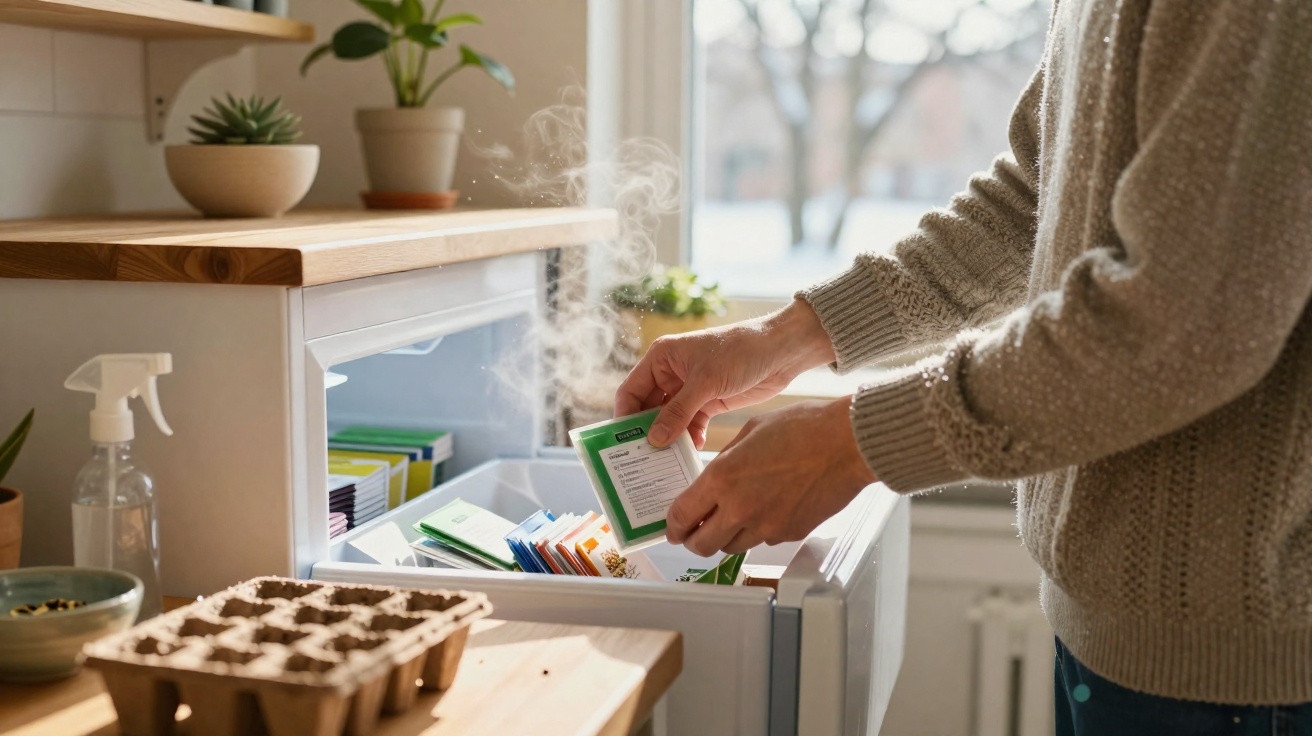
Most people keep seed catalogues beside the kettle, but a different sort of planning takes place in plenty of kitchens. Nestled among frozen peas and leftover pizza, seed packets wait in the darkness through a deliberately timed, artificial winter. That brief spell of ice can make a major difference to the season ahead.
The unusual January freezer ritual
For years, gardeners regarded the freezer as an enemy of delicate plants rather than a useful ally. More seasoned growers now quietly recommend “giving seeds a few days in the cold” before sowing them. Although it may sound like an odd online tip, the practice is rooted in proper plant science.
In the wild, seeds drop onto the soil during autumn. Were they to germinate immediately, the first severe frost would destroy them. Many species have therefore developed a protective mechanism: they remain dormant until they have effectively “experienced” winter. Only after a sustained cold spell will they treat spring as a genuine possibility.
By using the household freezer for a precise 72 hours, gardeners compress months of winter into just three days and switch that internal lock.
This technique is not a substitute for growing outdoors. Instead, it gives suitable seeds an unmistakable message: winter has occurred, the risk has gone, and growth can begin once warmth returns.
Cold as a trigger: what dormancy really means
Botanists use the term dormancy for this inbuilt protective lock. Natural chemical restraints within a dormant seed keep growth on hold. No matter how much heat or water it receives, nothing happens while those restraints remain in place.
Cold gradually breaks down those restraints. Lower temperatures reduce growth-inhibiting hormones in the seed coat. Meanwhile, the seed starts to regulate other hormones that encourage germination. Once the cold period finishes and temperatures rise again, the embryo interprets the changed conditions as permission to start growing.
Dormant seeds are not “old” or “dead”; they are deliberately waiting for proof that winter has been and gone.
Outside, this confirmation comes from months of changing weather. Indoors, gardeners can encourage the process through a managed cold shock.
Why use a freezer for 72 hours rather than a fridge?
Conventional cold stratification is usually carried out in a refrigerator, slightly above freezing, over several weeks. It remains an effective method and is appropriate for many species. The January freezer method relies instead on a more powerful signal delivered over a shorter period.
A three-day spell below 0°C has two effects at the same time:
- It signals that the seed has endured a proper, deep winter rather than merely a cold week.
- It can help destroy concealed pests, including tiny beetle larvae hidden inside beans or peas.
By using a brief but intense freeze immediately, some gardeners reduce the delay before sowing, particularly when their spring timetable is already busy.
Step-by-step: how gardeners create a 72-hour deep freeze
Getting seeds ready for the cold
This approach requires more attention than simply placing a paper packet beside the frozen chips. Moisture within the seed is the greatest danger. If a seed remains even slightly damp, ice crystals may develop and harm its cells.
| Step | What gardeners do | Why it matters |
|---|---|---|
| Drying | Spread saved seeds on a plate for several days indoors. | Reduces internal moisture and limits ice damage. |
| Packing | Place seeds in small airtight boxes or jars. | Shields from freezer humidity and food odours. |
| Labelling | Write species and date directly on the container. | Prevents mix-ups during late-winter sowing rush. |
Some gardeners also put a small paper envelope inside the container, keeping seeds together and making them easy to pour out afterwards.
The freezer period itself
After being securely packed, seeds should be placed on a steady freezer shelf, well away from the door, where temperatures fluctuate whenever somebody takes out ice cream.
The common rule is at least 48 hours, with 72 hours seen as the sweet spot for many garden species.
Extending the treatment much beyond this seldom provides additional value for the typical home grower. Limiting it to three days lowers the risk of harming more delicate seeds and works neatly within a standard weekend-plus schedule.
Bringing seeds back to temperature gently
Once the 72 hours are over, another delicate stage starts: returning the containers to room temperature. Opening them immediately in a warm kitchen causes moisture in the air to condense at once on the frozen seeds.
Experienced gardeners leave the lid shut and set the container on the worktop for several hours. Within their small microclimate, the seeds warm up slowly. They are opened and prepared for sowing only when the container feels pleasantly cool rather than cold.
The “VIP list”: seeds that respond best to an artificial winter
This treatment does not suit every seed. Warm-climate crops, including tomatoes, cucumbers and squash, can be harmed by deep freezing and should not be subjected to it. Other plants respond particularly well to the cold cue.
Perennials and hardy flowers
A wide range of long-lived ornamentals and wildflowers germinate far better after a simulated winter spell. These are among the seeds gardeners commonly place in the freezer:
- Aquilegia (columbine), renowned for its intricate, nodding blooms.
- Primroses, particularly unusual or heirloom varieties.
- Gentians, which are slow to germinate but spectacular once established.
- Violets and sweet violets, which may refuse to cooperate without a chill.
Creating a rapid cold period can bring germination forward for home growers and prevent uneven seed trays in which only a few plants appear.
Herbs and difficult edibles
Several kitchen-garden favourites benefit substantially from a short freeze, especially those known to challenge inexperienced gardeners.
- Parsley: often takes weeks to germinate; cold treatment may produce quicker, more consistent results.
- Lavender: when grown from seed rather than cuttings, it responds positively to a distinct winter cue.
- Lemon verbena or vervain relatives: cold can make their hard seed coats less resistant.
Gardeners attempting to grow fruit trees from pips or stones also rely on cold treatment. Apple seeds, cherry stones and other hardy fruit kernels seldom germinate dependably without chilling, whether that happens outside in soil, in a fridge or in a freezer.
From the freezer shelf to the seed tray: preventing errors
After warming, seeds should move directly to a seed tray or module containing moist, fine compost. Many gardeners handle them exactly as they would any spring sowing at this stage, but attentive growers make several adjustments.
- They sow a little more sparsely, anticipating improved germination once dormancy has been broken.
- They maintain compost that is moist but not waterlogged, preventing rot now that the seed is ready to develop.
- They provide reliable warmth, often around 18–20°C, enabling the plant to respond properly to the cold signal.
After a fake winter, the next days send a clear message: consistent light, gentle warmth, no sudden drought.
Many gardeners find that freezer-treated trays emerge sooner and more evenly, making later pricking out and seedling spacing simpler.
Risks, limitations and when cold treatment should be avoided
The freezer technique may seem ingenious, but it is not suitable for every gardening circumstance. Experts frequently raise several potential problems.
Firstly, wrongly identifying seeds can lead to difficulties. If a mixed packet contains species that prefer warmth, freezing could harm some of the seeds. Sorting and labelling before January helps prevent this problem.
Secondly, seeds that have not dried properly may crack internally. Saved seeds require thorough drying for at least a week in a low-humidity room. Shop-bought packets are generally sufficiently dry, but packets stored in damp sheds might not be.
Thirdly, species do not all react identically to a three-day deep freeze. Alpine plants and woodland species may sometimes favour a milder, longer refrigerator chill that more closely resembles natural winter conditions. Dedicated collectors often trial a small batch before placing rare seeds on the coldest shelf.
Why this quiet freezer technique suits a changing climate
Increasingly unpredictable winters are causing difficulties for many gardeners. Some areas scarcely experience frost, while others alternate between mild rain and abrupt icy weather. Seeds that require a distinct winter signal can receive confusing cues outdoors.
A controlled 72-hour freeze can recreate that signal indoors. It allows the gardener to regain some control over timing. By January, the busiest Christmas period is over and there is usually room in the freezer. That spare space becomes a miniature laboratory, providing plants with a definite chapter of “winter” before a carefully managed spring.
For growers keen to experiment-whether raising unusual perennial seeds, testing fresh herb varieties or starting fruit trees from kitchen scraps-the freezer method provides more possibilities. Rather than waiting and relying on outdoor conditions, they can conduct small trials: freeze half a batch, leave the remainder untreated, then compare which tray springs into life first.
The habit also encourages gardeners to consider plant biology more closely: the ways seeds interpret their surroundings, how climate influences those responses, and how slight changes in temperature and timing determine whether a tray remains empty or fills with green growth. In a peaceful January kitchen, the substantial white freezer becomes not merely an appliance but a seasonal gardening tool, bridging the long stretch from dark winter afternoons to the first seedlings reaching towards the light.

Comments
No comments yet. Be the first to comment!
Leave a Comment