
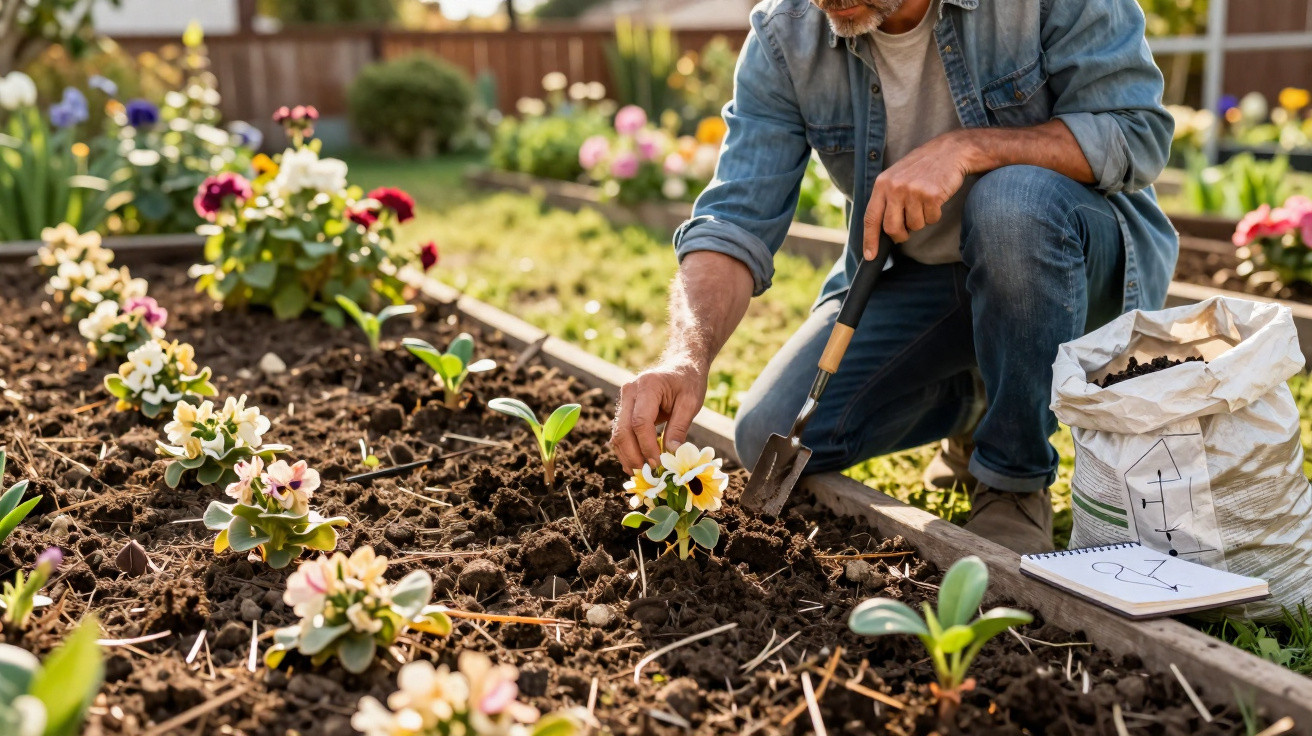
The rosebed in the corner had been the garden’s showpiece for years. Each June, it burst into layered petals and rich fragrance-the sort of display that stopped neighbours at the gate and made them ask, half enviously, “What on earth are you feeding these?” Then, one spring, that magic began to fade without fuss. The stems still emerged, but they were finer. Buds arrived late and their edges turned brown before they opened. By August, the roses that had once looked regal seemed more like survivors than stars.
You are certain that nothing changed: the same position, the same sunshine, the same gardener’s hands.
Yet somehow, the flowers appear to have grown… old.
When a star flowerbed suddenly loses its shine
The earliest clue is often easy to miss. A peony clump that once spilled over with frilled blooms suddenly produces fewer flowers. A hydrangea that used to conceal the fence now lets you see through it. Its leaves are slightly smaller, its stems a little less robust, as though the whole plant were breathing with only half a lung.
You pass by and feel a quiet unease: something is wrong, although you cannot quite identify it. The soil appears healthy, there are no obvious signs of pest damage, and no storm has broken the branches. Still, the display has diminished. After years of abundance, fragility seems to arrive from nowhere.
Speak to any experienced gardener and the stories soon appear. There is the bearded iris clump that put on a carnival for ten years, only to produce barely a single flower last spring. Or the lavender hedge that once hummed with bees, but became woody and sparse, as if its centre had aged before the outer growth could catch up.
One reader sent me a photograph of her favourite clematis: five summers filled with purple ribbons, followed by a year in which the vines grew long but the flowers appeared only in a shy handful, no bigger than coins. The same trellis, the same care, the same gardener. It was simply a plant that suddenly seemed weary of its own success.
Beneath all these scenes, a quiet and gradual process is taking place underground. Roots that once had room to travel begin meeting their own tangled past. Nutrients are drawn from the same slim strip of soil until little remains within reach. Fungal spores, nematodes and pathogens accumulate like invisible dust in a room that is seldom aired.
From above, plants may look settled while surviving on something like an ecological credit card. Once the limit is reached, they do not fail spectacularly; instead, they become smaller, stressed and delicate. What seems mysterious is often simply the long-term exhaustion of a patch that has never properly recovered between growing seasons.
Why “same place, same success” quietly stops working
One of the most helpful things you can do for a struggling flower is also among the most misunderstood: give it a fresh start elsewhere in the same garden. This may mean lifting and splitting an ageing daylily clump, moving a rose 60 cm to the left into renewed soil, or rotating annuals so one small square is not expected to support tulips, then dahlias, then chrysanthemums, year after year.
Think of this not as decoration, but as choreography. Roots require fresh ground. Soil requires recovery time. Microorganism populations benefit from being disrupted. With a small spade and the readiness to interfere with what “worked fine”, you can reset a plant’s future entirely.
Many gardeners blame themselves when flowers that once flourished begin to decline. They water more, feed more and spray more, as though dedication alone could undo a gradual deterioration. Sometimes, that additional attention makes the situation worse by drowning already stressed roots or burdening depleted soil with fertiliser the plant cannot even use.
We have all experienced that moment of looking at a cherished plant and wondering whether we spoiled it through affection. The straightforward reality is that most gardens are managed as though soil never becomes tired, when it actually has limits, just as we do.
Sometimes the kindest thing you can do for a flower is to disturb its comfort zone before it collapses.
As one seasoned horticulturist told me during an interview, “Plants don’t want to be pampered, they want to be challenged just enough.”
- Loosen and aerate soil around established flower clumps every few years.
- Move heavy-feeding flowers to another area rather than planting them again in precisely the same hole.
- Cut back and divide crowded perennials when their flowering begins to decline noticeably.
- Add organic matter to areas where plants have grown for years, not only to newly made beds.
- Allow at least one “rest year” between demanding flower species in the same patch.
Soil memory, plant fatigue, and the quiet art of renewal
When you begin to regard your garden as a living store of memory, the patterns become clearer. A bed that supported spectacular dahlias for six summers may resist them in the seventh. A corner that has nourished tulips each spring may one year produce foliage without flowers, as though the bulbs have simply had enough. The site has not “gone bad”; it has merely reached the limit of what that small ecosystem can provide without a break.
This is where the true skill of gardening starts. It is less about rushing towards the next variety and more about recognising subtle signs of tiredness, then acting early, carefully and wisely. You relocate a plant before it pleads for help. You restore the soil before it gives way.
| Key point | Detail | Value for the reader |
|---|---|---|
| Rotate long-lived flowers | Move or divide plants every few years instead of keeping them in one precise location for decades | Prevents soil exhaustion and helps favourite varieties flower for longer |
| Refresh the soil | Loosen it, add compost, and occasionally allow demanding beds to “rest” with lighter plants or green manures | Reduces concealed stress that can make flowers fragile over time |
| Watch for early signs | Smaller flowers, woody centres, fewer stems or dull foliage can indicate crowded roots or nutrient fatigue | Allows early action with straightforward solutions instead of losing the plant |
FAQ:
- Question 1 Why do my flowers suddenly look weak after years of thriving in the same place?
- Question 2 How often should I divide perennials to avoid this kind of decline?
- Question 3 Can adding fertiliser alone solve the problem of fragile, ageing flowerbeds?
- Question 4 Is it bad to replant annuals in the same spot every year?
- Question 5 What’s one simple habit that keeps flowers vigorous for longer in the same garden?


Comments
No comments yet. Be the first to comment!
Leave a Comment