
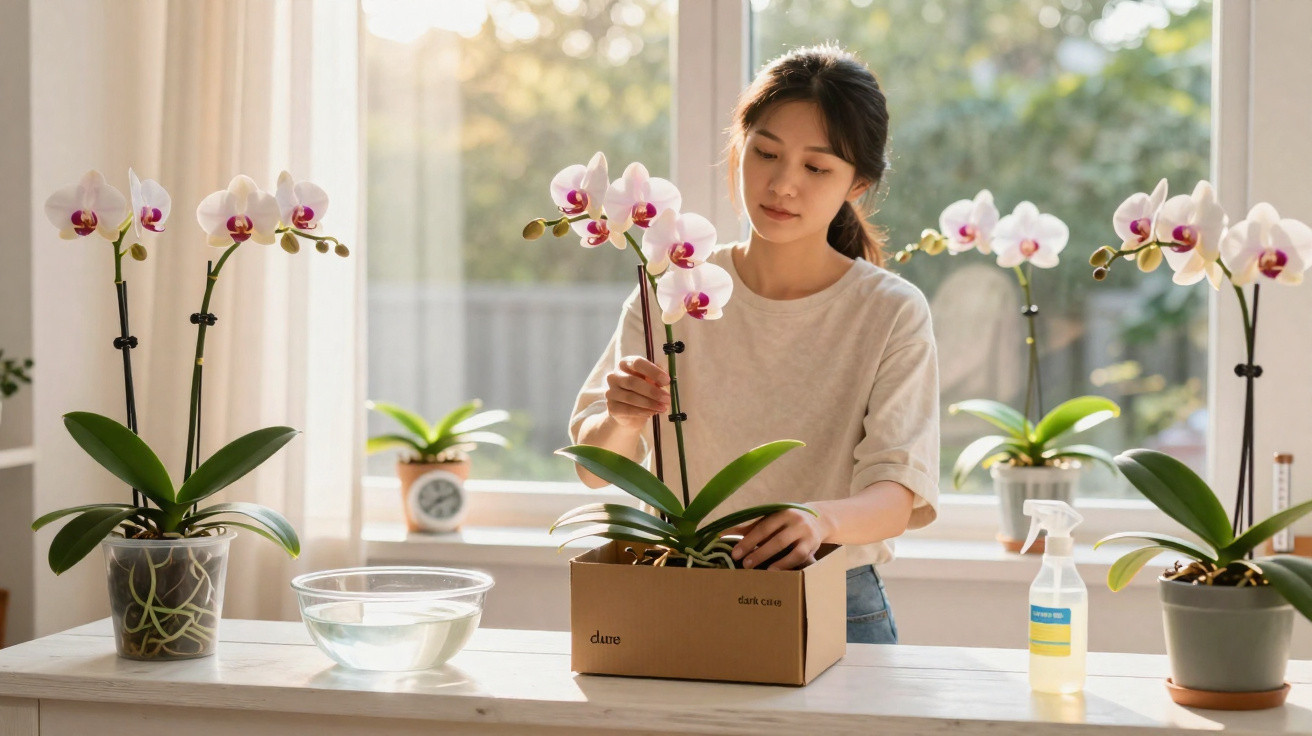
If you are given an orchid, you will usually enjoy its elegant flowers for weeks or months. Then the blooms drop, the pot remains green – and nothing more seems to happen. There is no fresh flower spike and no buds. This is precisely the stage at which many people give up. Yet these plants often have far more potential than they initially appear to offer. A few purposeful care measures and one clever nature-inspired technique can greatly improve the likelihood of a second, third or even ongoing display of flowers.
Why so many orchids are thrown away far too soon
At garden centres, orchids appear to flower endlessly. Once at home, however, they can suddenly look “bare” after just a few weeks. Many amateur gardeners assume the plant is simply “finished” – much like a bunch of cut flowers.
In reality, an orchid works very differently. Green leaves and thick aerial roots indicate that it is still alive and continuing to store energy. It is merely entering a kind of resting period, building up strength for its next flowering cycle.
An orchid with healthy leaves but no flowers is rarely dead – it is simply waiting for the right conditions to make a fresh start.
Anyone who becomes impatient at this point, waters too heavily or even discards the plant loses the opportunity for what can be an impressive second round of flowers.
Less fertiliser, more flowers: the biggest misconception
Many people associate abundant flowering with plenty of fertiliser. With orchids, this often produces the opposite result. In nature, they commonly grow as epiphytes on trees, frequently in areas with nutrient-poor conditions. They receive ample light, air and moisture there – but very little “food”.
For this reason, orchids in pots need only very modest feeding. An excess of nutrients causes salts to build up in the growing medium, harms the sensitive roots and encourages the plant to focus more on leaf growth than on producing flowers.
How orchid enthusiasts fertilise particularly gently
- Use a liquid fertiliser formulated specifically for orchids, preferably at around half the manufacturer’s recommended strength.
- Feed only during the growing period, when new leaves or roots are appearing, roughly every two to three weeks.
- Flush the growing medium with plain water between feeds so that salt deposits do not accumulate.
- Avoid strongly scented or highly concentrated home-made treatments.
Some plant lovers add a tiny amount of gentle household treatments, such as a splash of heavily diluted milk, to provide a little calcium and protein. The key principle remains the same: apply very small amounts regularly rather than giving too much infrequently.
The orchid soaking method: watering correctly instead of keeping roots wet
The most common care mistake is waterlogging. Orchids grow in an open medium that should allow plenty of air to reach their roots. If they sit in water continuously, this sensitive root system quickly begins to rot – preventing flowering or even killing the plant.
Many successful orchid keepers therefore use a type of water bath:
- Remove the inner pot from the decorative outer pot.
- Fill a bowl with room-temperature water.
- Place the pot in it so that the roots soak for 5–10 minutes.
- Allow the pot to drain thoroughly until no more water runs out.
- Only then return it to the outer pot.
In a typical indoor environment, such a “bath” is generally needed every 7–10 days. It is better to water a little late than to keep the plant constantly damp – orchids tolerate dryness more readily than wet roots.
A fine nutrient mist for more buds
Some enthusiasts supplement the soaking method with a foliar feed at an extremely weak dilution. Once a week, tiny droplets of nutrients are sprayed onto the leaves, aerial roots and, where present, the base of the flower spike. This can encourage new buds to develop, provided the light and temperature are suitable.
The surprising orchid method: a short dark period for new flowers
The approach becomes particularly interesting for plants that refuse to produce another flower spike despite receiving proper care. Experienced gardeners use a technique inspired directly by nature: a deliberate period with considerably less light.
In many of their native habitats, orchids experience seasons with changing light levels. They respond with resting phases followed by renewed flowering. This pattern can also be recreated in the home.
How the dark treatment works step by step
- Choose a healthy orchid that is not currently flowering.
- Put the plant in a relatively dark room for two to three weeks, such as a hallway or bedroom with limited daylight.
- Alternatively, cover the pot with an opaque paper bag – but do not seal it airtight, so air can still circulate.
- Water as usual but sparingly during this time, and do not fertilise.
- Keep the temperature as steady as possible and avoid draughts and waterlogging.
Afterwards, move the orchid back to a bright position, ideally by an east- or west-facing window away from harsh midday sun. Many owners report that a new flower spike then appears within a few weeks. There is never a guarantee, but the chances increase considerably.
The artificial “resting period” signals to the orchid: A new season is beginning – it is time to invest energy in flowers.
Light, temperature and air: the overlooked controls
Alongside water and nutrients, three further factors determine how willingly an orchid flowers: brightness, temperature and humidity.
| Factor | Guide value for common indoor orchids |
|---|---|
| Light | Bright, but without direct midday sun; for example, an east- or west-facing window |
| Temperature | 20–24 °C during the day, slightly cooler at night (18–20 °C) |
| Humidity | Around 40–60%; do not position directly above a radiator |
A slight difference between daytime and night-time temperatures supports flower production because it mirrors the natural fluctuations found in the orchid’s native habitat.
Learning to read orchids: what roots and leaves reveal
By checking an orchid regularly, you will gradually learn to recognise its subtle signals:
- Green, firm roots suggest that the plant is well supplied.
- Silvery-grey roots indicate dryness – it is time for the next water bath.
- Yellow, soft roots point to excessive watering and possible rot.
- New leaves show that the orchid is in a growth phase and may therefore have an opportunity to produce fresh flowers.
- Tiny swellings on the stem may develop into buds or keikis (plantlets).
Anyone who spends time in the same place each day, perhaps while working from home, can observe an orchid almost incidentally and respond early when it shows signs of stress.
Risks and limits of the dark method
Although reducing light can be helpful, it is not suitable in every situation. If the plant is already kept in conditions that are too dark, an additional shaded phase offers little benefit. Weak orchids or those affected by pests should also be stabilised before flowering becomes the priority.
Darkening the plant for too long, or watering it too heavily during this period, can lead to fungal issues and leaf loss. The treatment should therefore always be limited in duration and combined with good ventilation.
Practical additions for permanently vigorous orchids
Small everyday routines can make a significant difference for anyone wanting to keep an orchid in good condition over the long term. Dust on the leaves reduces photosynthesis, so wipe them carefully now and again with a slightly damp cloth. When repotting every two to three years, use fresh, coarse orchid growing medium to give the roots enough air again.
Location is another interesting consideration: many owners move their orchid temporarily to a sheltered spot on a balcony during summer. There it receives more fresh air and often better light. A shaded position without direct midday sun or cold draughts is essential.
Anyone who explores the subject more closely soon realises that orchids are not disposable items but long-lasting housemates. By paying close attention to roots, leaves, light and water, their natural rhythm can be replicated remarkably well. The dark period works well as a targeted prompt within this overall approach – a small technique that helps many plants shine for a second time rather than being discarded too soon.
Comments
No comments yet. Be the first to comment!
Leave a Comment