
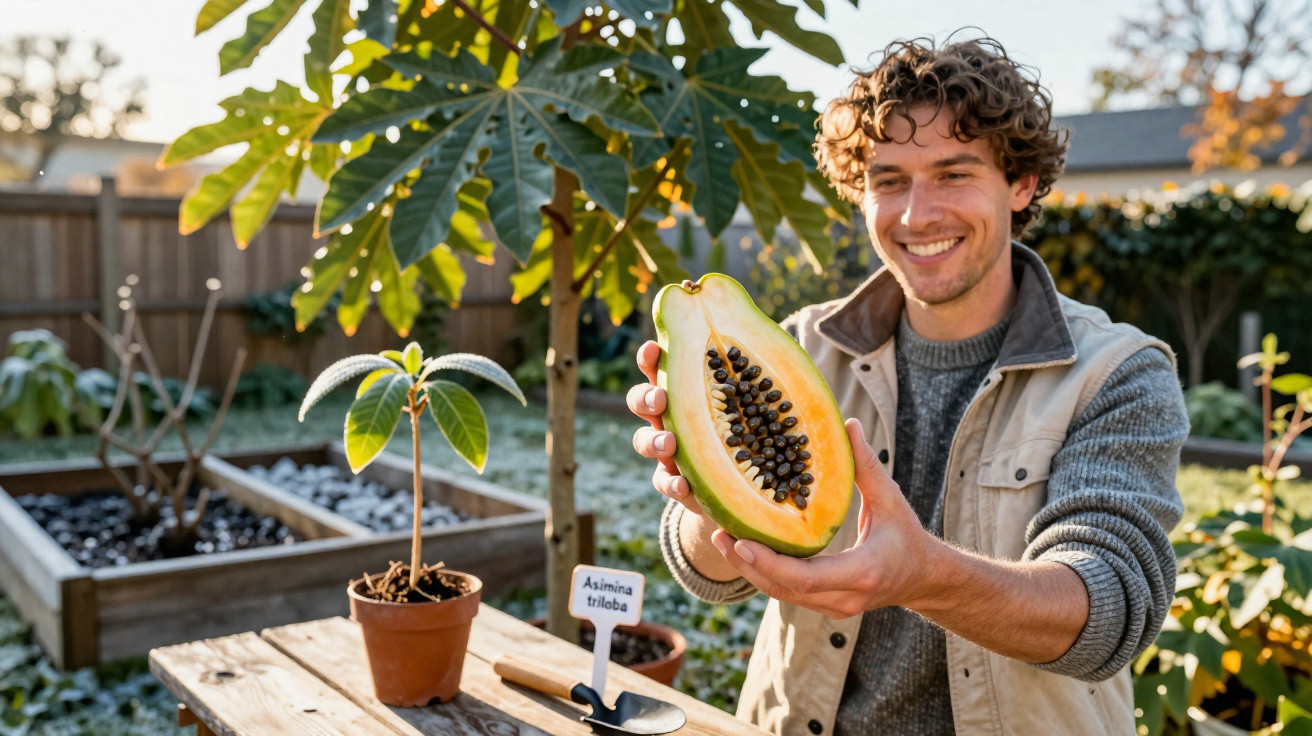
When hoar frost is clinging to the branches outside, many hobby gardeners start leafing through catalogues and, in the end, still default to apple, pear and plum. The worry is always the same: anything more exotic won’t survive the next cold snap. That’s where a common misunderstanding comes in. There’s a tree with an almost tropical look whose fruits evoke a beach holiday, yet it can feel remarkably at home in our climate-even in places where winter really bites.
Why this tree looks tropical but shrugs off the cold
Seeing it for the first time can be disorientating. Its large, softly drooping leaves-sometimes up to 30 centimetres long-look far more like rainforest foliage than something for a suburban garden. It’s no surprise that many people immediately think: “That’ll be killed by the first hard frost.”
In Europe, that very appearance has long worked against it. It seems like a plant for heated glasshouses or Mediterranean courtyards, not a tough choice for exposed sites. As a result, gardeners often label it “too fussy” and fall back on familiar fruit trees.
The tropical appearance is deceptive: it comes from regions with real winters-and that’s exactly what makes the tree so interesting.
Rather than originating in the Caribbean or South-East Asia, it comes from North America-areas with bitterly cold winters and hot summers. That background is the reason it adapts so well to Central European conditions.
The Asiminier: the “cold warrior” among exotic fruit trees
The tree is called the Asiminier (botanically Asimina triloba), and in English-speaking countries it’s known as the Pawpaw. In parts of the USA and Canada it grows as a matter of course, often along riverbanks or in lightly wooded areas.
Its best side appears in winter. While fig trees can start to struggle from around –10 °C, this one stays unbothered. It can tolerate temperatures down to roughly –25 °C without serious damage. That makes it suitable for places many hobby gardeners have written off for exotic fruit: windy plains, cooler upland areas, and frost-prone hollows.
For regions that often feel excluded from classic “southern fruits”, this creates a genuine alternative. If you live in a colder spot but still want something distinctive in the garden, the Asiminier is worth considering in your plans.
“Mango of the North”: what the fruits taste like
Things get particularly interesting when the tree fruits for the first time. The fruits-called asiminas-ripen from late summer into autumn. From the outside they are fairly understated: greenish to yellowish depending on variety and ripeness, and about the size of a fist.
Once you cut one open, the real appeal becomes obvious. The flesh is creamy and almost pudding-like, closer to a dessert than traditional pome fruit. Many first-time tasters describe the flavour as a blend of banana and mango, with a delicate note of pineapple or vanilla.
The fruit feels like a spoon dessert straight from nature-nothing like apple or pear.
Nutritionally, the Asiminier has plenty to offer too: the fruits provide lots of vitamins and minerals, as well as valuable amino acids. In a home garden they sit in a category of their own-somewhere between an exotic dessert and a substantial energy boost after a session outdoors.
There is a downside. Asiminas don’t store well and are difficult to transport, which is why you virtually never see them in supermarkets. That makes growing your own the only realistic way to enjoy them regularly. Planting an Asiminier is, in effect, bringing an exclusive fruit into your garden-one the retail trade barely supplies.
How to plant it successfully: without this detail there will be no harvest
If you’re tempted, you’ll need at least a little planning. With the Asiminier, a single tree is usually not enough for a worthwhile crop.
Two varieties rather than a lone tree - the pollination issue
Many varieties are not self-fertile. They need pollen from a different variety for fruit to set. If you plant only one, you may end up with an attractive tree and not a single fruit.
- Plant at least two Asiminiers.
- Make sure they are different varieties.
- Position them so insects can move easily between the trees.
In areas with low insect activity, some gardeners help things along with a fine paintbrush, moving pollen from flower to flower. It isn’t essential, but it can increase yields.
Site, soil, roots: what beginners should watch for
In its early years the Asiminier can be a little more sensitive, but later it becomes surprisingly easy to look after. Three points matter most:
| Aspect | Recommendation |
|---|---|
| Soil | Loose, humus-rich, slightly acidic to neutral; avoid heavy, waterlogged or strongly chalky soils |
| Position | Full sun once established; young plants are better lightly shaded for the first few years |
| Watering | Keep evenly moist, especially in the first year after planting and during dry summers |
The roots deserve special care. The Asiminier forms a strong taproot that dislikes disturbance. When planting, handle the root ball very gently and, if possible, use young plants bought in containers. Moving it after a few years only works to a limited extent-so it’s best to choose a permanent spot from the outset.
Hardly any pests, little work: why this tree suits wildlife-friendly gardens
Many conventional fruit trees bring recurring frustration: aphids, fungal diseases, maggots in the fruit-and suddenly a spraying schedule is back on the list. The Asiminier tends to be different.
Its leaves contain natural substances that deter many pest insects. In Central Europe, Asiminiers are currently considered notably robust against the usual fruit-tree diseases. That saves not just patience, but also money on plant protection products and time spent constantly checking for problems.
If you want to garden as naturally as possible and still harvest fruit, the Asiminier is a valuable ally.
At a final height of around 4 to 5 metres, it also remains relatively compact. That’s ideal for smaller gardens: it won’t shade half the neighbour’s plot, and you can usually harvest with a normal ladder. A light thinning prune in winter is typically enough to keep it in shape.
When to plant - and how long until the first “garden cream”?
If you plant an Asiminier today, a bit of patience is required. Depending on variety, location and care, the first meaningful harvests usually arrive after three to five years. During that time the tree builds up its root system and settles into its surroundings.
Planting times are similar to other woody plants: autumn or early spring. As long as the ground isn’t frozen, you can plant. Winter planting has the advantage that young trees can start growing in spring without stress, because they’ve already rooted in.
A practical tip for impatient gardeners: if you buy slightly older, already grafted plants, you can skip the longest waiting period and shorten the path to your first “spoonable” fruit by one to two years.
Who the Asiminier is especially worthwhile for
Not every garden needs an Asiminier, but certain groups gain a lot from it:
- Hobby gardeners in cold areas who have previously had to go without exotic fruits
- Families who want to show children how unusual fruit can taste
- People with limited time who prefer robust, low-maintenance fruit trees
- Self-sufficiency-minded growers who deliberately cultivate varieties that shops rarely offer
If you’re curious, enjoy trying new things, and don’t want a garden full of standard fruit trees, the Asiminier is a genuinely intriguing choice. It doesn’t replace an apple tree, but it does add a fruit that will reliably become a talking point at the next garden get-together.
People encountering the name for the first time often stumble over it. “Pawpaw” can sound almost childlike, while Asiminier feels more botanical. Both refer to the same tree. Some nurseries now also sell it as the “Mango of the North” or “Indian banana”-these are not separate species, merely marketing names for Asimina triloba.
It’s also an interesting companion to other fruit trees. In cooler gardens it combines well with hardy apple or cherry varieties. If you plan ripening times cleverly, you can pick cherries in early summer, apples later on-and then, in autumn, finish the season with asiminas as a creamy finale. Over time, that approach creates a diverse home garden that goes well beyond the usual.
Comments
No comments yet. Be the first to comment!
Leave a Comment