
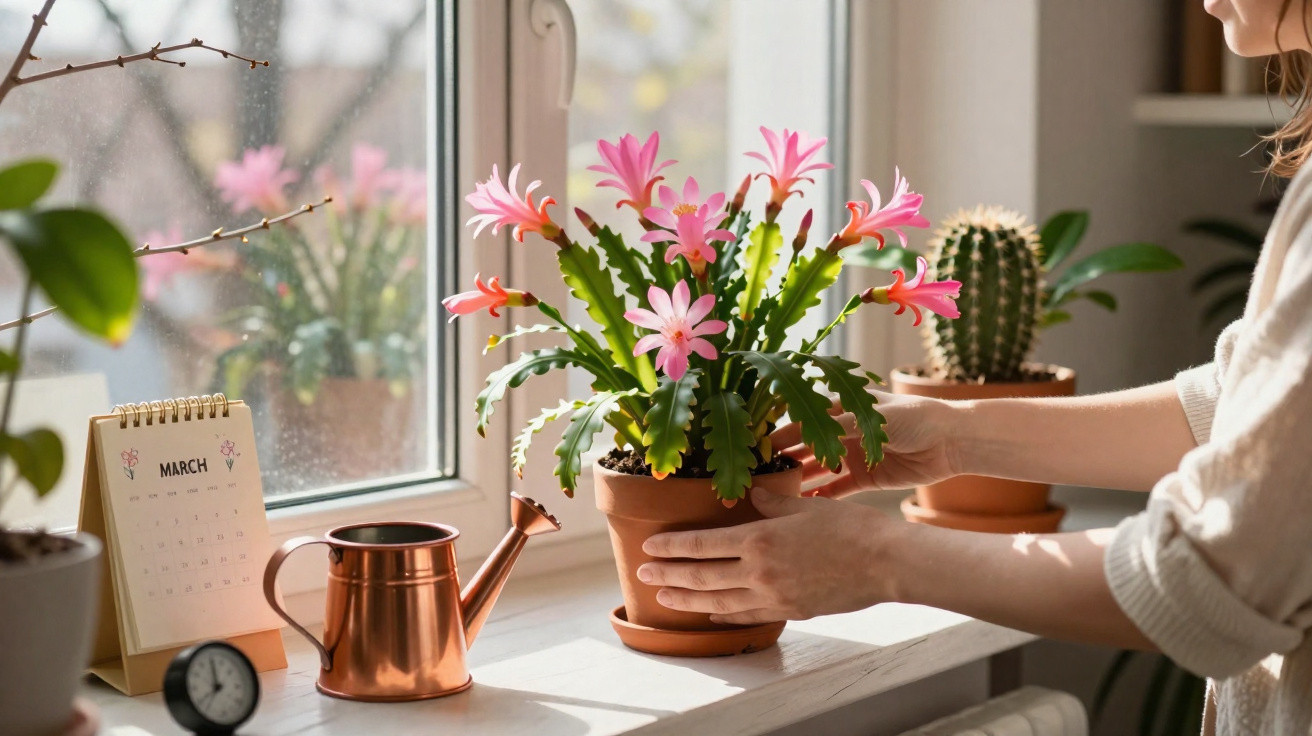
The reason is almost always found in the winter months.
A lot of people buy an Osterkaktus when it’s covered in starry blooms, put it in the living room - and then the following year, nothing happens. The plant looks perfectly healthy, the segments are a rich green, yet at Easter there isn’t a single bud. This disappointment is rarely down to a “black thumb”; it usually comes from misunderstanding how this unusual cactus works.
Why the Osterkaktus isn’t a desert cactus
The Osterkaktus (botanical name Rhipsalidopsis, sometimes also Hatiora) originates in the humid forests of South America. There it grows high up in trees as an epiphyte - not rooted in hot, sandy ground.
In practice, that means it wants bright conditions but not scorching sun, prefers things cool but not freezing, and needs moisture without sitting in water. If you treat it like a spiny desert cactus and park it in blazing sun at a south-facing window, you create stress - and stress is exactly what reduces flowering.
"A green plant without flowers is usually not a care problem, but one whose annual rhythm has been thrown off."
In its natural habitat the Osterkaktus flowers in spring. In the UK this period is usually between March and May. At that time the plant can be covered in upright, star-shaped blooms in pink, red, orange, or white - provided it was allowed to build up strength beforehand.
The one winter mistake that costs almost all the buds
The most common reason for a lack of flowers is simply that winter was too cosy for the Osterkaktus. Many plants stand from October to March in a consistently warm living room, often close to a radiator. There’s no real rest period at all.
That constant “summer mode” stops many plants from setting buds. The segments keep growing and look vigorous, but the plant never receives the signal: “Now is the time to form flowers.”
"Without several weeks of cooler temperatures and clearly reduced light, the Osterkaktus often sets no buds, or only a few."
Artificial light in the evening can be just as damaging as excess warmth. If the pot sits in a room that’s brightly lit until late, the long dark spell the cactus needs in winter never happens - to the plant it becomes an “endless day”.
The right annual plan: how the Osterkaktus flowers on time
1. Rest period in late autumn and winter
From around November, the most important phase begins for the Osterkaktus. It needs a cooler, calmer place:
- Temperature: ideally 10 to 15 °C, for instance a bright stairwell, a spare bedroom, or a cool hallway.
- Light: indirect daylight only, around eight hours per day. Nights must be genuinely dark - no permanent lighting and no glow from the television.
- Duration: 8 to 12 weeks under these conditions, from late autumn into the latter part of winter.
During this time the plant forms the internal basis for later flowering. You won’t see much change from the outside - but this is exactly when you set things up for Easter.
2. Adjust the watering routine
If you keep watering in winter “out of sympathy” as if it were summer, you increase the risk of rot and, at the same time, prevent the plant from properly resting:
- Spring / summer: water every one to two weeks, once the top layer of compost has dried.
- Autumn: gradually extend the intervals so the plant can shift into rest mode.
- Winter rest: only every three to four weeks, and just a small amount. The compost should stay almost dry.
"It’s better to water once too little than too often - wet, compact compost is the Osterkaktus’s greatest enemy."
If the cactus develops shrivelled, soft-feeling segments, it’s short of water. In that case, add a small top-up carefully - but never so much that water is left standing in the saucer.
The start of the flowering year: what needs to happen from February
After the cool phase comes the point when the cactus “wakes up” again. If you want blooms for Easter, start changing conditions gradually from around February:
- Move the pot to a brighter room, but not into full sun.
- Raise the temperature to 18 to 20 °C.
- Increase watering moderately, while still allowing the compost to dry slightly between waterings.
This is when the first buds begin to form. The plant is sensitive now, and stress can quickly cause it to drop the tiny developing flower buds.
Typical stress factors just before flowering
To keep the buds intact, avoid these familiar pitfalls:
- Constantly moving the pot: sudden changes in light and temperature unsettle the plant.
- Draughts: cold air blasts, for example from frequent airing right next to a window, can make buds fall.
- A hot radiator: dries out both air and compost, and flowers drop sooner.
"Once the Osterkaktus has buds, it should stay in the same place for a few weeks where possible - like a ‘do-not-disturb’ hotel guest."
Substrate, humidity, and the difference from the Christmas cactus
After purchase, many plants end up in heavy, dense multipurpose compost. For an epiphytic cactus, that becomes too compact over time. A more open, airy mix is better:
- around two thirds high-quality, loose potting compost
- one third drainage material such as perlite, broken expanded clay, coarse sand, or fine pine bark
This keeps the roots well aerated, lets water drain away faster, and significantly reduces the risk of rot. If you place the cactus on a saucer filled with damp clay pebbles, you raise humidity around the plant without standing the pot directly in water.
It’s easy to confuse it with the Christmas cactus. The Christmas cactus has more sharply toothed segments and its main flowering period is in winter. The Osterkaktus has more softly rounded segments and shows its colours in spring. Both need a cooler, darker phase - only the timing differs.
Common practical questions
Can an older Osterkaktus that “refuses” to flower still be rescued?
Yes. As long as the segments are green and firm, you can almost always get the flowering rhythm back on track. The key is to stick to the cool rest period next autumn and move the pot away from constant evening light in the living room.
Do I need to feed it to get more flowers?
A weak cactus fertiliser in spring and summer can help, but it should be used sparingly. During the rest period, no fertiliser belongs in the water. Too many nutrients tend to produce lush green growth rather than dense, starry blooms.
Why the effort is worth it
Once you understand your Osterkaktus’s rhythm, it can be a long-term joy. Many plants stay with their owners for decades, gradually forming impressive, richly branched cushions and opening their colourful display at Easter year after year. What’s often labelled a “fussy” houseplant turns out to be a dependable bloomer - as long as it gets winter rest, cool temperatures, and quiet, dark nights.
For hobby gardeners, this cactus is also a great introduction to epiphytic species. If you can manage the shift between rest and growth here, you’ll usually find orchids, bromeliads, and other epiphytes much easier too. The green “hold-out” on the windowsill can become a teacher for an entire indoor-jungle approach - and a reliable splash of colour for the Easter table.





Comments
No comments yet. Be the first to comment!
Leave a Comment