
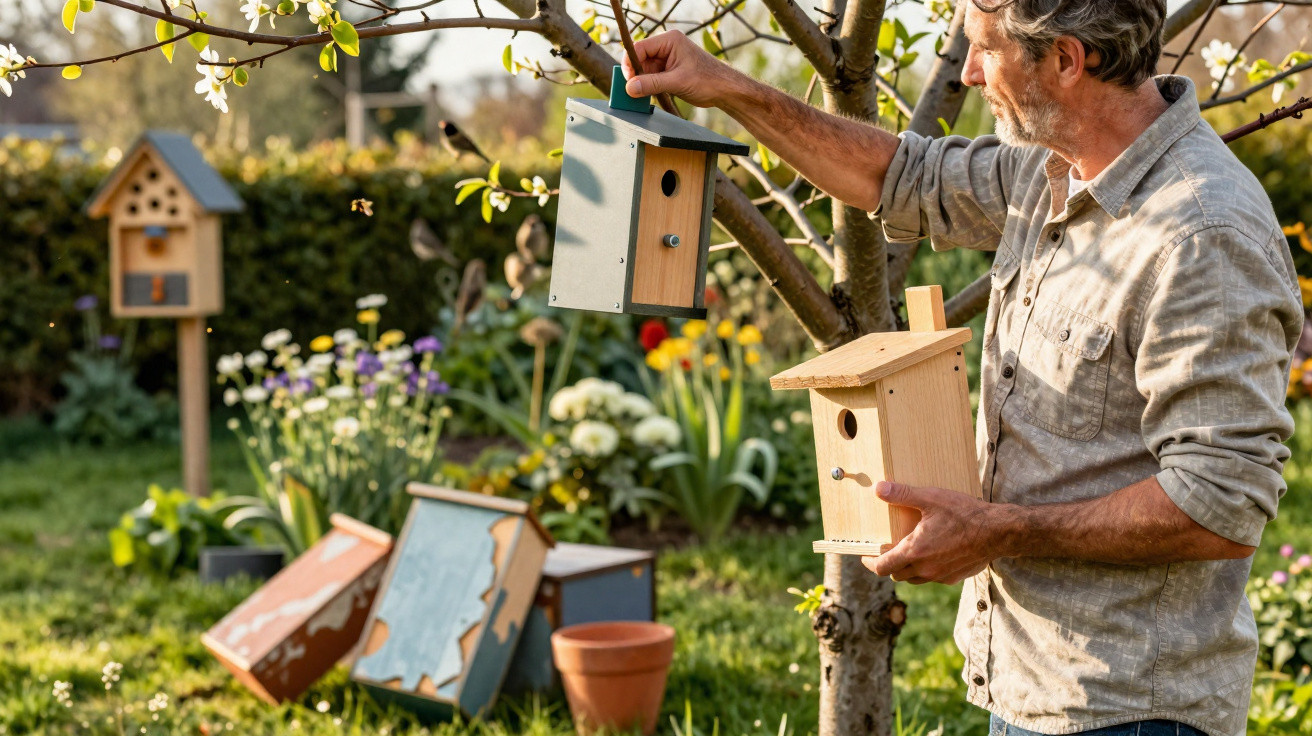
Colourful, simple to install and sometimes fitted with small windows, modern nest boxes have long appealed to garden owners. Yet a growing number of enthusiasts are choosing to remove or replace them. Their decision is not simply about appearance. It answers a practical question: does a decorative shelter genuinely provide suitable conditions for eggs and young birds?
An attractive object can make a poor shelter
In garden centres, plastic, resin and composite boards take up considerable shelf space. These materials make it possible to produce lightweight, brightly coloured and inexpensive models. They also appear to withstand rain. However, a nest box is not a patio ornament: it is a tiny enclosed space where temperature, moisture and ventilation must remain tolerable.
Sunny spring days present an initial danger. A dark box facing due south, or one made with thin walls, can heat up very quickly. Plastic materials may retain heat, particularly when ventilation is inadequate. Inside, eggs and nestlings that cannot regulate their own body temperature become far more vulnerable.
“A nest box must shelter birds from wind and cool nights without becoming a suffocating box as soon as the sun hits its front.”
Models with a transparent front also raise concerns. Being able to see inside may seem entertaining to people, but extra light and changing temperatures do not necessarily create a reassuring environment for the occupants. Birds usually seek out a dark, stable and discreet cavity.
Materials that may deteriorate badly
A second disappointment often becomes apparent after winter. Chipboard panels swell when exposed to damp. Coatings crack, glued parts come loose and water can enter through the roof. A damp shelter encourages parasites and rapidly chills the brood on cool nights.
Enthusiasts therefore take down these installations when they begin to deteriorate, but also when they realise they are never used. An empty nest box is not necessarily in the wrong position: it may be poorly designed, too conspicuous or unsuitable for the species found in the garden.
Untreated timber returns to the heart of the garden
In response to the shortcomings of decorative models, untreated solid wood remains a dependable choice. It provides better insulation than a thin plastic wall and retains some ability to absorb and then release moisture. Its rough surface also helps young birds climb towards the entrance hole when they are preparing to leave the nest.
Choosing timber still requires a degree of care. Reclaimed boards may contain treatment products, old paint or solvent residues. Not every pallet is suitable. Some have been treated against insects or fungi, making them unsuitable for such a confined space.
- Choose thick boards of bare, unpainted and unvarnished wood.
- Avoid particleboard and impregnated timber.
- Assemble the parts with screws rather than glue.
- Include an overhanging roof to reduce water ingress.
- Fit an opening front or base so the shelter can be cleaned outside the breeding season.
Terracotta: an option to use in moderation
Old roof tiles can create a robust, long-lasting roof, provided the structure can carry their weight. Terracotta offers good rain protection and does not warp in the way that some plastics do. That does not, however, turn the nest box into a perfect temperature regulator. Its position, the thickness of the timber and air circulation matter more than the roof material alone.
It is also important to ensure that a tile does not make the whole structure too heavy or unstable. A shelter blown down by the wind poses a direct risk to the brood. Securing it to a solid support is preferable to merely hanging it from a fragile branch.
A nest box construction detail can make all the difference
Specialists advise against adding a perch beneath the entrance. Common on novelty nest boxes, this small peg does not help tits or sparrows. These species do not need it to get inside. It can, however, assist a predator in reaching the opening.
The entrance-hole diameter must match the intended species. An opening that is too large allows bigger birds inside or makes access easier for certain predators. For small tits, a diameter of around 28 millimetres is often suitable; for the great tit, 32 millimetres is commonly used. These guidelines can vary according to the region and the species observed.
| Element | Recommended choice | Risk to avoid |
|---|---|---|
| Walls | Sufficiently thick solid wood | Thin plastic or swelling boards |
| Roof | Overhanging and watertight | Leaks and direct sun exposure |
| Entrance | Sized for the target species | An opening that is too large |
| Fixing | Stable and at an appropriate height | An unstable branch or a support accessible to cats |
Removing a nest box: yes, but never at the wrong time
One point calls for absolute caution: an occupied nest box must not be taken down. During nesting, adults may abandon eggs or young if the shelter is severely disturbed. Before taking any action, discreetly watch birds coming and going over several days. Adults regularly entering with food almost always indicate an active brood.
“A poorly designed shelter should be replaced between autumn and late winter, when it is empty, never in the middle of raising young.”
Cleaning should ideally be done outside the breeding season. Remove the old nest while wearing gloves, brush the interior dry and inspect the fixings. Scented products and strong disinfectants should be avoided. A clean nest box should not smell of household cleaner.
The right location matters just as much as the material
Even a well-made model will fail if it faces prevailing winds, sits in full sun throughout the day or is immediately within a cat's reach. An east- or south-east-facing position is often favoured, as it reduces exposure to driving rain from the west while avoiding intense afternoon heat.
Placing the shelter at a sufficient height and away from a heavily used bird feeder also reduces disturbance. Feeders attract a great deal of activity and may draw in predators. A shallow water source, native hedges and a few wilder areas will provide parents with insects, seeds and natural cover.
A nest box does not replace these resources; it complements a living garden. A dense hedge, flowering plants and the absence of pesticides often give birds far more lasting support than a shiny little house placed at random near the patio.


Comments
No comments yet. Be the first to comment!
Leave a Comment