
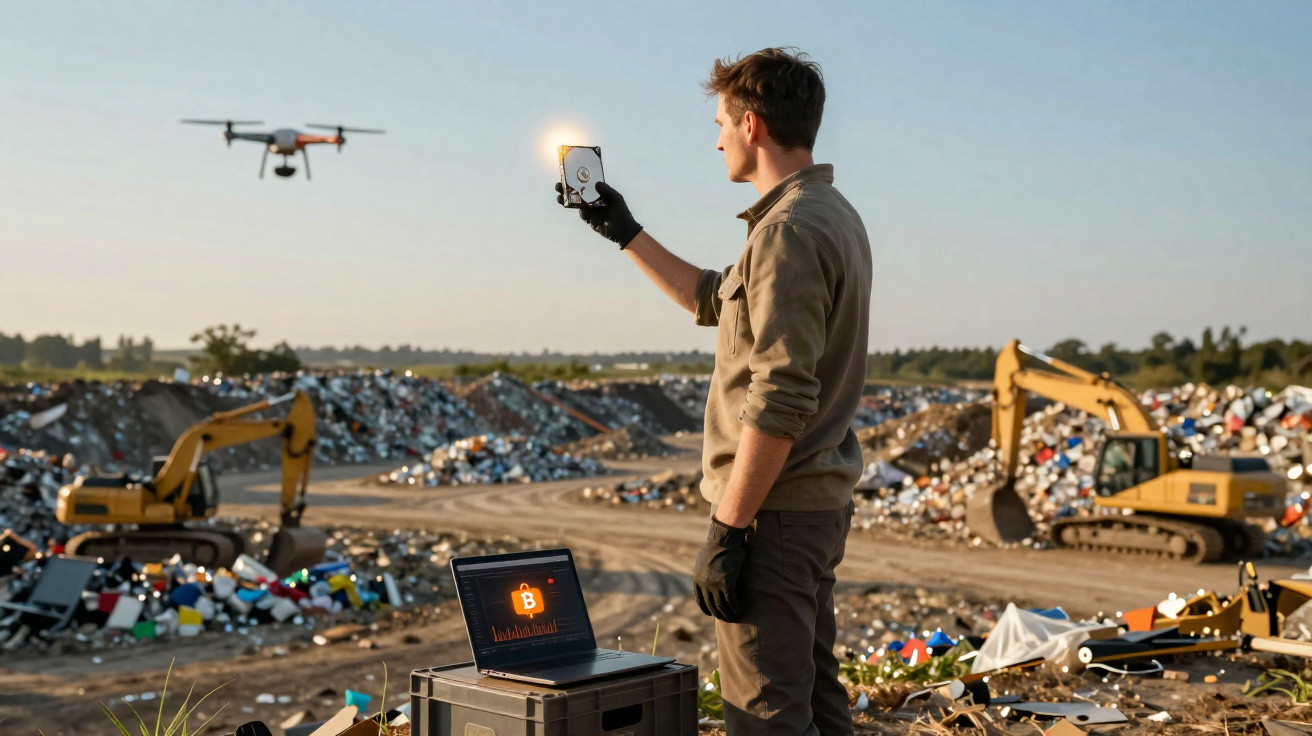
A Welsh IT technician accidentally threw away a hard drive while clearing out an office. It contained access credentials for thousands of Bitcoins. What sounds like an odd anecdote has become a saga involving hundreds of millions of dollars, environmental restrictions, court proceedings – and now a major documentary production.
The clear-out mistake that cost 649 million dollars
In 2013, James Howells was tidying his workspace in Newport, Wales. Old equipment, tangled cables and several hard drives were among the items discarded. Only when Bitcoin's price began to soar did he realise what had gone into the bin: the very hard drive holding the private keys to around 8,000 Bitcoins.
At the time, those coins were already worth a fortune – roughly eight million dollars. Compared with what followed, however, that amount was almost a “bargain”. Over the years, Bitcoin's value climbed to ever higher levels, with one coin at one point passing 90,000 dollars. On paper, Howells was suddenly sitting on around 649 million dollars – but had no way to access it.
“A hard drive in the rubbish – containing a fortune that could transform a small town.”
By then, the crucial hard drive had long been buried beneath tens of metres of compacted waste at Newport's municipal landfill site. Household rubbish, construction debris and industrial waste all end up there – everything a region disposes of over decades.
High-tech plans for mountains of waste
Howells refused to give up. Instead, he developed increasingly elaborate proposals to locate the hard drive within the landfill maze. His aim was a precise, managed search that would minimise disruption for both the environment and local residents.
To do so, he planned to deploy an extensive range of modern technology:
- AI-enabled drones to map the surface and subsurface with millimetre-level precision
- Robotic excavators to remove selected layers only
- Monitoring equipment for toxic gases and liquids
- Dedicated safety zones for contaminated materials taken from the landfill
Howells offered to fund the entire operation himself. Taxpayers would not be asked to contribute, and there would be no risk to the council's budget. His view was straightforward: anyone who believes 649 million dollars is buried in the ground is willing to spend several million on the search.
Newport City Council, however, remained firm. Officials warned about escaping landfill gases, risks to groundwater and unpredictable consequences if tonnes of compressed rubbish were disturbed again. There was another obstacle too: under UK law, everything deposited at a landfill belongs to its operator. Legally, the discarded hard drive was no longer Howells' property.
“In purely legal terms, the lost hard drive belongs to the landfill – no longer to the man desperately searching for it.”
Court ruling: virtually no prospect of recovery
Howells took the matter to court, presenting expert reports and setting out his high-tech search proposal in detail. He sought an exemption, permission or any legal route that would allow excavation to go ahead.
Then came the blow in 2024. A British judge assessed the case pragmatically and stated what many specialists had long believed: after more than a decade in landfill, the realistic chance of not only finding the hard drive but also being able to read it was virtually nil.
Experts explained during the proceedings why:
- Magnetic storage media deteriorate rapidly in the hostile conditions of a landfill.
- Moisture penetrates the device, metals corrode and solder joints break down.
- Pressure from numerous layers of rubbish damages mechanical components.
- Chemical reactions from decomposing waste directly attack electronic parts.
Even if the drive were actually located, the likelihood was extremely high that its delicate internal structures would have been irreparably destroyed. That was sufficient for the court to remove any realistic hope. The judge made it clear: this digital treasure chest would remain closed.
“The courts force him to officially accept that his Bitcoin fortune is lost.”
From personal nightmare to global warning
The ruling brought the landfill search to an end. Yet the story itself only became bigger. Within the cryptocurrency world, the case has long served as a lesson in how fragile digital wealth can be when access is poorly protected.
Anyone who loses control of their private keys loses their coins. There is no “Forgot password?” button and no customer service team that can recover anything. Howells' experience illustrates that reality in an extreme form.
It also raises questions reaching far beyond technology. What value should be placed on an environmental condition if hundreds of thousands of people could become rich overnight? Who decides when an ecological risk is “worth” the money? And who is responsible if such a search goes wrong?
The Bitcoin hunt becomes a documentary series
Rather than fading away without notice, Howells' story is now entering a new phase – on screen. US production company LEBUL has secured the exclusive rights to turn the years-long search into an extensive documentary series.
Its working title is “The Buried Bitcoin: The Real-Life Treasure Hunt of James Howells”. The series is intended to trace the whole story, from the casually discarded hard drive and the increasingly complex recovery plans to the courtroom battles and the bitter realisation that the coins will probably remain trapped in rubbish forever.
“For the first time, Howells can show in detail what he truly intended to do at the landfill.”
The production is expected to feature elaborate visual effects, satellite maps, landfill simulations and deeply personal insights. Its makers want to show how one mistake can consume an entire life, and how hope, determination and despair shift with every rise in Bitcoin's price.
Howells himself welcomes the project. For him, the series is more than entertainment – it is also a chance to put forward his side of the story. He wants to demonstrate that his proposals were not mere fantasy, but calculated, developed with experts and technically demanding. The figure of “649 million dollars” should not be the only thing people remember; the effort behind it matters too.
What investors can learn from the case
The Howells case is almost an ideal illustration for anyone dealing in Bitcoin and other cryptocurrencies. It shows how unforgiving the rules can be when personal security arrangements have not been properly considered.
Anyone holding substantial amounts in digital assets needs a security plan. This could include:
- Backup strategies: Keep private keys and seed phrases in several secure locations.
- Hardware wallets: Dedicated devices designed solely to store keys.
- Clear labelling: Do not throw away an “anonymous” hard drive with no indication of what it contains.
- Test runs: Check regularly that wallets can still actually be opened.
Many newcomers only recognise the importance of these steps when it is already too late. Unlike with a bank account, there is generally nobody on a blockchain who can reverse a transaction or restore access.
Digital money, real environmental risks
Another compelling aspect of the story is the clash between private wealth and the public interest. On one side is a man sitting on a theoretical billion-dollar sum. On the other is a landfill operated under strict environmental rules and located within a sensitive ecosystem.
Newport City Council argues that toxic gases, contaminated liquids and microplastics create risks at active or former landfill sites that can scarcely be calculated in full. Once large sections are reopened, substances contained for years or decades may escape. That could affect residents and nature alike.
Howells' case therefore highlights how modern societies set their priorities. Money alone is not enough to override environmental requirements – even where the sums involved could alter a local authority's budget for decades.
Why this story endures – even without a happy ending
James Howells will almost certainly never see his Bitcoins again. Nevertheless, through his persistence he has created one of the best-known cryptocurrency stories of our time. It combines human drama, technical sophistication, legal complexities and environmental responsibility.
For investors, it is a warning; for filmmakers, a gift; and for authorities, a case study. Above all, it demonstrates that digital wealth may appear light and abstract on a screen – but the consequences of poor decisions are very real, very costly and sometimes permanent.






Comments
No comments yet. Be the first to comment!
Leave a Comment