
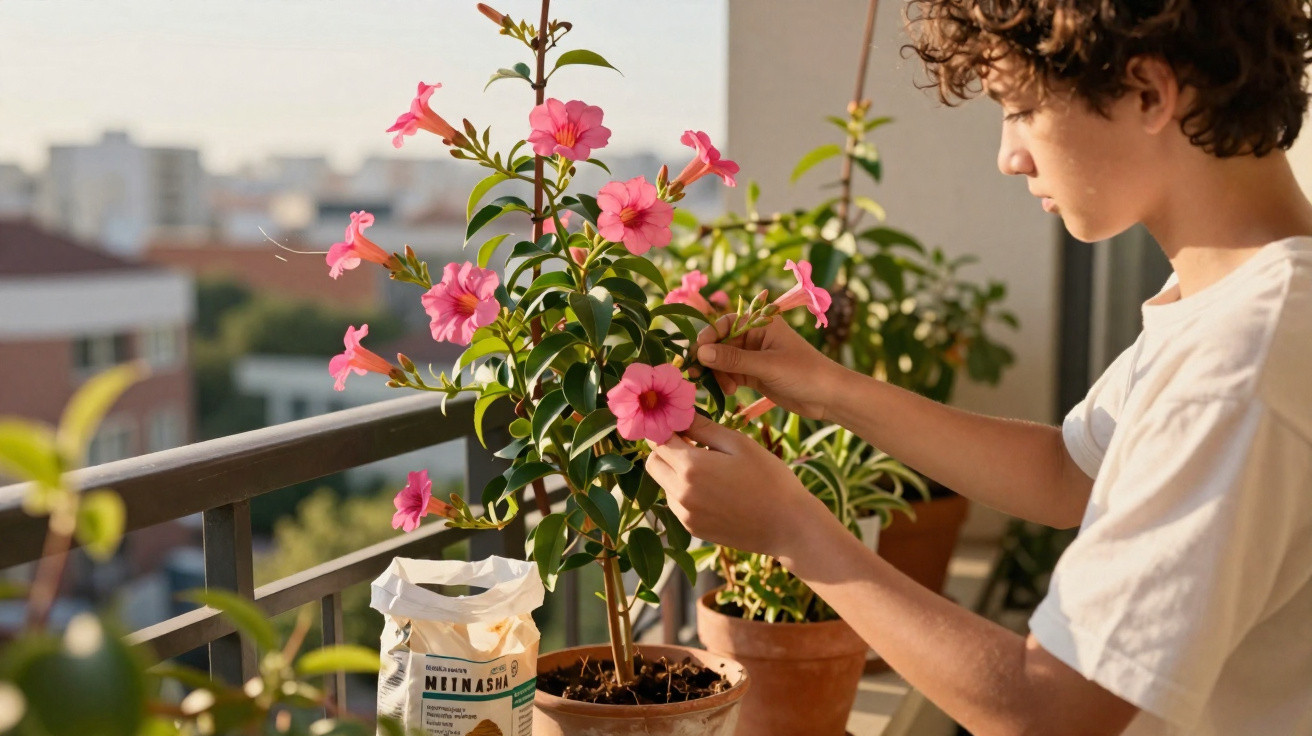
The most floriferous climber to grow in a balcony pot is dipladenia, also known as mandevilla. It produces trumpet-shaped blooms, performs well on a vertical support and adapts more readily to containers than very heavy climbers. Given sun, free-draining growing medium, light pruning and trained stems, it can keep a balcony colourful for many months, particularly in warm-climate areas.
Why is dipladenia ideal for a balcony pot?
Dipladenia is easier to control than bougainvillea, seven-league vine or thunbergia, all of which can become too large for a small balcony. It climbs trellises, arches and railings without developing heavy woody trunks, making it simpler to maintain in a pot.
Its extended flowering period is another advantage. In warm, brightly lit positions, mandevilla may bloom through much of the year, with heavier flushes in spring and summer. Its flowers come in pink, red, white or yellow, standing out against glossy green foliage.
Which pot and support should be used for climbing?
The pot needs to be suitably deep, as dipladenia develops vigorous roots while actively growing. A 30- to 50-litre container allows the plant to be trained more securely on a balcony, provided that the drainage holes at its base remain unobstructed.
Install the support at planting time, before the stems become long and tangled. The best choices include:
- A wooden or metal trellis fixed behind the pot.
- A narrow arch to create a framing effect against the wall.
- A balcony railing, provided it receives sun and allows loose ties to be attached.
- Strong vertical wires, firmly secured and set away from the wall.
- A central cane for young plants that have not yet produced many stems.
Which growing medium keeps this climber flowering?
The best growing medium for dipladenia is fertile, light and free-draining. The plant appreciates consistent moisture but cannot tolerate waterlogged roots; compacted soil therefore tends to reduce flowering and cause yellow leaves.
A reliable mix combines topsoil, well-rotted organic compost and a drainage-improving material, such as coarse sand, perlite or carbonised rice husks. At the bottom of the pot, a layer of expanded clay pebbles or gravel helps keep water flowing out freely.
How should stems be pruned and trained without losing flowers?
Dipladenia should be pruned lightly and with care. Hard cuts at the height of flowering remove productive stems and delay the next batch of buds. Instead, remove untidy tips, dry leaves and weak shoots throughout the year.
To retain a full appearance without overcrowding the plant, follow these steps:
- Tie in new stems using soft tape or loosely tied twine.
- Train the stems in a zigzag pattern across the trellis rather than directing them only upwards.
- Remove shoots growing inwards that make the canopy too congested.
- Carry out a more thorough clean-up prune in late winter or early spring.
- Wear gloves when pruning, as the milky sap may irritate the skin.
How can you create a flowering display in limited space?
On a small balcony, dipladenia works best when grown vertically, covering a wall, sunny corner or the side of a railing. Place the pot where it will receive several hours of light, while sheltering it from strong winds that can snap fresh shoots and knock off buds.
The most attractive result comes from distributing the stems early on, creating a light curtain of foliage and flowers. With careful watering, moderate fertiliser for flowering, and a well-positioned support, this climber remains compact, gradually covers its structure and turns a small amount of floor space into a flowering wall for much of the year.





Comments
No comments yet. Be the first to comment!
Leave a Comment