
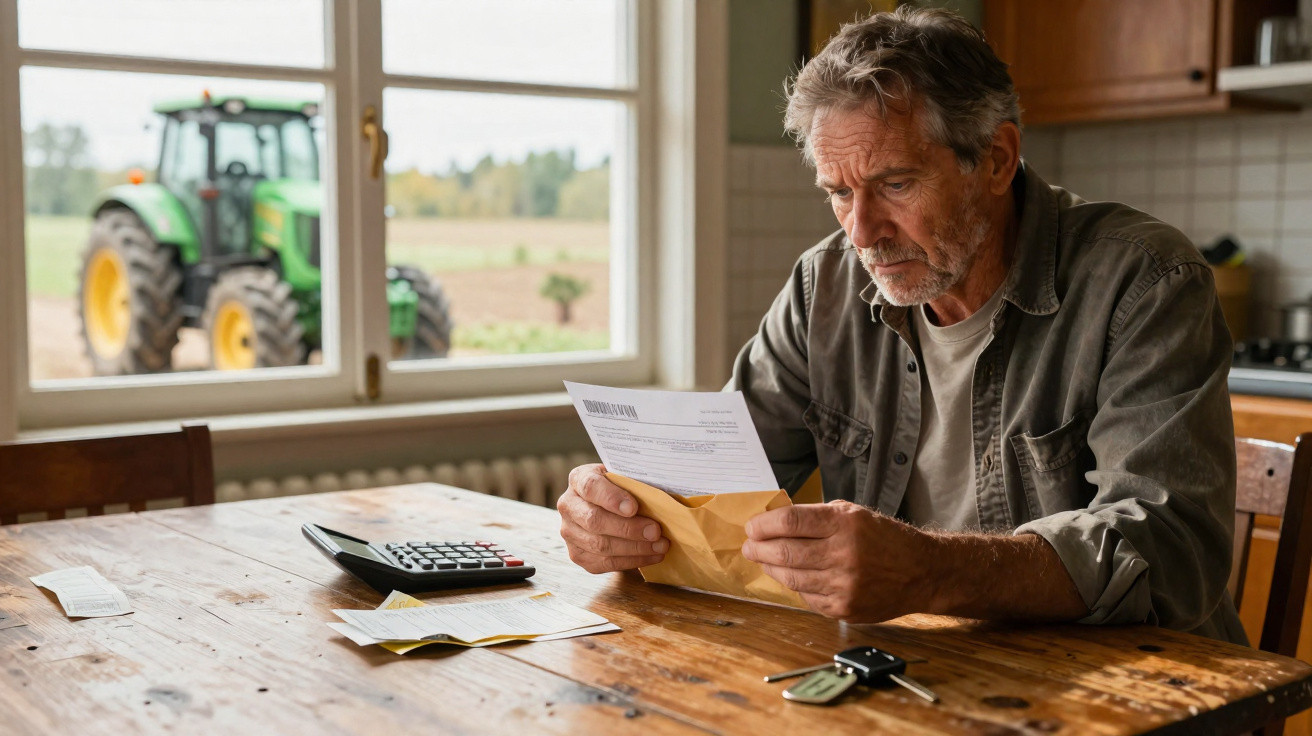
It often begins as a modest act of goodwill.
A neighbour asks whether you could “just store” a caravan in your barn for a while. A cousin asks you to “help them out” by letting two horses stay in your field while they get back on their feet. A friend from town wants to use your address to qualify for cheaper parking, or a local young man suggests putting a piece of land in his name “for now” so he can seek a grant. In the more remote parts of the UK, that is often the order of things: do the favour first and deal with the paperwork afterwards.
Then an HMRC brown envelope appears on the mat. Or a solicitor pauses before saying, “You do realise that might be taxable?” Suddenly, the helpful gesture seems less like neighbourly generosity and more like an expensive error. You go over the original chat again, wishing you had asked one straightforward question: “Is there any tax thing I should know about?” Naturally, you did not ask it. Nobody wants to bring up HMRC when they are being asked to lend a hand.
The favour that started with a tractor and ended with a tax bill
A few years ago, in a village somewhere between nowhere and the nearest Costco, a farmer I will call Mike did what many people in the countryside do: he said “yeah, no problem” without giving it much thought. His friend Dan had left employment and was setting up a small landscaping firm. As Dan had no land of his own, he asked to put his equipment in one of Mike’s sheds “just until things get going.” There was no tenancy agreement, no official rent and no formalities; it was simply one mate helping another.
Initially, Dan stored only a small tractor and trailer. Before long, there was a digger too, followed by several pallets of supplies. Each month, Dan started giving Mike some cash “for diesel and hassle”, and he would occasionally bring him logs. It did not seem remotely business-like. Nobody described it as “commercial”. The arrangement was casual, friendly and largely unspoken, agreed in muddy boots beside the farm gate.
Three years on, an ordinary mortgage application brought the whole arrangement into view. The lender requested evidence of every source of income. The amounts were not substantial, but they arrived consistently. The accountant looked closely, put a few direct questions, then delivered the phrase that can make rural people visibly tense: “HMRC would probably see this as taxable rental income.” At that point, the favour no longer felt generous; it felt like an unnoticed loophole with a financial drop at the bottom.
The rural habit: “We’ll just sort it between us”
Rural Britain has a distinct culture that city dwellers do not always grasp. When something goes wrong, you do not necessarily call a helpline or complete a form. You phone your uncle, call at a neighbour’s house, or rest against a gate and discuss it until the cold comes through your coat and the dog begins to whine. Arrangements are made with a nod, a handshake and a low-key assurance to “square it up later.”
It is both generous and determined. People do not want to feel they are charging “proper money” to a friend, so they refer instead to a “bung”, “bit of help”, “cover my costs” or “whatever you think is fair.” Payment may come as cash, logs, lamb or beer. It seems informal and perhaps too insignificant to interest the taxman. But when money, or anything of value, changes hands in return for land, storage or services, HMRC may quietly start paying attention.
Most of us have experienced the point at which something completely ordinary turns out to be adult, complicated and consequential. You allow a friend to keep a horse in your field, receive a monthly payment for a caravan in your barn, or let a relative operate their “little sideline” from your address. It does not feel commercial; it feels considerate. That is exactly what leaves so many people unprepared.
Where the HMRC tax line really lies - and why it is less clear than you think
“I’m not running a business, I’m just being helpful”
For most people, the surprise is not that tax exists. It is discovering that the informal, slightly undefined arrangement they have had for years may count as income in HMRC’s view. If somebody uses part of your land, an outbuilding, a static caravan, a yard or even a driveway, and provides regular payment or another benefit in return, it could be treated as rental income or trading income. You do not need a written contract or an online advert. A recurring flow of payment can be enough.
There are also personal allowances, property allowances, trading allowances, capital gains and business rates for particular uses. The terminology alone can send you back to the kitchen table to study a bank statement and wonder which heading covers your “bit of cash for the shed”. Let’s be honest: no one really sits down every month and combs through their bank transfers with HMRC rules open in another tab. Most people simply assume their arrangement is too minor to count.
But modest sums can accumulate over time. A favour that begins at £40 each month can rise to £80 and later £150. Cash payments turn into bank transfers, while a note scribbled in a diary becomes a standing order. Amounts can move beyond thresholds without anyone deliberately choosing that outcome. When an accountant or an inquisitive mortgage lender eventually reviews it, the picture may look like a small but reliable channel of undeclared income.
The emotional sting of “accidental” tax
The hardest part is not always the tax bill, although unexpected tax and late-payment interest are hardly welcome. Often, it is the sense of being told off for trying to do the decent thing. People make comments such as, “So I do my mate a favour for years, and now I’m the one in trouble?” or “I wasn’t trying to dodge anything; I was just helping out.” They feel morally justified, yet technically at fault.
That distance between intent and official interpretation is where bitterness can take hold. HMRC does not arrive with sympathetic context about village favours, harsh winters or understated generosity. It comes with forms, figures and regulations, none of which leaves room for: “He was in a tough spot, I couldn’t just say no.” For many countryside households, this is where trust begins to wear thin. The system can appear to penalise the very conduct that enables isolated communities to function.
The quiet traps no one warns you about
Horses, caravans and that “spare” bit of land
Rural accountants hear the same examples repeatedly. Horses in fields are one of the most common. Someone has a field that is not being used much, allows a couple of liveries to graze there, and receives a useful monthly amount in exchange. There is no business name or website, only recommendations between local people. From a tax standpoint, however, it may look very similar to operating a small livery yard.
Caravans and campervans are another frequent issue. A neighbour needs somewhere to store one long term, a relative puts a static caravan on your property, or a friend working away asks whether they can “just plug in” for several months. There is an electrical hook-up, a modest charge and everyone is content. Then the questions emerge: does this amount to rental income? If people are staying intermittently, could it even be viewed as a kind of holiday let?
There are also parcels of land and barns put into another person’s name “temporarily”. This may be intended to secure a grant, avoid a benefits difficulty or get around planning restrictions. Such arrangements are commonly made in an atmosphere of trust and mutual necessity. Later, they can run directly into capital gains tax or inheritance tax, because what seemed like a favour may legally amount to the transfer of a valuable asset.
When addresses and paperwork become part of the story
Not every problem starts with cash changing hands. Sometimes, the favour consists of allowing someone to use your address as the base for their business. It could be a cousin who works as a tradesman and moves frequently, or an online seller who does not want customers visiting their flat in town. At first, it seems to involve no money at all. You are only receiving letters, passing along the occasional parcel and dealing with some unwanted post.
A few years later, though, a letter may arrive about business rates, an insurance claim or liability after something has gone wrong. You then discover that the place you regarded as “my home, my land” has been listed somewhere as “commercial premises”, however limited that use may be. Nobody explained that it was happening. Your act of kindness was simply reclassified by the wider system without your consent.
Why this keeps happening in the countryside
In theory, tax rules apply in the same way everywhere. In reality, country life can bend them into unusual forms. Journeys are longer, public services are more limited and family networks carry greater weight. When your tractor fails, you are more likely to borrow a neighbour’s than contact a hire firm. When someone loses their job, they are more likely to piece together income from other people’s sheds, yards and unused corners of land.
Pride also plays a role. People are reluctant to seek formal support, so they rely on help from those around them. A field here, a workshop there, a caravan connection beside the hedge. It all depends on trust and shared experience: a quiet “we look after our own” principle that has supported communities for longer than anyone at an HMRC office has been alive.
Against that background sits a system designed around certainty, formality and neat classifications: business or not business, personal or commercial, asset or non-asset. It cannot account for your neighbour’s divorce, your cousin’s illness or the fact that the person keeping a digger in your barn repaired your roof without charge last winter. The taxman is not necessarily uncaring, but it is blind to those details. From your side of the kitchen table, that can feel much the same.
The tiny questions that save big headaches
Oddly, avoiding these rural loopholes does not always require extensive professional advice. Sometimes, it only means pausing before agreeing and asking an extra question. “Are you paying me for this?” “Will anyone else be using my place?” “Is this going in your business accounts?” Those brief, mildly uncomfortable questions can reveal whether the request is genuinely a straightforward favour or the framework of a commercial arrangement.
Where the reply is “yes, I’ll pay you every month,” tax may be sitting in the background. It is neither certain nor automatic, but it is a possibility. That is the time to record the arrangement properly, even if the record is just one sentence in a notebook or a basic written agreement. A little certainty at the start can prevent that sinking feeling later when a person in a suit asks for “evidence.”
One rural solicitor told me she would like more people to do one very simple thing: make a rough note of who pays them, how much they pay and what they use the land or buildings for. There is no need for software or spreadsheets, only a record. It may sound dull until it prevents you having to rebuild five years of favours from vague recollections and forgotten payments.
Holding on to kindness without being naïve
There is a danger that accounts like these persuade people never to help anybody again. “If everything’s a tax risk, why bother?” That would be unfortunate and, in truth, impractical. Rural Britain will always be a place where people quietly help one another. A handful of brown envelopes will not change that.
The more useful change is a quieter one: recognising that kindness and clarity can coexist. You can still let your neighbour use the barn, allow your cousin to graze two horses or give your friend somewhere to park their van. You can simply say, without embarrassment, “Let’s just be clear what this is. Is it a proper arrangement, or just a one-off?” That one conversation can alter the whole position.
The loophole people repeatedly fall into is not really about HMRC or legal terminology. It is about the divide between how an arrangement feels and how it appears on paper. That is where the difficulty lies. You do not need to become a walking tax manual to avoid it. You only need to recognise when a favour has quietly become a pattern, then ask the question rural Britain has avoided for too long: “If this went under a microscope, would I still call it just helping out?”






Comments
No comments yet. Be the first to comment!
Leave a Comment