
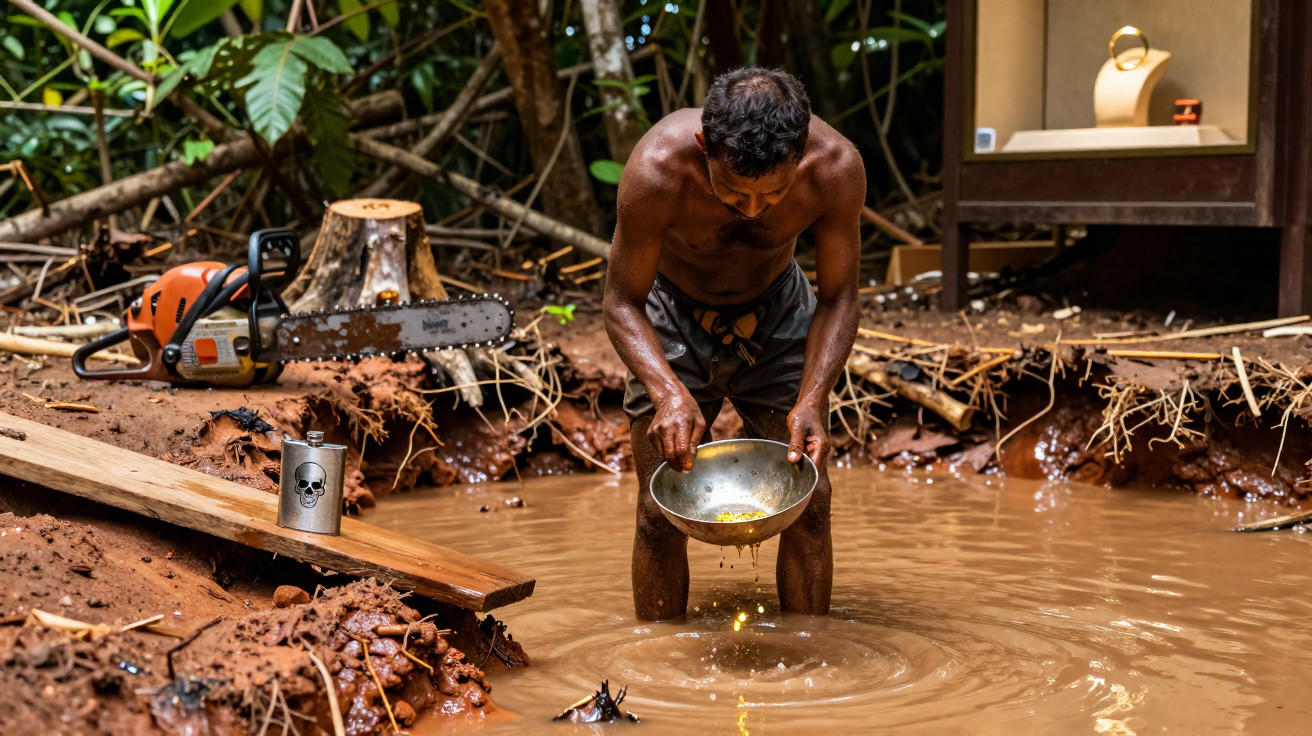
The rapid rise in the gold price is quietly reshaping the global commodities landscape. In many countries, a second, informal gold sector is emerging, where small-scale miners dig without permits, mix mercury-containing slurry and sell their output through dubious middlemen. Industry experts now believe that this shadow market accounts for almost one third of the total gold supply.
Gold price pushes people from fields into mines
Where maize, cocoa or coffee once grew, the landscape is now scarred by craters. This is particularly apparent in countries with rich gold deposits, including Ghana, Peru and parts of South-East Asia. Village after village, families are changing livelihoods: leaving agriculture behind for improvised gold prospecting with shovels, picks and basic washing equipment.
The incentive is enormous. Those who are fortunate can earn in a few days what they previously made during an entire month in the fields. That leap creates hope, but it also brings new dependencies. Seasonal fluctuations, debts to equipment hire companies and the influence of local gangs mean that many artisanal miners can barely leave the trade.
Estimates suggest that around 30 per cent of gold mined worldwide now comes from artisanal and informal mines – significantly more than just a few years ago.
The World Bank still put the share at roughly 20 per cent in 2021. Experts believe that figure has long been outdated. With the gold price at record levels, even remote deposits that were once unattractive have suddenly become profitable.
Mercury, deforestation and crime: the heavy cost of cheap gold
The boom in the shadow economy has a toxic downside. A large proportion of improvised mines use mercury to separate fine gold particles from rock. The method is cheap and straightforward, but extremely dangerous.
People washing gold on riverbanks usually pour surplus mercury straight into the water. Fish absorb the heavy metal, which later enters human bodies. Children in affected regions are increasingly showing neurological damage, while women face a higher risk during pregnancy.
- Water: Rivers are contaminated with silt, chemicals and mercury.
- Forests: Rainforest and savannah are cleared to make way for new pits.
- Health: Workers inhale toxic fumes, often without protective masks.
- Security: Gangs and smuggling organisations use gold as a source of funding.
Gold is ideally suited to illegal dealings: it is valuable, easy to transport and can be introduced into legal trade relatively easily. Organised groups use the metal for money laundering, to finance other offences or as a stable store of value when currencies fluctuate.
A market worth almost half a trillion dollars
According to figures from the industry body World Gold Council, global gold production totalled around 3,591 tonnes in 2024. At the current price, that represents more than US$480 billion. Within this enormous market, informal suppliers may initially appear to be a minor detail, yet their share is increasing far faster than conventional industrial mining.
Large listed companies are under pressure from investors, regulators and environmental organisations. They are investing increasingly in safety, land restoration and modern processes. This makes official production more expensive and limits growth. In the shadow of this trend, small groups are filling the gap, abandoning all standards and therefore operating at lower costs.
The stricter regulated gold mining becomes, the more appealing informal activity appears as an alternative to many people – especially where the state is weak.
Countries with limited budgets can scarcely monitor remote areas. They often lack trained inspectors, modern measuring equipment or simply the political will to act against well-connected local elites who profit from the trade.
Attempts to regulate the grey market
Some countries are looking for ways not merely to fight the informal sector, but to bring it into order gradually. The idea is that small-scale miners should be able to legalise their work, access approved processing facilities and bring their gold into official trade.
One example is Veta Dorada, a facility operated by Dynacor in Peru. Small producers deliver their ore there, where it is processed without mercury. The operators pay a documented price, remit taxes and can sell the gold to international buyers that value traceable origins.
Such centres are intended to tackle several problems at once:
- Fewer environmental toxins through cleaner processing.
- More stable incomes for small producers, as they are no longer dependent on middlemen.
- Greater transparency, because authorities can track volumes, payments and participants more effectively.
- Less scope for smuggling networks that have so far benefited from anonymity.
Formalisation rather than prohibition: a realistic approach?
Many specialists doubt that a strict ban on informal mining would work. Poverty, unemployment and the prospect of quick earnings are too significant. Taking shovels away from people without creating alternatives risks social tensions and fresh conflicts.
Formalisation sounds more pragmatic, but it is demanding. Governments must simplify legal procedures so that small groups can genuinely obtain licences. Banks and microfinance institutions need products suited to seasonal, fluctuating income. International gold buyers must also be willing to pay slightly higher prices if environmental standards and human rights are to be better upheld.
What the boom means for consumers in Europe
Gold from informal mines does not end up only in jewellery shops in producing countries. Via refineries and middlemen, it reaches trading hubs in Switzerland, London and Dubai, before finding its way into bars, coins, jewellery and industrial products.
Anyone buying a gold bracelet or investing in coins in Germany can rarely say with certainty which mine produced the metal. Certification schemes and proof of origin do exist, but they cover only part of the market. Supply chains in which gold is repeatedly melted down and mixed are especially problematic.
Some dealers are now placing greater emphasis on recovering old gold. Recycling conserves deposits and produces substantially fewer emissions. At the same time, organisations are seeking to establish programmes for “responsibly mined” gold, under which small-scale miners meet certain environmental and social requirements in exchange for a premium.
Terms and context: what lies behind small-scale mining?
Artisanal or small-scale gold mining refers to activities usually carried out by families or small groups using basic tools. It ranges from semi-legal co-operatives holding fundamental permits to entirely illegal operations deep within rainforest vegetation.
In many regions, this form of production has existed for generations. However, the latest price surge has made the work far more intensive and market-driven. Where people previously dug for a few days each year, permanent operations now run with pumps, generators and heavy machinery.
For the countries concerned, the balance is difficult: gold brings foreign currency, jobs and infrastructure projects. At the same time, damaged river systems, poisoned soils and armed groups threaten long-term development. Those who maximise short-term profits risk lasting damage and dependence on a commodity whose price fluctuates sharply.
Investors, policymakers and consumers in German-speaking countries therefore have good reason to look more closely behind the gleaming gold bar: the current gold rush is no longer merely a story of record prices, but also one of informal mines, vulnerable communities and the difficult attempt to bring a global multibillion-dollar market into order.






Comments
No comments yet. Be the first to comment!
Leave a Comment