
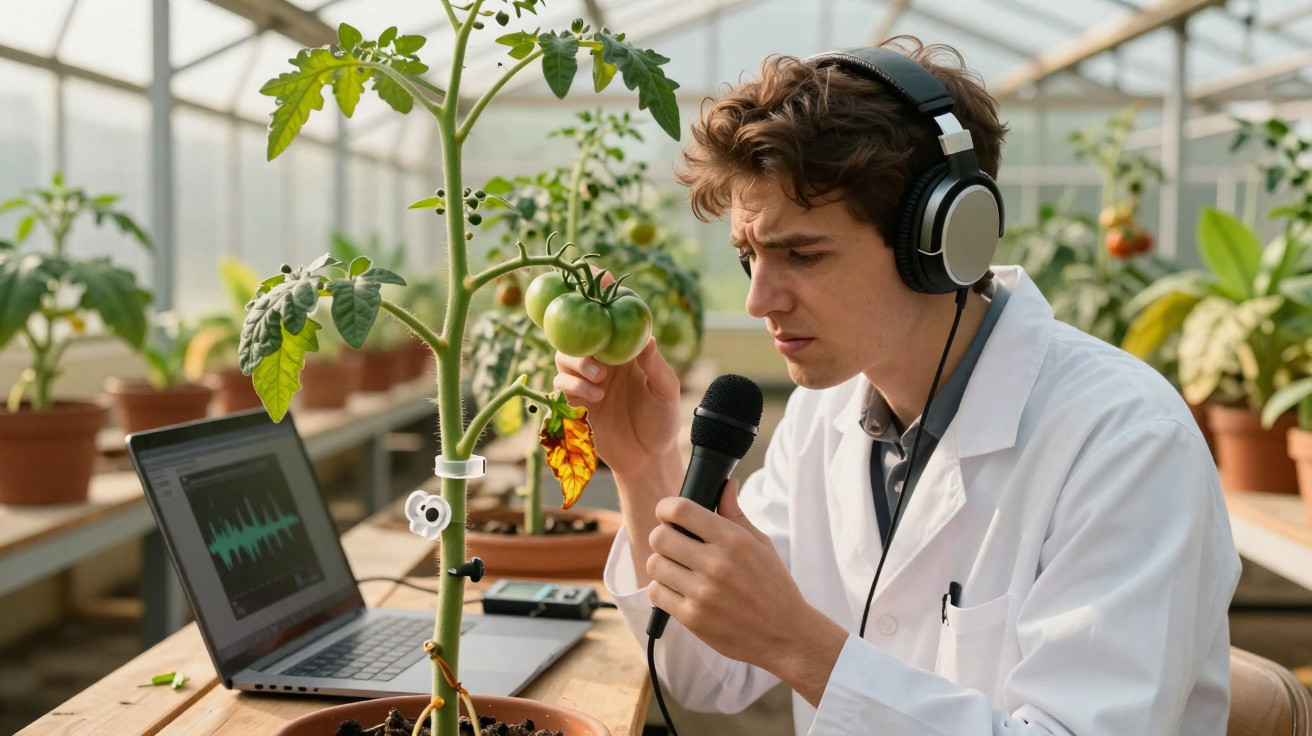
Roald Dahl may, it seems, have been right about one thing: when a plant is hurt, it screams.
Not quite in the way a person would, of course. Instead, plants give off ultrasonic popping or clicking sounds beyond the limits of human hearing, and these noises become more frequent when a plant is under stress.
According to a 2023 study, this may be one way plants convey distress to the surrounding world.
Plants and ultrasonic distress signals
"Even in a quiet field, there are actually sounds that we don't hear, and those sounds carry information. There are animals that can hear these sounds, so there is the possibility that a lot of acoustic interaction is occurring," explained evolutionary biologist Lilach Hadany of Tel Aviv University in Israel when the research was published.
"Plants interact with insects and other animals all the time, and many of these organisms use sound for communication, so it would be very suboptimal for plants to not use sound at all."
Stressed plants are not as passive as they may appear. They can undergo striking changes, including releasing potent aromas - among the easiest changes for humans to detect. Their colour and form can change as well.
Such alterations may warn nearby plants of danger, allowing them to strengthen their own defences. They can also draw animals that may deal with pests harming the plant.
Whether plants produce other signals, including sounds, had not been thoroughly investigated. Several years ago, Hadany and her team discovered that plants can detect sound. The obvious follow-up was to establish whether plants can make sounds too.
How tomato and tobacco plants were recorded
To investigate, the researchers recorded tomato and tobacco plants under several conditions. They first captured recordings from unstressed plants to establish a baseline. They then recorded dehydrated plants and plants whose stems had been cut. The recordings were made initially in a soundproof acoustic chamber and later in an ordinary greenhouse setting.
Next, they trained a machine-learning algorithm to tell apart sounds made by unstressed, cut and dehydrated plants.
The sounds produced by plants resemble pops or clicks at frequencies too high for people to hear, and can be detected from more than a metre away (3.3 feet). Unstressed plants make very little sound; they simply carry on quietly being plants.
Stressed plants, however, are considerably louder, producing an average of up to around 40 clicks per hour, depending on the species. Water-deprived plants also have a distinct sound pattern. They begin clicking more often before visible dehydration appears, intensifying as they become thirstier, then easing as the plant wilts away.
Plant sounds, species and unanswered questions
The algorithm could distinguish these sounds and identify the plant species that made them. Nor is this limited to tomato and tobacco plants. The team examined a range of plants and found that producing sound seems to be a fairly widespread plant behaviour. Wheat, corn, grape, cactus and henbit were all recorded making noise.
Several questions remain, however. For instance, it is not yet known how the sounds are generated. Earlier research found that dehydrated plants undergo cavitation, in which air bubbles form, expand and collapse in the stem. In the case of human knuckle-cracking, this process creates an audible pop; something comparable may occur in plants.
It is also unknown whether other forms of distress trigger sound. Pathogens, attacks, UV exposure, extreme temperatures and other unfavourable conditions may likewise cause plants to pop like bubble wrap.
Nor is it certain whether making sounds is an adaptive development in plants or merely a by-product of stress. The team did show that an algorithm can be trained to recognise and differentiate plant sounds. Other organisms may well have developed the same ability.
Those organisms could also have learnt to react to distressed-plant noises in different ways.
"For example, a moth that intends to lay eggs on a plant or an animal that intends to eat a plant could use the sounds to help guide their decision," Hadany said.
The practical implications for people are fairly straightforward: we may be able to listen for the distress calls of thirsty plants and water them before the problem worsens.
Whether other plants detect and respond to these sounds remains unknown. Previous research has shown that plants can improve their drought tolerance in response to sound, making the idea plausible. This is the direction the team intends to take in the next stage of its research.
"Now that we know that plants do emit sounds, the next question is – 'who might be listening?'" Hadany said.
"We are currently investigating the responses of other organisms, both animals and plants, to these sounds, and we're also exploring our ability to identify and interpret the sounds in completely natural environments."
The research was published in Cell.
An earlier version of this article was published in March 2023.






Comments
No comments yet. Be the first to comment!
Leave a Comment