
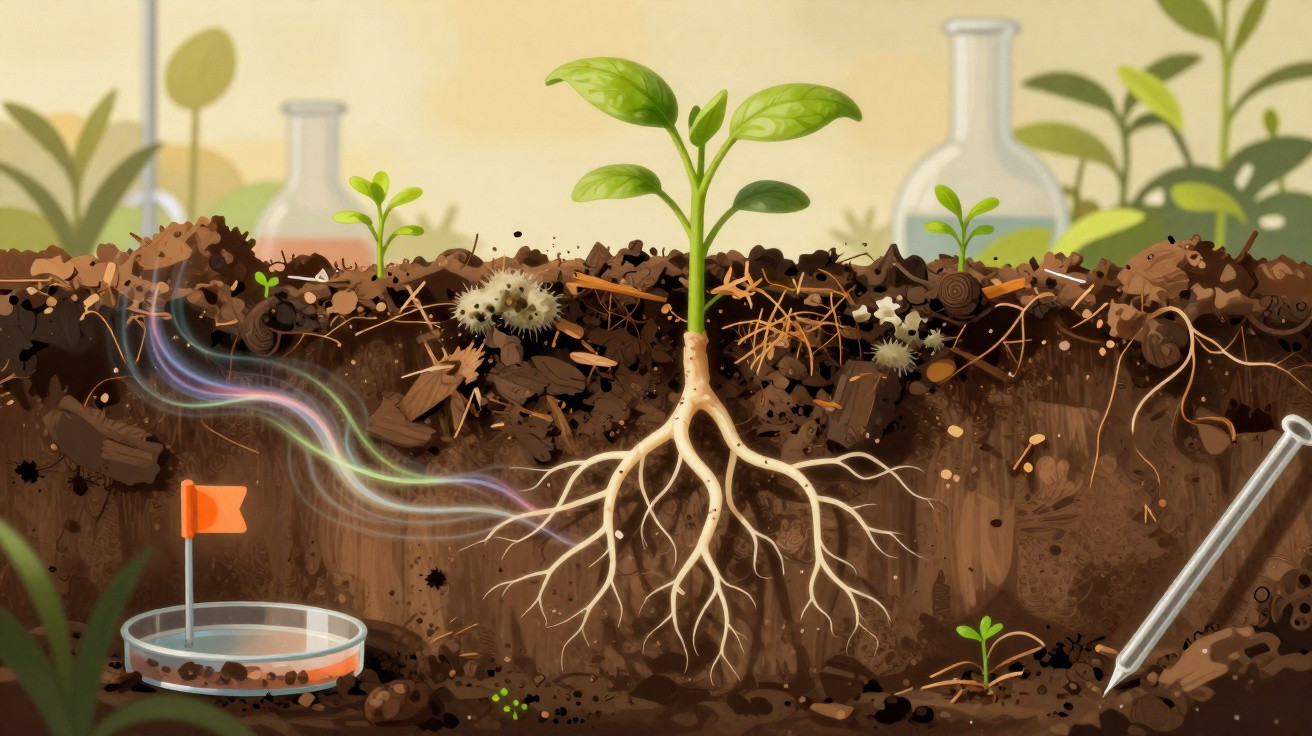
Plant roots can detect decaying plant material in nearby soil and redirect their growth before they come into contact with it, according to a new study.
They identify decomposition from a distance by following the chemical trace it creates in the surrounding soil.
This behaviour represents a previously unrecognised method of root navigation, protecting a plant’s most susceptible tissue from the microbes responsible for decomposition.
It also demonstrates that chemicals released as material decays can influence the direction in which a plant grows.
Why roots avoid rot
Decaying plant matter creates a highly active environment in soil. Fungi and bacteria gather on it, and microbes that decompose dead tissue can also infect living roots that venture too near.
Yuzhou Zhang, the plant biologist who led the research at Northwest A&F University (NWAFU) in China, and his colleagues wanted to establish whether roots deliberately avoid such areas.
When Earth.com asked how a root can respond to decay without touching it, Zhang said, “Roots do not need to touch the decaying plant material to react to it.”
To investigate, the scientists positioned a rotting apple next to the root tips of thale cress (Arabidopsis), a small plant widely used in plant research.
After two days, roots directed towards the decomposing material had slowed and then stopped, failing to grow into it. Roots in uncontaminated soil, meanwhile, continued to extend as usual.
Crop plants showed the same response, including canola, tomatoes and wheat, indicating that it was not unique to a single species. The researchers called this growth response saprotropism, using a Greek-derived term meaning rotten.
Roots follow chemical trails
In a separate experiment, the team placed decomposing material 1.27 cm to one side of a root without allowing contact. Rather than continuing straight downwards, the roots bent away from it.
This indicated that the roots were detecting a substance moving through the soil instead of responding to physical contact. The researchers identified acidity as the signal.
As fungi broke down the dead plant material, they produced organic acids that lowered the pH of the nearby soil.
A pH-sensitive dye shifted colour in a halo around the rotten apple, revealing a stable pH gradient: the soil was more acidic close to the decay and less acidic farther away.
To determine whether acidity by itself could trigger the effect, the researchers created an equivalent gradient using a weak acid but no decaying material.
The roots turned away in the same manner as they did from genuine rot. When a buffer neutralised the acid, the bending stopped.
Roots ignore false alarms
The signal was selective as well. When the researchers used decomposing chicken, which makes soil slightly alkaline rather than acidic, the roots did not react.
In other words, roots respond to the acidic chemical signature produced by decaying plant tissue, rather than to decomposition generally.
The degree of selectivity surprised the team. Study co-author Jiří Friml is a plant biologist at the Institute of Science and Technology Austria (ISTA).
“This tells us that saprotropism is not a general reaction to decay, but a specific response to the chemical environment created by decomposing plant matter,” Friml told Earth.com.
A different hormone pathway
Most recognised tropisms depend on a single hormone. The best-known example is gravitropism, in which roots grow downwards; for roughly a century, this has been linked to auxin – a growth hormone that accumulates along one side of a root and causes it to bend.
Saprotropism did not follow this model. Roots genetically engineered without the systems that transport auxin still curved away from decay, and frequently bent more strongly than ordinary roots, meaning the established auxin pathway could not explain the response.
Instead, receptors capable of sensing pH on the outermost root cells seem to detect the acid gradient.
This prompts abscisic acid, a hormone that plants usually use during stress, to accumulate more strongly on the side of the root facing the decaying material.
Turning away from danger
A fluorescent sensor directly recorded this accumulation: within hours of exposure to decay, the hormone increased in the root tip and collected on the side facing the acid. This uneven distribution determines the direction of bending.
The unequal hormone levels subsequently reorganise microtubules, internal fibres that control the direction in which a cell elongates.
Cells on one side grow more than those on the other, causing the root to turn away from the acidic area.
Plants already use this hormone-and-fibre mechanism. Previous research found that roots rely on the same abscisic acid signal and microtubule twisting to grow away from saline soil, in a response known as halotropism.
Helping crops avoid disease
The study shows that roots can interpret the chemistry of nearby decay and grow away from it through a hormone signal distinct from that responsible for most tropisms.
It identifies acidity generated by decomposition as a true directional cue, rather than merely a background factor that stresses plant growth.
The result also supports the idea that individual roots assess several signals simultaneously.
In an earlier paper, the same research group described a tug-of-war between a root’s attraction to gravity and its attraction to water; saprotropism appears to form part of this same process of balancing competing signals.
For agriculture, the findings suggest that crop roots might avoid concentrations of rotting material and the disease-causing microbes that collect around them.
Plants that can avoid infection
Zhang thinks the discovery may ultimately have applications in plant breeding.
“This would not replace classical disease resistance, but it could complement it by helping roots avoid pathogen-rich zones before an infection happens,” he told Earth.com.
This would provide a subtle form of underground self-protection.
Plants already shape soil life through substances released by their roots. In this case, however, the influence moves in the opposite direction, as the chemistry of microbial decomposition redirects the plant.
Evolutionary mystery remains
Zhang’s team believes saprotropism may have emerged after plants colonised land, because stable acid gradients of this kind would probably be difficult to maintain underwater.
It remains unknown whether the response occurs throughout the plant kingdom and how the receptor transfers its signal to the hormone.
These questions are part of the laboratory’s broader work on how roots first evolved the ability to navigate soil.
Image credit: Bao et al. / Science





Comments
No comments yet. Be the first to comment!
Leave a Comment