
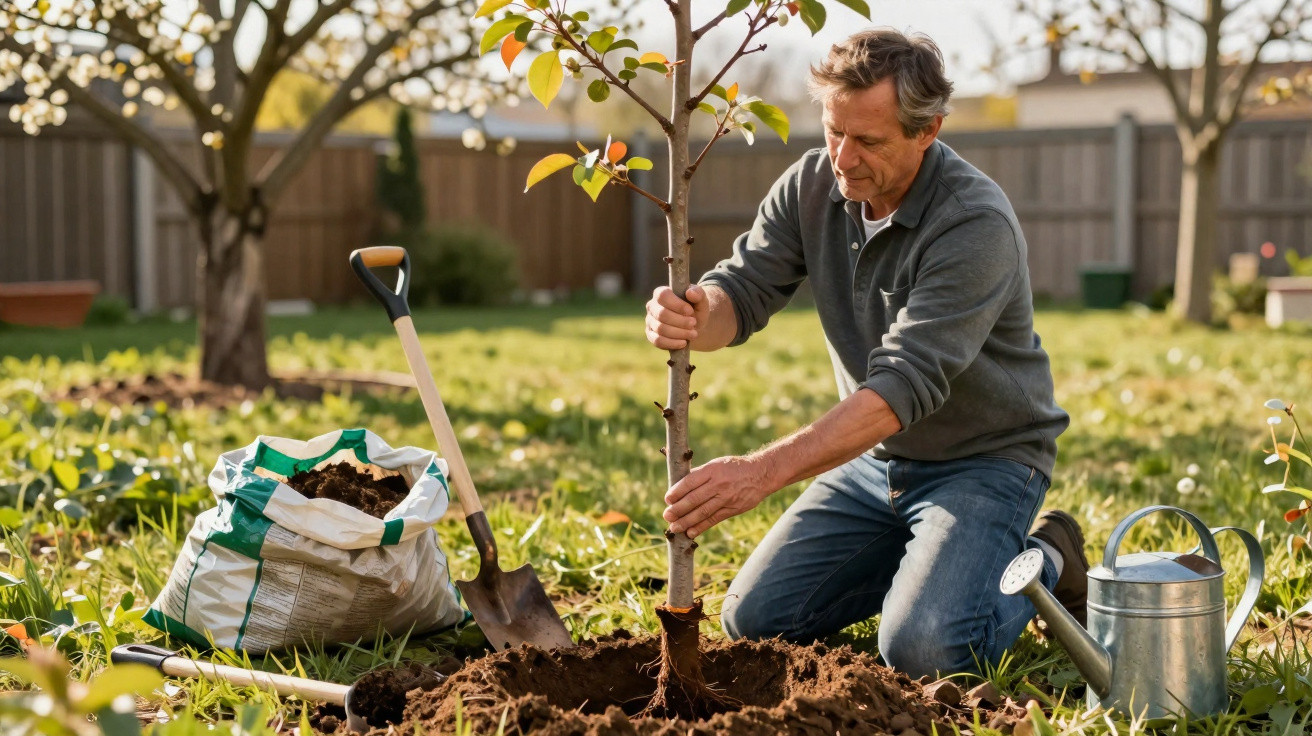
Anyone planting an apple, cherry or apricot tree in March or April imagines fragrant blossom and fruit picked from their own garden. Yet the reality is often the reverse: the tree languishes, produces scarcely any new growth, fails to flower – and the reason remains unclear. Often, the problem is not the tree itself, but a few crucial centimetres during planting.
The most common planting trap: fruit trees planted too deeply
Well intended, but disastrously done
Many gardeners assume that a tree needs to sit as deeply and securely in the ground as possible. They therefore dig a generously sized planting hole, mound soil firmly around the base of the trunk and press it all down. It sounds sensible, but for fruit trees it can be extremely damaging.
“Anyone who covers the base of the trunk and the graft union with soil is quite literally depriving their fruit tree of air.”
As a result, oxygen exchange around the tree’s sensitive base is severely reduced, moisture builds up and the tree remains permanently wet. This is precisely the area that is not designed to cope with such conditions.
Why wet soil around the trunk is so dangerous
The bark on the trunk is very different from the root sections. Roots can tolerate permanently moist soil because they are adapted to it. Trunk bark, by contrast, is highly sensitive to continual dampness.
When soil remains pressed directly against the trunk over a long period, the following can happen:
- the bark becomes soft and swollen,
- damage develops in the concealed wood,
- fungi and organisms that cause rot can enter,
- the channels carrying water and nutrients are destroyed.
At first, the tree may appear perfectly normal from above ground. Beneath the soil, however, the trunk gradually decays. Shoots above the damaged section receive less and less sap, until the tree either grows poorly or dies altogether.
The crucial point on the trunk: finding the graft union
How to identify the sensitive areas on a young fruit tree
Most fruit trees bought from a nursery are grafted. This means that a hardy rootstock, forming the root section, is joined to a high-quality fruiting variety. This join can be clearly seen on the trunk.
Two points are especially important:
- Root collar (base of the trunk): the transition between root and trunk, where the root tissue ends and the actual trunk begins.
- Graft union: a few centimetres above this, there is usually a swelling, scar or slight bend in the wood where the fruiting variety was attached.
This very “scar” later produces the productive crown. It must never disappear beneath the soil.
Why the graft zone must remain exposed
“The graft union is the heart of your fruit tree – if it disappears into the soil, the tree loses its strengths.”
If the graft union ends up below ground, the upper part of the tree attempts to form roots of its own. That may initially sound beneficial, but it is not: the advantages provided by the rootstock – frost resistance, disease resistance and reduced vigour for smaller gardens – are lost.
Gardeners call this “own-rooting”: the fruiting variety “emancipates” itself from the rootstock. The consequences are:
- the tree often grows more wildly and less predictably,
- flower formation is significantly delayed,
- yields suffer,
- susceptibility to disease increases.
Instead of directing its energy into flower buds and fruit, the tree is struggling to survive. Little remains of what was meant to be a good start.
How to plant fruit trees correctly in March
The golden rule for planting depth
The most important practical rule is this: After planting, the graft union must sit 5 to 10 centimetres above the finished soil level. The root collar itself should remain just above ground level or level with it, but it must not be buried.
“Keep the base of the trunk clear and the graft union plainly visible – this gives fruit trees a strong start in their new home.”
This keeps the sensitive section dry, exposed to sunlight and air, and protected from attack by permanently damp soil. The tree can then put all of its spring energy into new growth and flowering.
A trick to prevent the soil sinking later
Freshly loosened soil is airy and settles considerably after a few weeks. If this is not allowed for, the tree may still end up sitting too low.
A practical method is as follows:
- Build a small, firm mound of soil in the planting hole.
- Spread the roots out like a fan over this mound.
- Lay a straight cane or spade handle across the hole to mark the eventual soil level.
- While backfilling, check that the graft union remains 5–10 cm above this line.
- Firm the soil gently, but do not compact it until it is hard as concrete.
This ensures that the tree remains high enough even after the soil has settled, and stays at the correct level for the years ahead.
How to recognise a “livingly buried” tree
Warning signs in the first and second year after planting
Fruit trees with a root collar planted too deeply do not immediately signal that they need help. Symptoms develop gradually, particularly in spring and early summer:
- short, weak new shoots,
- small, yellowish leaves,
- flower buds that dry out before opening,
- barely noticeable growth for a long time, as if the tree were “on pause”.
At the latest, if the second year again brings only sparse growth and no flowers, it is worth inspecting the very bottom of the trunk. You can often then see that the graft union is disappearing just below the soil surface or is densely covered with soil.
Rescue action: uncover the base of the trunk
“If the damage has not progressed too far, a fruit tree planted too deeply can be saved by exposing its base.”
With a little care, such a tree can still be stabilised:
- Carefully remove soil from around the trunk using your hands or a small hand trowel.
- Create a shallow hollow around the trunk so that the root collar and graft union are visible and uncovered.
- Take care not to damage fine roots or scratch the bark.
- Make the watering rim slightly further out, so that water does not run directly against the trunk.
The tree usually responds to this relief in the following spring with much stronger new growth and more stable leaf colour. Even so, it may take one to two years before the first full flowering period – patience is worthwhile here.
Checklist: helping your fruit trees establish healthily in the garden
Checks while backfilling the planting hole
Anyone following a few basic rules can easily avoid the usual mistakes. This short checklist is useful while planting:
- Position the graft union clearly above the eventual soil line.
- Do not press soil directly against the trunk; the bark must remain exposed.
- Form the watering hollow a little away from the trunk so that water cannot collect against the wood.
- Firm the soil only enough for the tree to stand securely while leaving air in the ground.
- During the first few weeks, check regularly whether the tree has sunk.
Following these points lays the foundations for a vigorous root system and a resilient crown.
What specialist terms such as root collar and grafting mean
A brief look at fruit tree “anatomy”
The root collar is the point where the root becomes the trunk. Here, the underground and above-ground parts of the tree meet. This area reacts particularly sensitively to constant dampness, frost and bark damage.
The graft union is created when a selected variety – such as a flavoursome apple – is attached to a rootstock that copes well with the soil, climate and diseases. Without this technique, many modern fruit varieties would be difficult to grow reliably in a home garden.
That is exactly why the position of this scar in relation to the soil surface is so important. Anyone who accidentally buries it removes the very traits they intended to buy in the tree.
Practical examples for different sites
Sloping ground, heavy soils and container planting
On sloping ground, water is more likely to run away, so the risk of waterlogging is lower. Even there, however, the same principle applies: keep the base of the trunk exposed and leave the graft union above soil level. In very heavy clay soils, it is worthwhile adding a drainage layer or at least mixing in sand and compost so that water can drain away more quickly.
Anyone growing fruit trees in containers, such as columnar fruit trees or trees on low-vigour rootstocks, needs to pay even closer attention: waterlogging develops faster in pots. A thick layer of broken terracotta at the bottom, high-quality structurally stable compost and one firm rule will help: never pull soil over the root collar, even if the surface drops slightly over time.
Ultimately, success or failure depends not only on the variety, but also on paying attention to these few yet vital centimetres on the trunk. Those who keep an eye on them will not be looking at bare branches in spring, but at a sea of blossom – and later, baskets full of fruit from their own garden.




Comments
No comments yet. Be the first to comment!
Leave a Comment