
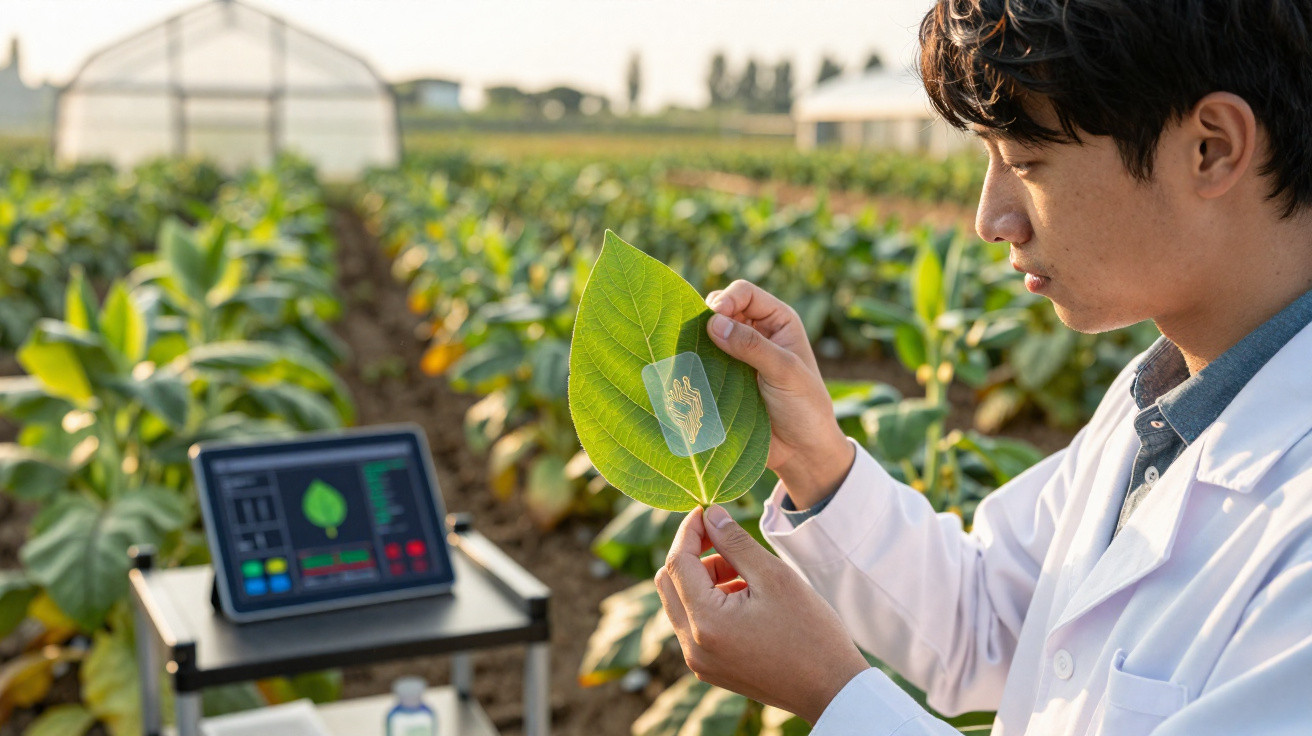
A patch worn on a leaf can identify concealed stress in living soybean and tobacco plants before any visible damage develops, researchers have discovered.
The development makes one of the plant’s first internal warning signs detectable early enough for growers to potentially prevent more extensive losses.
Inside the leaf
Applied to the undersides of infected soybean and tobacco leaves, the patch produced a higher current than it recorded in healthy tissue.
Liang Dong and his colleagues at Iowa State University linked this increased current directly to the stress signal accumulating within the leaf.
For both crops, measurements remained low in control plants but increased once bacterial infection triggered the plants’ defence response.
This trend indicated that the device was registering a genuine early warning, although it did not resolve the broader issue of which type of stress had triggered it.
A signal for early stress detection
The patch measures hydrogen peroxide, a reactive compound that plants rapidly produce inside their cells when stress disrupts normal chemistry.
Plant cells also employ it within reactive oxygen species, unstable oxygen-based chemicals that help initiate broader defence reactions.
As these concentrations increase at an early stage, the sensor may detect a problem before growers notice spotting, wilting or reduced growth.
However, this benefit has a limitation: the signal indicates stress but cannot identify its precise underlying cause.
Monitoring chemistry inside the leaf
Below the sensing surface is a microneedle array: miniature spikes that penetrate leaf tissue without requiring samples to be removed.
The needle tips were covered with a soft layer containing an enzyme that reacts with hydrogen peroxide and emits electrons when the two meet.
The researchers made this layer from hydrogel, a water-rich material that retains the chemistry, and incorporated graphene to conduct the charge.
When the electrical current increases, the device converts chemical activity inside the leaf into a reading that a grower can interpret.
How infected plants respond
After leaves were exposed to a common bacterium that infects plants, the patch rapidly registered a substantially stronger signal than on healthy plants.
In tobacco, the reading increased markedly following infection, signalling a distinct change from stable to stressed conditions within the leaf.
Soybean plants followed the same trend: their readings rose after infection, although less dramatically than those in tobacco.
Even with the natural variation between individual plants, the device reliably distinguished stressed leaves from healthy leaves in both crops.
Confirmation in the lab
Brown-stain testing made infected leaves darker, supporting the patch’s higher measurements rather than suggesting an alternative explanation.
A fluorescent laboratory assay on tobacco produced comparable values in live trials, backing the patch’s accuracy when used on leaves.
The assay gave slightly higher results, probably because leaf pigments produce background light that can interfere with fluorescence measurements.
This agreement was significant, as rapid results would have limited value if the patch did not correspond with established laboratory findings.
Faster tests for detecting plant stress
Conventional assessments frequently required tissue to be crushed, stained or examined with optical equipment before a plant’s state could be evaluated.
This patch, in comparison, supplied direct readings from leaves still attached to plants, without any sample preparation.
Previous wearable plant sensors had monitored gases released by leaves, whereas this design detected an internal alarm molecule.
By eliminating additional handling, the approach also lowered the risk of changing the very signal the patch was intended to measure.
What farmers gain
“We can achieve direct measurements in under a minute for less than a dollar per test,” said Dong.
Such rapid testing could enable farmers to check suspicious rows earlier, contain disease or adjust care before losses become more widespread.
Home gardeners could benefit too, although the research focused on crop plants rather than vegetables or flower beds in domestic gardens.
Limitations of the patch
The patch is not yet a universal stress detector, as the trials involved only soybean and tobacco leaves.
Although every measurement tracked hydrogen peroxide, increased levels in leaves can result from drought, heat, pests or infection.
Its reusability is also limited: the microneedles retained their form for six insertions but had failed after nine.
These constraints provide a realistic view of the findings and identify the engineering work still needed before field deployment.
Potential beyond one chemical
Eventually, the same platform could track several plant alarm signals simultaneously in one patch, allowing far more precise diagnoses.
Because enzymes can be tailored to specific molecules, a single patch could potentially follow multiple stress pathways together.
“Our next step is to refine the technology and enhance its reusability,” said Dong, outlining the team’s next engineering goal.
Should this be achieved, one leaf patch could form part of larger field networks monitoring disease, nutrients and water.
The device converts an unseen chemical alert into a rapid electrical reading in the field, connecting plant biology with practical decision-making.
Its potential depends on timing, since earlier information gives growers an opportunity to respond before stress becomes visible damage.






Comments
No comments yet. Be the first to comment!
Leave a Comment