
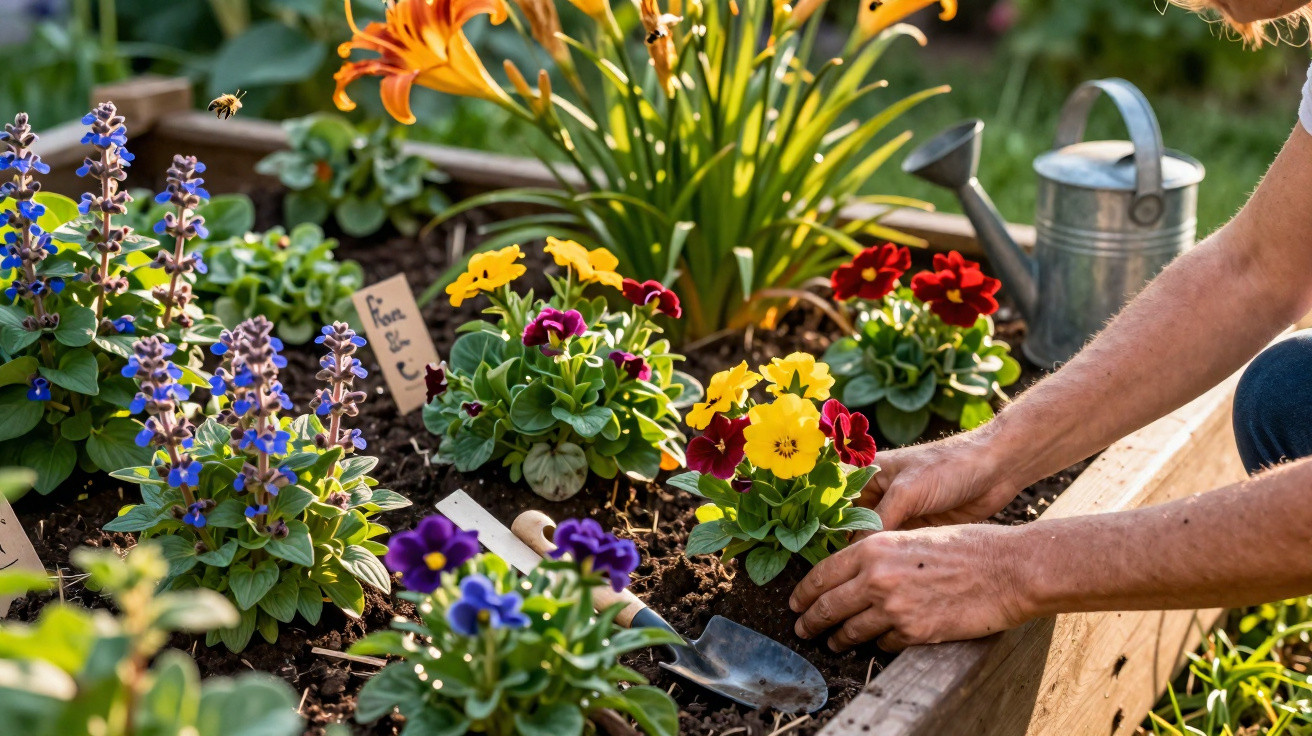
With the right perennials, that can be changed – far more quickly than you might expect. Hardy plants that return year after year can create dense cushions, tall clouds of flowers and masses of colour after just one or two seasons. They establish rapidly, reappear annually and leave little opportunity for weeds.
Why fast-growing perennials are so popular
Perennials are the long-term performers of the border: once planted, they produce fresh growth every year. Unlike annual summer bedding plants, they do not need to be bought again each season. Choosing fast-growing varieties saves time, money and effort while still producing a lush planting scheme.
The usual pattern is: establish in year one, spread in year two, take over the area in year three – fast starters shorten this process considerably.
Many of these perennials are considered insect-friendly. They provide plentiful pollen and nectar for bees, bumblebees and butterflies. The garden will not only look full and colourful, but will seem to buzz and flutter with life.
Position and care: helping plants get off to a flying start
Most vigorous growers share a few basic requirements. Meet them and they will take off, growing at a remarkable pace.
- Well-drained soil: They rarely tolerate waterlogging, but thrive in loose soil.
- Hours of sunshine matter: Full sun means roughly six hours of direct light daily.
- Make use of partial shade: Around half that amount is enough for species that are more sensitive to light.
- A boost at planting time: Remove weeds, loosen the soil and work in a little compost before planting.
- Water correctly: Keep the soil evenly moist during the first season; afterwards, many become very undemanding.
Larger container-grown plants with well-developed root systems fill gaps more quickly than tiny young plants. They may cost a little more, but can easily save one or two years of waiting.
The 10 perennials that genuinely fill borders quickly
1. Agastache – fragrant flower spikes for sunny spots
Agastache, often called giant hyssop, enjoys sunny and relatively dry positions. It quickly develops into upright clumps with long flower spikes that add colour to the border from high summer into autumn.
Its leaves release a light aniseed or minty scent when touched. Bees and butterflies are particularly drawn to it. Planting several specimens in loose groups soon creates a tall, moving backdrop of flowers at the rear of the border.
2. Catmint (Nepeta) – effortless blue flower cushions
Nepeta rapidly forms broad, gently trailing cushions. Countless small blooms in blue or violet shades create an almost continuous carpet of colour from late spring well into summer.
The plant copes with heat, drought and even the occasional neglectful gardener. Cutting it back after its first flush of flowers often encourages a second display. At the front of borders or beside paths, it closes gaps exceptionally quickly.
3. Tickseed (Coreopsis) – long-flowering yellow and red blooms
Coreopsis grows into bushy, well-branched plants and covers itself with daisy-like flowers in summer. Depending on the variety, they shine in yellow, orange, red or two-tone colours.
These plants manage in poor soils as long as the ground is not permanently wet. Regularly removing faded flowers extends the flowering season and keeps the perennials compact. Several plants in a sunny border look like a glowing carpet of colour.
4. Blanket flower (Gaillardia) – sunshine for poor soils
Gaillardia is among the quickest plants for adding colour to a border. Even in its first year, it forms substantial clumps and flowers for weeks in warm reds, yellows and oranges.
Its advantage is that it loves free-draining, rather dry soil, and also feels at home in rock gardens or sandy beds. Combined with grasses, it quickly creates a very modern, drought-tolerant planting.
5. Gaura lindheimeri – a delicate, repeat-flowering cloud
At first glance, Gaura may seem almost fragile, yet it is surprisingly robust in the border. Long, fine stems emerge from its base, carrying countless small, butterfly-like flowers that appear to dance.
It flowers from early summer into autumn. Its airy growth fills spaces without smothering other perennials. It is ideal for borders that should look “light” while still becoming densely planted quickly.
6. Red hot poker (Kniphofia) – exotic colour with rapid growth
Kniphofia brings a touch of the exotic to the garden with its upright flower spikes. Its yellow, orange or red torches rise well above the foliage and stand out from a distance.
This perennial soon forms larger clumps if it has a sunny position that is not too wet. Paired with grasses or used as a feature beside a patio, it rapidly provides structure and height.
7. Hardy geraniums – living ground cover instead of weeds
Creeping types of hardy geranium make excellent fast-growing ground cover. They spread swiftly, cover bare soil and thereby suppress unwanted growth.
According to the variety, the plants flower in pink, violet, blue or white, generally from late spring into summer. They work exceptionally well beneath shrubs, along the edge of a border or among taller perennials.
8. Perennial sage – violet flower spires with a bonus for bees
Perennial sage forms dense bushes with upright flower spikes in violet, pink or blue tones. It remains compact, yet quickly spreads across an area when provided with sunshine and well-drained soil.
Cutting it back after the main flowering period often produces a second burst of blooms. Few perennials attract insects as strongly – it is a genuine garden magnet.
9. Daylily – robust clumps with fresh flowers every day
Daylilies are classic gap-fillers that forgive almost any site, provided they are not growing in boggy ground. Their grass-like foliage develops into strong clumps that occupy plenty of space in a short time.
Although each individual flower lasts only a day, fresh buds continually open. This creates a richly coloured succession of flowers for weeks in yellow, orange, red or even darker shades.
10. Bee balm – clusters of colour for moister sites
Bee balm spreads by short runners and can form dense stands within a few years. It prefers soil that does not dry out completely and enjoys sunny to partially shaded locations.
Its striking flower heads in red, pink or violet attract bumblebees and butterflies. In a perennial border, bee balm quickly forms dense groups that typically occupy the middle layer.
How to combine fast-growing perennials effectively
Anyone creating a new border or giving an old one a major refresh will benefit from mixing different heights and flowering periods. A simple basic formula is:
- Back of the border: Agastache, red hot poker, tall Gaura
- Middle: Bee balm, daylily, tall Coreopsis
- Front: Hardy geraniums, catmint, low Gaillardia, low perennial sage
Planting in groups of three to five of each species creates the impression of a complete, carefully planned border more quickly than a collection of individual plants.
Common mistakes and how to avoid them
Many fast starters tolerate drought, but not during their first year. Insufficient watering at this stage is one of the most common reasons why perennials “fail to get going”.
Space requirements are another important consideration. Some species, including bee balm and vigorous hardy geraniums, spread more than their pots suggest when purchased. Allowing a little extra room from the beginning avoids the labour of dividing and moving plants later.
What terms such as “poor soil” and “well-drained” mean
These terms crop up constantly in everyday gardening, but their meaning is not always clear. “Poor soil” refers to earth with few nutrients and without a deep humus layer. Many perennials grow more compactly and remain sturdier in such conditions. “Well-drained” means that water runs away promptly rather than remaining around the roots for days.
If you are unsure, dig a small test hole after heavy rain. If water is still standing in it after two days, the site is problematic for many of the perennials listed here. In that case, add sand or fine grit to the upper soil layers – or deliberately choose plants that prefer slightly moister conditions, such as bee balm or certain daylilies.
Comments
No comments yet. Be the first to comment!
Leave a Comment