
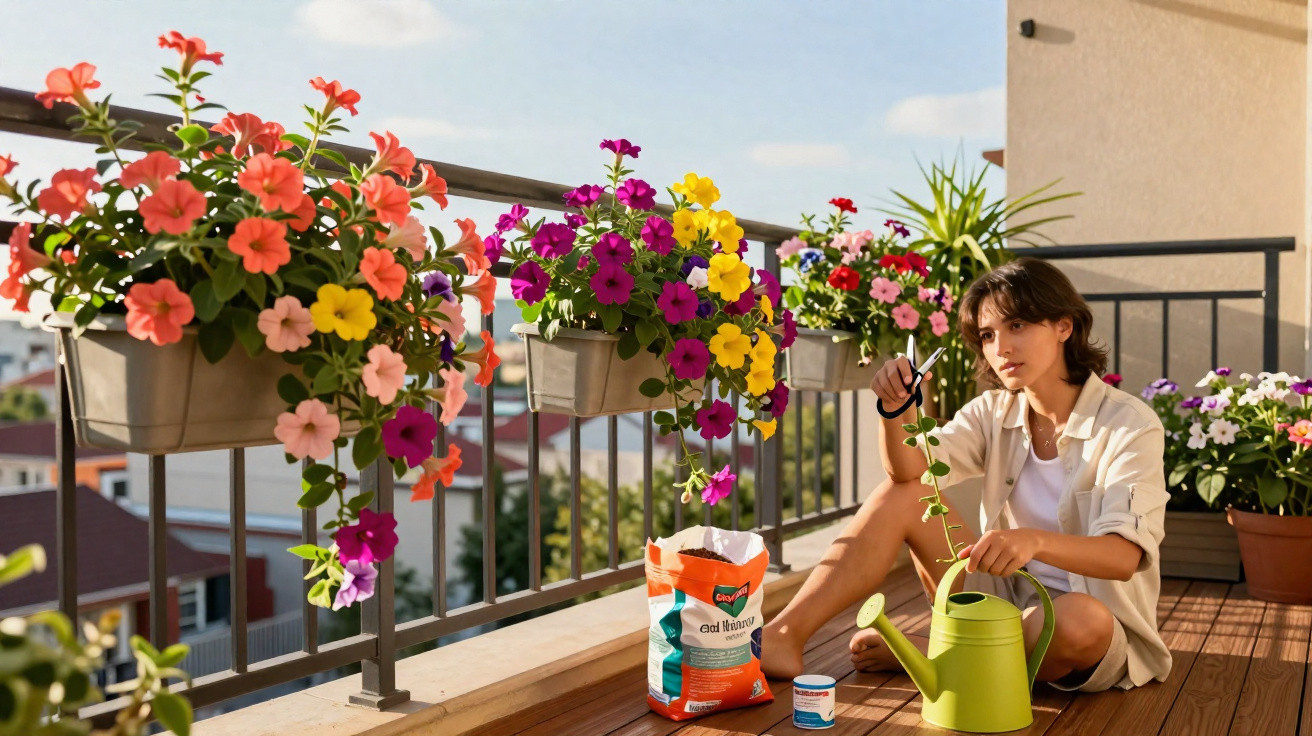
Many balcony gardeners know the disappointment: expensive window boxes, attractive pots and plants put in with high hopes - only for everything to look sparse by July. The good news is that one particular plant makes generously trailing displays in containers almost a certainty. The key lies in planting it at the right time and in the right way.
Calibrachoa: the star of cascading flowers
Anyone passing an especially lavish window box in summer has probably seen Calibrachoa without knowing its name. In garden centres, it is often sold as “Million Bells” or “mini petunia”. Botanically, it is closely related to the petunia, although it has a more delicate, compact appearance.
The plants create a dense, gently trailing cushion, around 15 to 30 centimetres tall and up to 60 centimetres wide. Throughout summer, this green cloud is covered in hundreds of small bell-shaped flowers, in colours ranging from white, yellow and orange to pink and red, as well as two-tone “camouflage” shades.
Calibrachoa turns plain window boxes into overflowing fountains of flowers - with a manageable amount of care.
One particularly useful benefit is that the plant cleans itself. Spent blooms drop away naturally, so there is no need to pick off dry flower heads every day with your fingertips. This keeps containers looking fresh, even when there is not time for daily gardening.
Breeders continually introduce new varieties. “Chameleon” types, whose flower colour changes as the season progresses - for example, from yellow to pink - are especially sought after. These effects mean the same window box can look entirely different in June from how it does in August, without replacing a single plant.
Spring planting time determines success
Calibrachoa enjoys warmth and is sensitive to cold. In cooler areas, it is therefore grown as a traditional summer bedding plant, with fresh plants added to pots and window boxes each year.
A useful rule is to plant once night frosts are no longer expected and temperatures have settled consistently above 8 to 10°C. Depending on the area, this can be anywhere from mid-April to late May.
- Planted too early: Roots stall in cold compost, and growth slows to a standstill.
- Planted too late: Plants will still establish, but have less time to develop a dense root system before the first heatwave arrives.
- Ideal timing: Plant straight after the final frosty nights, into well-warmed containers, then allow several weeks for rooting.
During this spring period, most of the important activity happens below the compost surface. Roots spread through the whole pot while shoots begin to lengthen. By July, they will trail clearly over the edge, creating the desired overflowing floral effect.
For a genuinely full display in a standard window box, use three to four young plants in a medium-sized container. Hanging baskets can be planted just as densely, helping them fill out more quickly and evenly.
Planting Calibrachoa in pots and hanging baskets
Calibrachoa is prone to waterlogging. The most important principle is therefore to choose a free-draining, airy growing medium rather than one that stays wet and heavy.
Choosing the container and compost
- Select a pot or window box with large drainage holes.
- Put a layer of expanded clay pellets or coarse gravel in the base.
- Add a high-quality, loose compost designed for window boxes or hanging baskets.
- Mix in a handful of perlite or sand if desired, to improve drainage.
Set plants at a depth where the upper part of the rootball is only just covered with compost. Leave a little room between plants, as they will quickly grow together. Water thoroughly after planting so the roots make good contact with the growing medium.
For Calibrachoa, a pot with excellent drainage matters more than its exact size.
Care for abundant flowers from May until the first frosts
Once the spring foundations are in place, ongoing care is straightforward. Three factors determine success: light, water and nutrients.
Position: sunshine, but not baking heat
Calibrachoa loves bright conditions and flowers most abundantly in full sun. However, plants can struggle at times on balconies exposed to fierce midday sun and heat radiating from walls. For many varieties, a spot with morning or evening sunshine and some shelter from hot winds is more suitable.
Watering correctly: never constantly wet, never bone dry
Keep the compost evenly and lightly moist, without allowing water to sit in a saucer. Ideally, let the top layer of compost dry slightly before watering again.
- In spring, watering every two to three days is often sufficient.
- During hot spells in high summer, daily watering may be necessary, especially for hanging baskets.
- Water in the morning where possible, so plants do not go into the night with wet foliage.
Anyone who travels frequently can use water-retaining fleece, clay watering cones or automatic irrigation systems. A reliable water supply is rewarded with consistently strong flowering.
Feeding: this plant is a heavy feeder
Calibrachoa is among the hungriest balcony plants. Nutrient reserves are quickly exhausted in a small container. Applying a base feed at planting time, such as a controlled-release fertiliser, provides a good starting point.
For continuous, abundant flowering, also add a liquid fertiliser for flowering plants to the water every two weeks. This helps shoots remain compact, leaves stay deep green and flower production continue without fading.
When Calibrachoa looks tired: a small trim with a big effect
By around mid-July, many window boxes begin to look a little untidy. A light trim can help at this point. Shorten selected shoots by around one centimetre or slightly more, spreading the cuts across the whole plant.
A light summer trim encourages fresh branching and a second wave of flowers into autumn.
After trimming, the plant produces new shoots from its leaf joints. Combined with a good feed, this prompts a renewed flush of flowers within a few weeks. The container can then remain attractive right up to the first frosty nights.
Colours, combinations and practical tips for balcony planting
Calibrachoa is available with single, semi-double and double flowers. Individual blooms may be smaller than those of classic petunias, but their massed effect is highly striking. By choosing colours carefully, it is possible to create particular moods:
- Yellow and orange: warm and Mediterranean, well suited to terracotta pots
- Pink and salmon: romantic, ideal against white house fronts
- Burgundy and violet: elegant and particularly effective with dark containers
- Two-tone varieties: lively, creating the impression of a mixed planting even on their own
It is also interesting to combine Calibrachoa with other trailing or cushion-forming plants. Particularly harmonious companions include:
- Silver-leaved partners such as dusty miller, which bring calm to bold colour mixes
- Scented plants such as heliotrope, which add fragrance to the abundance of flowers
- Structural plants such as ornamental grasses, which introduce height and movement to the arrangement
For gardeners with limited time, Calibrachoa is particularly useful because there is no deadheading work. Those who follow the basics - good timing, free-draining compost and regular feeding - can achieve, with comparatively little effort, a balcony display more commonly seen in garden catalogues.
One final note for gardeners who enjoy experimenting: in very mild areas, individual plants can survive winter in frost-free spaces, such as a bright garage or conservatory. In the UK, this is generally more of an experiment than a practical approach. Fresh young plants grow so rapidly in spring that most home gardeners prefer to start again each year - and look forward once more to their full summer cascade.
Comments
No comments yet. Be the first to comment!
Leave a Comment