
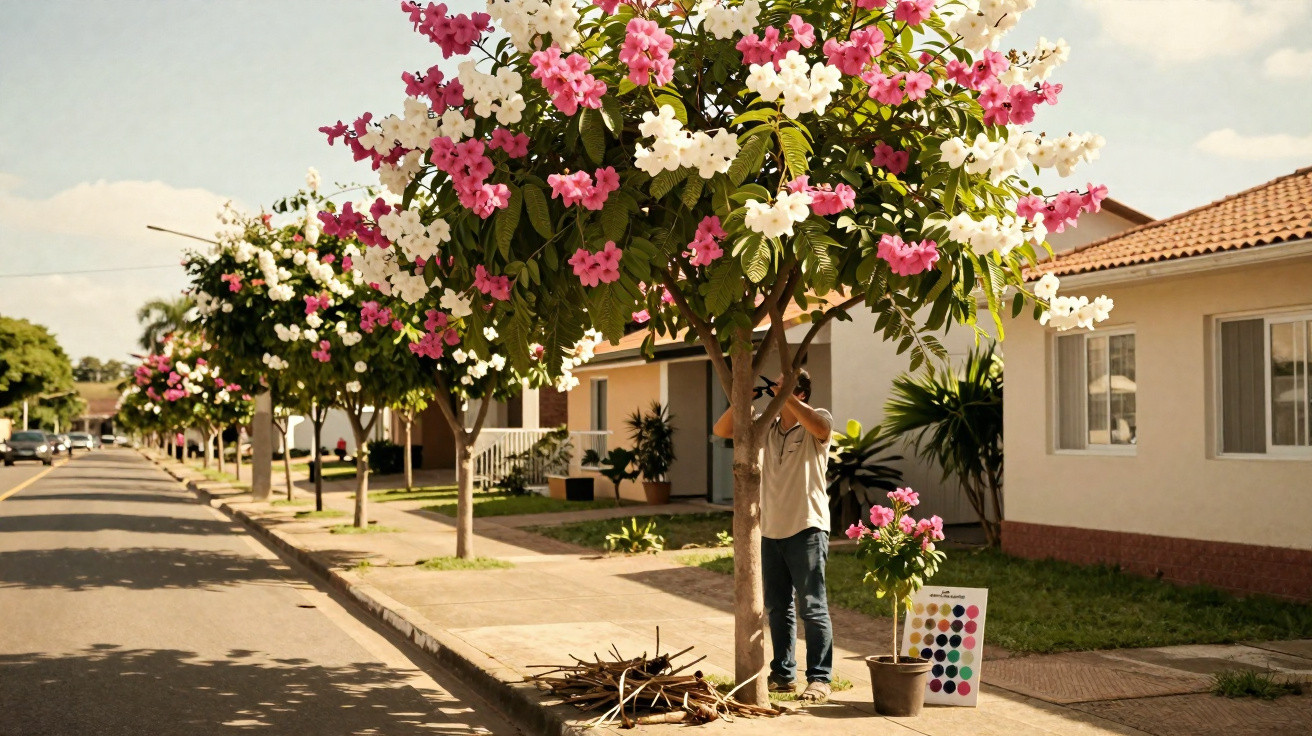
Anyone who has seen a pavement broken up by the roots of a poorly chosen tree knows that the mistake is expensive and can take years to put right. Selecting the right species for planting outside the house calls for attention to at least three practical factors: roots that will not damage the paving, tolerance of strong sunshine, and care requirements that will not consume every weekend. The Resedá (Lagerstroemia indica) meets all three requirements, while offering pink, lilac and white flowers that can turn any entrance into a striking scene.
The feature that sets the Resedá apart from most urban trees
The main issue with pavement trees in Brazil is not their size or flowering, but their root systems. Species with shallow roots spread horizontally just beneath the surface, lifting concrete within a few years and creating uneven ground that can cause pedestrians to trip while bringing costly repair bills for the property owner. The Resedá is entirely different: its roots grow downwards rather than sideways, keeping the surrounding paving intact even once the tree has matured.
This quality is no coincidence - it is closely linked to the soil and climate in which the species evolved. Native to East Asia, Lagerstroemia indica formed deep roots as a way of finding water during dry spells. In its native regions, this rooting habit was a survival adaptation; in Brazil's urban setting, it becomes a pavement-friendly advantage offered by very few ornamental trees.
- Pink, lilac and white flowers: dense clusters emerge in summer and remain for weeks, turning the canopy into a visual display that can be enjoyed at any time of day.
- Deep roots that do not damage paving: they grow downwards, not outwards, protecting pavements, surfaces and foundations for decades without intervention.
- Tolerates full sun and moderate drought: once properly established, it withstands intense Brazilian summer heat and rainless periods without losing vigour.
- Produces little debris: unlike many ornamental species commonly planted along Brazilian pavements, its flowers do not create a constant carpet that needs sweeping every day.
- Takes pruning well: it can be kept below its maximum height of six metres, making it suitable even for pavements with nearby overhead power lines.
Why the Resedá flowers more heavily after every pruning
One of the most valued traits of Lagerstroemia indica is the link between pruning and flowering. Unlike many species that need a long time to recover after being cut back, the Resedá reacts to winter pruning by producing an even more abundant flowering display in the following season. Cutting the tips of the branches encourages several side shoots, and every new shoot can become a flowering stem in the next spring and summer.
Prune in winter, when the plant is dormant and leafless in Brazil's colder regions. Cut back the branch tips, leaving only two or three pairs of buds, without cutting into the thicker, woodier part of the trunk. This is a task that anyone with pruning shears can carry out without professional help, and it ensures a denser canopy and far more generous flowering in the months ahead.
How to train the Resedá canopy in its first years for an attractive, practical result
The Resedá's eventual canopy shape depends greatly on what is done during the first two years after planting. At this stage, formative pruning determines whether the tree develops one strong, upright main trunk or branches near ground level like a shrub. For pavement planting, the aim is to encourage a single leading trunk and remove side branches appearing below 1.5 metres, leaving clear space for pedestrians once the canopy develops.
Resedá care calendar throughout the year
Four points in the year determine the plant's health and appearance.
Winter (June to August): this is the ideal time for cleaning and formative pruning, taking advantage of dormancy and the lack of leaves to see the branch structure clearly. Early spring (September): apply a phosphorus-rich compost to encourage the formation of flower buds. Summer (October to March): the main flowering period - water regularly during exceptionally hot days and check new shoots for aphids.
Autumn (April and May): a season of lower activity, suitable for assessing the plant's overall condition, inspecting the base of the trunk for signs of fungi, and preparing the surrounding soil for the coming winter pruning. Apart from these occasional tasks, the Resedá needs virtually no attention, making it ideal for anyone who wants attractive landscaping without a weekly maintenance commitment.
Plant it at least two metres from the pavement and no less than three metres from other trees, so the canopies will not overlap when both are fully grown. On narrower pavements, upright training combined with more frequent pruning keeps the canopy compact and well above pedestrian head height without diminishing the plant's appearance.
What to check when buying a sapling and choosing a colour
Resedá flower colour is genetically determined, and saplings of unknown origin may not produce the shade expected - the surprise will only become clear at the first flowering, which can take a year or longer. For this reason, anyone wanting the intense pink, soft lilac or pure white planned for the front of the house should always buy from reputable nurseries.
When choosing a sapling, check that the trunk is firm and straight, the leaves are green and unmarked, and the growing medium in the pot does not smell rotten. Saplings with trunks at least two centimetres in diameter establish themselves more quickly in their permanent position and reach their first flowering sooner than very young, slender plants.
Why the Resedá has adapted so successfully to Brazil's climate
The species' Asian origins clearly explain its suitability for Brazil. The warm, humid climate of Brazil's south-east and central-west resembles the conditions in East Asia where the plant evolved. It copes with the intense heat and high ultraviolet radiation of the summer months without leaf scorch or loss of vigour, and, once established in its final position, it tolerates moderately dry spells without constant watering.
In the colder areas of southern Brazil, the Resedá sheds its leaves in winter and regains them vigorously in spring - a cycle that creates visual change throughout the year and makes its flowering even more dramatic when it arrives after months of bare branches. It is a tree that solves three issues at once - paving, sunshine and maintenance - while also bringing flowers to the front of the house. Share this with anyone considering planting a tree but unsure where to begin.

Comments
No comments yet. Be the first to comment!
Leave a Comment