
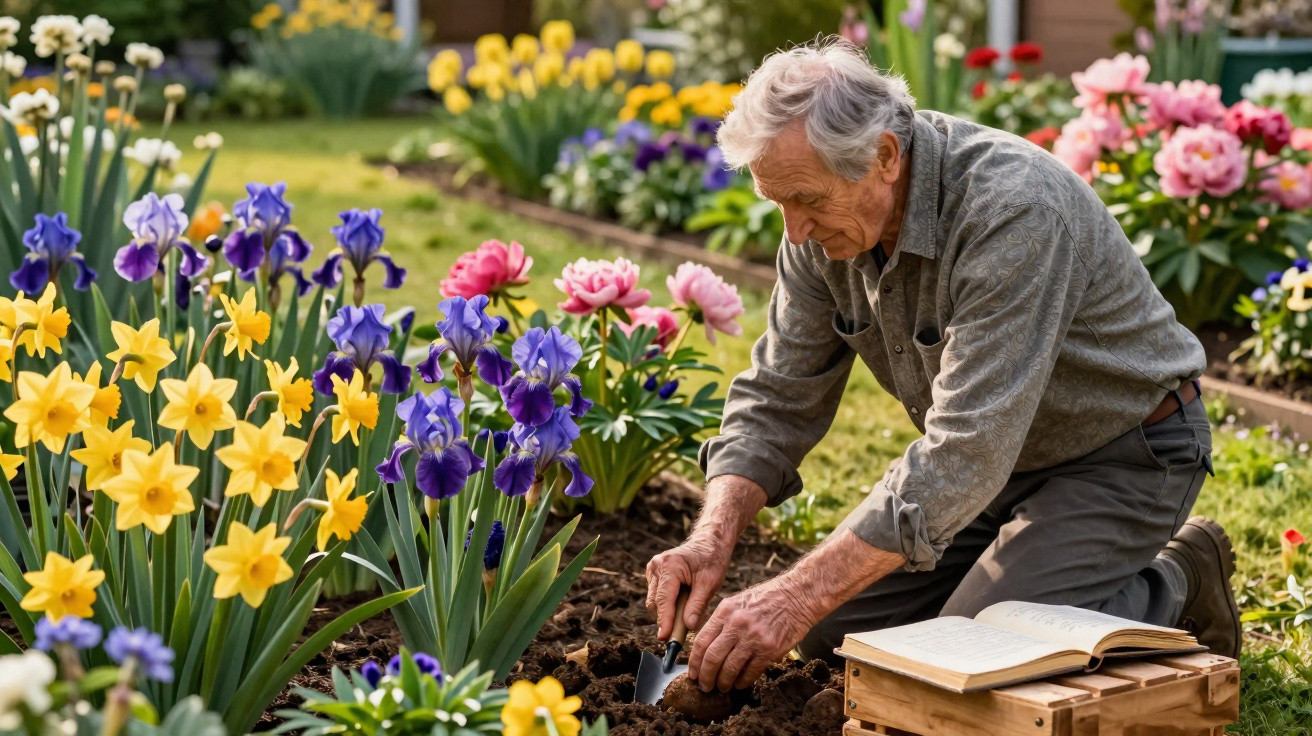
Anyone who buys, carries home, plants and waters vast numbers of young plants every spring may not realise just how much work can be avoided. Some plants need planting only once, then return dependably each year for years or even decades, becoming more attractive as time goes on.
Why long-flowering perennials save so much garden work
After a long winter, the garden can look bleak: bare soil and empty beds everywhere. Yet nature is already working at full speed, albeit out of sight. Beneath the surface, roots, rhizomes and bulbs are waiting for milder weather before they begin growing. Choosing perennial plants makes use of precisely this natural cycle.
“Perennials are the garden’s quiet pension plan: planted wisely once, they repay you with flowers year after year.”
Unlike annuals, which disappear after one season, perennials withstand frost, heat and rain. In autumn they die back, store their reserves below ground and begin again in spring. Gardeners with years of experience value these “multi-year contracts” with their borders, not simply for convenience, but because they make it far easier to create a balanced, resilient garden.
Perennials instead of throwaway flowers: how the principle works
Many amateur gardeners habitually choose geraniums, petunias or other traditional seasonal flowers. They can look spectacular in their first year, but need continual attention and are discarded at the end of the season. Perennials, by contrast, direct their energy into building roots and structures that help them survive from one year to the next.
Three groups are especially important:
- Long-lived perennials with rootstocks, such as peonies
- Rhizome-forming perennials, which spread through underground shoots, including many irises
- Perennial bulb plants, which gradually multiply beneath the soil, such as daffodils and botanical tulips
Using these types of plant means designing a border for the long term. Rather than starting from scratch every year, you gradually establish a framework of dependable plants that return season after season.
The reliable border favourite: easy-care daffodils
Daffodils are among the most dependable early-flowering plants available. Once planted correctly, they form dense clumps over the years and widen naturally without intervention. They bring colour to borders in early spring, often while the rest of the garden is still only half awake.
How to plant daffodils correctly
Experienced gardeners follow one straightforward rule: plant bulbs at a depth roughly three times their height. A bulb measuring 5 centimetres high should therefore be planted around 15 centimetres deep.
- Planting time: autumn, ideally from September to November
- Position: full sun to partial shade
- Soil: loose, free-draining and not prone to waterlogging
- Spacing: planting groups of five to seven bulbs creates a particularly natural-looking result
Daffodils are suitable not only for borders, but also for lawns, front gardens and containers. If the foliage is left to die back naturally after flowering, the bulbs can build up enough energy for the following spring.
Irises: an explosion of colour with lasting power
Bearded irises, botanically Iris germanica, add height and structure to perennial borders. Their stiff, fan-shaped leaves and often scented flowers in blue, yellow, white or violet look almost like miniature works of art.
The secret to their durability lies in their rhizomes. These are thickened, horizontally growing shoots positioned close to the soil surface. They store nutrients and water, making the plants remarkably tolerant of dry conditions.
Professional tips for irises
- Never plant rhizomes too deeply; they may remain slightly visible at the surface.
- Divide and replant overcrowded clumps every few years after flowering.
- Full sun produces the most abundant display of flowers.
- Avoid waterlogged conditions completely, as the rhizomes will rot.
Combining different varieties can extend the flowering period from May into July. Paired with peonies, they create elegant, almost painterly planting schemes.
Peonies: the classic plants Grandmother already knew
Few perennials represent longevity as clearly as the traditional peony. Many gardens contain plants that have occupied the same spot for more than 40 or 50 years. They do not stop flowering; on the contrary, they often become more magnificent with age.
Their lavish blooms can exceed 15 centimetres in diameter. Colours range from pure white and pink through to rich dark red. Correct planting is essential: the rootstock must not be positioned too deeply in the ground.
“Peonies are sensitive when settling in, but faithful once established: plant them properly once and you will not need to touch them for decades.”
The buds should sit just below the surface. If they are planted deeper than two to three centimetres, the plants often produce very few flowers. A bright site that is not excessively wet also helps.
Self-seeders: annual visitors that return on their own
An experienced gardener does not rely solely on classic perennials. Certain annuals also earn their place because they reappear in the border each year from their own seed. This keeps the garden lively without the need for constant replanting.
Typical self-seeding flowers include:
- Cornflowers (Centaurea)
- Cosmos
- Love-in-a-mist (Nigella)
- Sunflowers, particularly shorter varieties
The method is almost absurdly simple: do not remove every faded flower immediately. Allow some seed heads to ripen and drop their seeds onto the ground. Birds will take their share, while the remainder germinates the following spring.
Keep containers in bloom for weeks with layered planting
The principle of long-lasting planting can also be used in containers. Experienced gardeners often create “layered pots”, placing several types of flowering bulb one above another. This significantly lengthens the display period.
| Layer | Plant | Flowering period (approximately) |
|---|---|---|
| Top, just below the surface | Grape hyacinths (Muscari) | January to March |
| Middle layer | Daffodils | February to April |
| Lowest layer | Tulips | April to May |
A single container can therefore become a small stage of flowers that lasts for several months. It reduces the workload while also making balconies and patios more appealing in the long term.
Common mistakes that hold back long-lived bloomers
Many issues with perennials and bulb plants arise from minor, easily avoided errors:
- Too much water: waterlogging causes bulbs and rhizomes to rot.
- Overly rich soil: excessive nitrogen produces plenty of foliage but few flowers.
- Impatience: some perennials need two to three years before reaching their full flowering potential.
- Constant hoeing in perennial borders: deep digging damages rhizomes and bulbs.
Gardeners who keep cultivation light and avoid disturbing the soil unnecessarily, while allowing plants time to establish, will have a garden that looks more harmonious with every passing year.
How an experienced gardener plans borders for the long term
After decades of gardening, it becomes clear that the most successful borders are often surprisingly simple in design. A tried-and-tested basic approach looks like this:
- Choose the structural plants: use a small number of tough perennials, such as peonies and irises.
- Scatter spring flowers throughout: add daffodils, grape hyacinths and early tulips.
- Allow self-seeders to appear: cosmos, cornflowers or Nigella provide spontaneous effects.
- Accept gaps deliberately: these will gradually fill in by themselves.
The result is a garden that does not look rigidly composed, but natural, lively and surprisingly low-maintenance. Many jobs shift away from buying plants and towards observation and the occasional adjustment.
Why switching to perennials pays off in the long run
Changing from seasonal plants to long-lived perennials and flowering bulbs does more than save money. It also cuts the time required considerably, while the garden manages with fewer resources such as water and fertiliser. There is another benefit too: many of these plants provide plentiful nectar and pollen, helping bees, bumblebees and other insects.
With a little planning, a few robust classics and a willingness to place more trust in nature, a high-maintenance border can become a garden that largely looks after itself and delivers reliable flowers year after year.




Comments
No comments yet. Be the first to comment!
Leave a Comment