
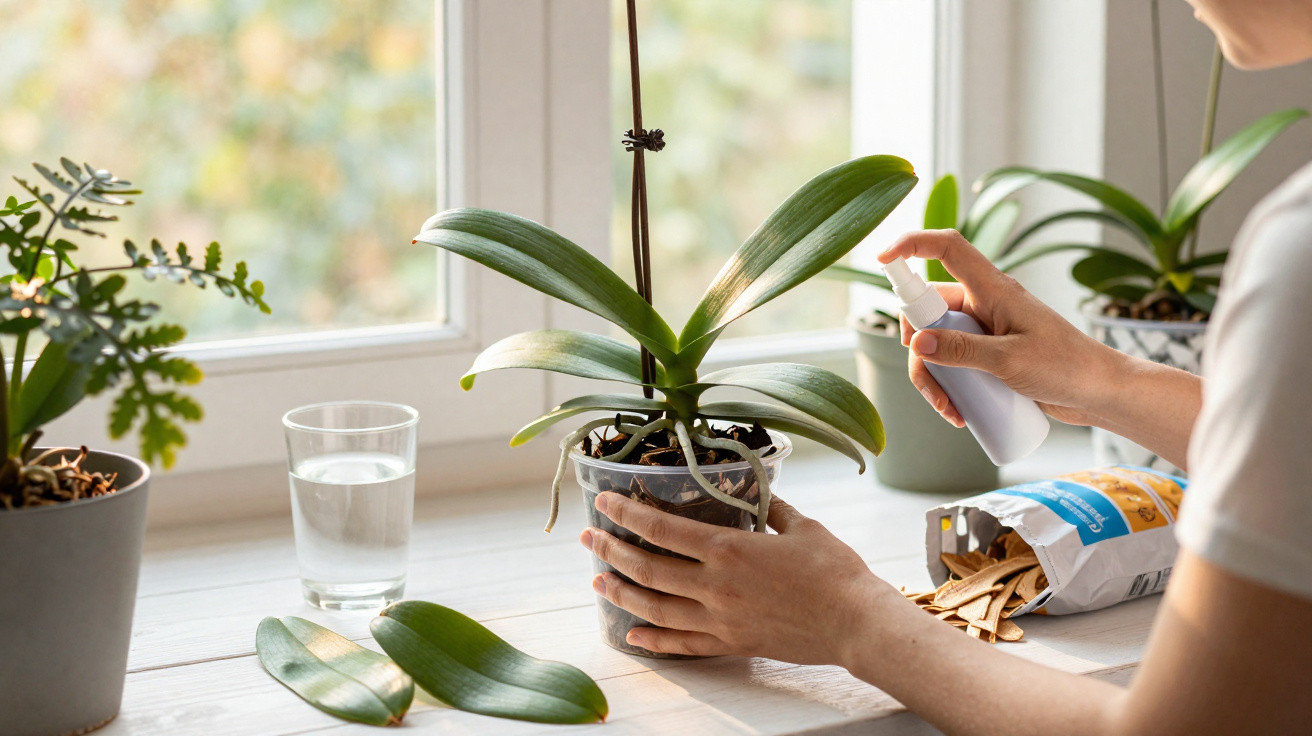
Seeing an orchid suddenly shed leaves can worry any grower. While it is natural for older leaves to drop over time, rapid or heavy leaf loss usually signals that the plant is experiencing a cultivation issue. Overwatering, damaged roots, sudden temperature changes and insufficient light are among the most frequent causes. The encouraging news is that many orchids can recover when the cause is spotted promptly.
Why do orchid leaves suddenly fall off?
The roots are often the primary source of the problem. If they stay waterlogged for too long, they rot and can no longer take up water or nutrients. As a result, the leaves become soft, turn yellow and fall away.
Abrupt changes in conditions, severe cold, excessive heat, scorching from direct sunlight, and fungal or bacterial attacks may also lead to this symptom.
How can you identify the cause of the problem?
Before taking action, inspect the entire plant closely. Its roots, leaves and growing medium can offer important clues about the cause.
The earlier the issue is recognised, the better the chances of recovery.
- Check whether the roots are green and firm, or dark and soft.
- See whether the growing medium remains saturated for several days.
- Look for black or yellow patches, or rotting areas, on the leaves.
- Ensure the plant is receiving enough indirect light.
- Consider whether it has recently been moved or exposed to a temperature change.
- Inspect it for insects or fungi.
How to revive an orchid with falling leaves
Where roots are rotten, remove the orchid from its pot, discard all the old growing medium and use sterilised scissors to cut away only the affected roots.
Then repot it in a suitable orchid medium, such as pine bark, horticultural charcoal or coconut fibre. Wait a few days before watering for the first time, allowing the cut roots to heal. Adjusting the light levels and preventing overwatering are equally important.
- Water only once the growing medium is nearly dry.
- Choose pots with excellent drainage.
- Do not allow water to collect in the saucer.
- Stop fertilising until fresh growth appears.
- Maintain good air circulation around the plant.
- Remove leaves that are completely dry or rotten.
When is leaf loss normal in an orchid?
For certain species, especially when the oldest leaf is being replaced by a new one, leaf drop forms part of the plant’s natural cycle. In these situations, just one ageing leaf dries out gradually before falling, while the rest of the orchid remains healthy.
However, if several leaves fall within a short period or the stem starts to darken, the issue requires immediate attention to prevent the plant from being lost.




Comments
No comments yet. Be the first to comment!
Leave a Comment