
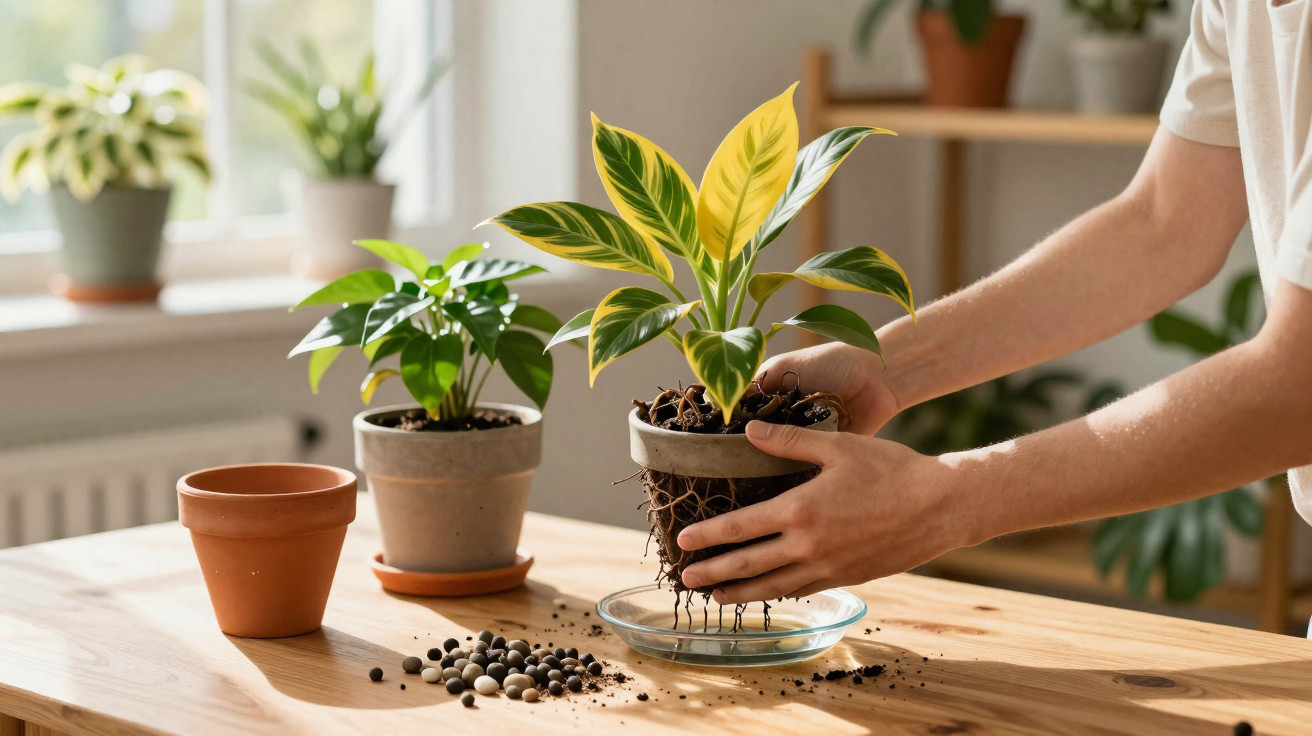
From across the room, Emma’s lounge could have been lifted straight from a Pinterest mood board: hanging planters, terracotta pots, and a small jungle gathered by the window. Every three days, without fail, she watered with care-exactly as the blogs advised. The compost felt moist. The light was good. On Instagram, it all read as effortless.
Closer up, the illusion fell apart. Leaves that had once been richly green were washing out into a weak yellow, one after another. Her ficus was shedding foliage like weary confetti. A peace lily sat in the corner looking offended, with crisping edges and veins that had lost their colour. Emma reacted the way most of us do: first she blamed herself… then she blamed the watering can.
She experimented. More water. Less water. Watering first thing. Watering at night. Fresh fertiliser. A new pot. Nothing held for long; the yellowing returned like a stubborn habit.
The real cause was there the whole time, quietly hiding in plain sight.
The detail your watering routine can’t fix
When leaves go yellow, most people jump to a single conclusion: “I’m watering wrong.” So they tweak the tap, shuffle schedules, and download reminder apps. It feels logical-plants need water, leaves look unhappy, so water must be the issue. Yet, very often, it isn’t.
What’s easy to miss is the bit that sits between the roots and the outside world: the drainage holes, the saucer that always has a little water left in it, or the plastic nursery pot tucked inside a nicer cachepot with nowhere for excess to go. The water doesn’t look alarming. It simply lingers.
And that quiet puddle is usually where the problems begin.
James is a perfect example. He once proudly showed me his monstera, a lockdown purchase that had turned into a statement plant. Huge, glossy leaves framed his sofa like something from a magazine shoot. Then, about a year in, the yellowing started-one leaf, then two, then five.
He got nervous and cut back on watering. The surface compost felt dry, so he sometimes left it a full week. The leaves still yellowed. He bought an expensive “plant health” spray. No improvement. Eventually, he admitted he was close to giving up on big plants entirely.
When we finally lifted the monstera out of its decorative pot, the mystery was solved in seconds. The inner pot was sitting in a hidden bath of stagnant water, perhaps two centimetres deep. The lowest roots were brown and soft; rot had already set in. The plant wasn’t parched-it was drowning from the bottom up.
Plants don’t just drink through their roots; they also need to breathe through them. Roots rely on air spaces in the compost to work properly. When water fills those gaps, the roots suffocate. Suffocation leads to rot, rot blocks nutrient and moisture uptake, and once roots fail, leaves start to turn yellow.
To make it more confusing, the compost on top can look dry and convince you the plant is thirsty. Down at the base of the pot, though, it can be boggy. That’s why “just water less” isn’t always a solution. If water can’t escape freely, the roots remain trapped in an unhealthy, airless layer.
So while we fixate on watering frequency, the overlooked detail is painfully straightforward: poor drainage and oxygen-starved compost can undermine plants that appear “well looked after” on the surface.
How to rescue your plants from invisible drowning
Want the fastest check? The next time you water, pay attention to the first thirty seconds. Water should begin running from the drainage holes almost straight away-not dribbling out five minutes later in a miserable trickle. If nothing drains, or if the pot sits in a saucer that never gets emptied, you’ve likely found your yellow-leaf smoking gun.
Begin with the container itself. Any genuinely functional plant pot needs drainage holes-even that lovely ceramic one. If it doesn’t have them, use it purely as an outer cachepot and keep the plant in a plastic nursery pot inside, leaving space underneath for runoff. Then tip that runoff away every time you water. Yes, every time. Let’s be honest: nobody truly does this without fail, but doing it most of the time can still change everything.
Next, assess the compost. Dense garden soil or a cheap, compacted mix holds moisture and starves the roots of air. Switching to a lighter blend-amended with perlite, bark, or sand-returns oxygen to the root zone. That unseen airflow is often exactly what yellowing leaves are asking for.
A subtle mistake many people make is assuming one compost suits every plant. They buy a large bag of generic potting mix and use it for everything: cacti, peace lilies, herbs, ficus. Some plants can’t stand a thick, sponge-like medium; others prefer a bit more moisture. When the match is wrong, drainage stops helping and starts harming.
Most of us have had this moment: you lift the pot and it feels oddly heavy even though the surface looks bone dry. That usually means deeper layers are still holding water like a soaked sponge. In that scenario, watering less only makes the top dusty while the bottom stays flooded-leaving the plant stressed from both ends.
If you gently slide the plant from its pot and notice roots tightly circling, with dark, mushy patches, root rot is already underway. Cutting away the rotten sections, repotting into a slightly larger container with a more open mix, and giving the plant time to recover is often the difference between a slow decline and a quiet comeback.
“Most people think they’re bad with plants,” a London plant shop owner told me one afternoon, “but what they really have is bad drainage and heavy soil.” Her comment stayed with me, because it shifts the blame from a vague idea of a “black thumb” to something practical you can actually fix.
Once you start looking at the bottom of the pot first, a lot of plant mysteries stop being mysteries at all. That’s also where a few small routines make an outsized difference. Lift the pot before and after watering to learn the weight change. Leave at least a few centimetres between the compost surface and the rim so water doesn’t simply spill over the edge. And if your plant lives inside a cover pot, lift the inner pot every couple of days and pour away any standing water.
“Yellow leaves are your plant whispering, not screaming,” the same shop owner added. “They’re saying: something’s off down here, at the roots. Don’t just talk to the leaves.”
- Choose pots with proper drainage holes, not only “decorative” bases.
- Use lighter, airier compost mixes for indoor plants, especially tropicals.
- Empty saucers and cachepots after every watering.
- Check root condition every few months by gently sliding the plant out.
- Let the top few centimetres of compost dry before watering again.
When yellow leaves become a useful conversation
Once you understand that waterlogging and suffocated roots often sit behind yellowing, the way you relate to your plants shifts slightly. Each fading leaf stops feeling like a personal failing. Instead, it becomes information-a clue about what’s happening where you can’t see. That change alone makes plant care feel less like guesswork and more like a quiet partnership.
You may start spotting patterns you’d overlooked. The pothos by a north-facing window that stays flawless on the same watering rhythm that ruins a fiddle-leaf fig planted in a heavier pot beside the heater. The peace lily that dramatically droops when it’s thirsty, yet turns yellow if it’s left in a puddle for two days. Every plant shows you its own limit.
And then the “embarrassing” question-why do my plants keep turning yellow even though I water them regularly?-turns into something you can almost enjoy testing. You lift pots, prod the compost, repot one or two, perhaps change the mix. You mention it to a friend who’s also been quietly losing plants and feeling a bit guilty. Those small experiments, shared along with the modest wins that follow, are often how a private frustration becomes a shared language of care.
| Key point | Detail | Benefit to the reader |
|---|---|---|
| Pot drainage | Pots without holes, or saucers that are always full, create a permanent bath | Spot a hidden cause of yellowing even when watering seems “correct” |
| Compost structure | Compost that’s too heavy and compact holds water and suffocates roots | Know when to change compost to save a struggling plant |
| Reading the signs | Pot weight, root appearance, and how quickly water drains | Learn to diagnose root problems before it’s too late |
FAQ:
- Are yellow leaves always a sign of overwatering? Not necessarily. Overwatering and poor drainage are common causes, but leaf age, insufficient light, pests, or nutrient shortages can also trigger yellowing. Start by checking the roots and how quickly water drains.
- Should I cut off yellow leaves from my plant? Yes. Once a leaf has turned fully yellow, it won’t become green again. Removing it helps the plant focus energy on healthy growth and makes it easier to notice fresh problems.
- How often should I repot to prevent root problems? Most indoor plants benefit from repotting every 1–2 years. If roots are tightly circling or emerging through drainage holes, that’s a clear sign the plant needs more room and fresher compost.
- Is misting leaves helpful for yellowing plants? Misting can increase local humidity for tropical plants, but it won’t resolve root rot or fix poor drainage. If roots are suffocating, misting won’t stop the yellowing.
- Can a plant recover from root rot caused by bad drainage? Often, yes. Remove mushy roots, repot into fresh, airy compost, and allow the plant to dry slightly between waterings. New growth that appears green and firm is a strong sign of recovery.
Comments
No comments yet. Be the first to comment!
Leave a Comment