
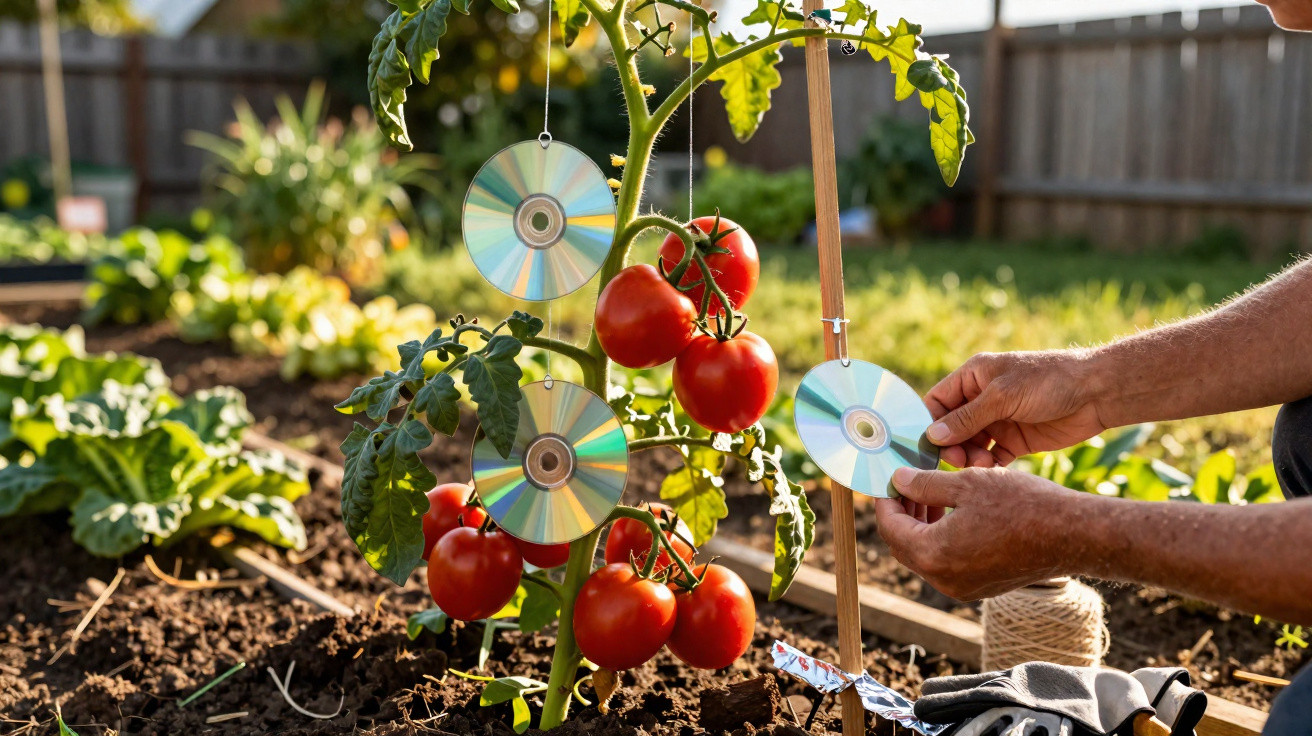
Hanging old CDs on a tomato plant is a straightforward way to guard nearly ripe fruit without using chemical products. The light bouncing off the discs creates shifting flashes that unsettle birds and can cut down attacks before harvest and ripening.
What is the point of hanging CDs on a tomato plant?
This technique works like a homemade visual scarecrow. Traditional scarecrows are used to deter birds from crops, and CDs rely on the same principle by producing reflections that disrupt the birds’ sense of security.
As the disc catches sunlight and sways in the breeze, it throws bright glints in multiple directions. That changing movement can confuse birds approaching the tomatoes, making the patch feel less inviting for pecking at ripe fruit.
The key parts of the trick are:
- Reflection: the shiny surface produces flashes when it catches the sun.
- Wind: it works best when the disc can spin or swing.
- Tomatoes: it is most protective for fruit that is close to harvest.
- Height: hanging it above the plant increases how far the reflections travel.
- Combination: aluminium foil strips can strengthen the visual effect.
When is this trick worth using in the garden?
The most effective time is when tomatoes start to colour up and become more tempting to birds. Earlier on, you may not need it as much, but as harvest approaches, this visual deterrent can help prevent losses from pecking and damage.
It is also useful in open gardens, sunny balconies, back gardens with nearby trees, or anywhere birds already visit often. In places with little wind or limited direct sunlight, CDs may have a more limited effect.
How do you hang CDs without harming the tomato plant?
It is best to attach CDs to a stake, support wire, fence, or a nearby frame-rather than tying them directly to the tomato plant’s more delicate stems. This way, the disc can move freely without snapping branches, flowers, or trusses of tomatoes.
Moving reflections
The disc needs to swing to attract attention
A CD that stays still loses part of its impact, because birds may get used to it.
Hang it on thin string, leave room for it to rotate, and move it every few days if needed.
Use string, nylon line, or thin wire, keeping the disc suspended a few centimetres above the fruit. If you have more than one tomato plant, spread the discs across the area rather than clustering them in one spot of the garden or bed.
For a better set-up:
- Hang the CD above the height of the fruit.
- Leave enough space for the disc to spin in the wind.
- Avoid letting the disc touch leaves and fragile stems.
- Change its position if birds start to ignore it.
Why combine CDs with aluminium foil?
A CD produces circular reflections, but aluminium foil strips increase the number of bright points in the garden. When both elements move together, the area becomes more visually unpredictable for birds trying to reach ripe tomatoes.
This pairing often works better than relying on a single object that barely moves. The foil’s irregular flutter, alongside the disc’s shine, makes it harder for birds to adapt and extends protection in small gardens, pots, and sunny balconies.
Other easy reinforcements include:
- Reflective tape fixed to stakes.
- Small pinwheels near the bed.
- Light mesh placed over almost-ripe fruit.
- Regularly moving the objects to new positions.
What precautions make the trick more effective?
The CD method performs best as a preventative measure, not as the only solution. Where bird pressure is high, you may need to combine reflections, netting, and other simple barriers-similar to approaches used to deter pigeons from a roof or garden without resorting to harsh methods.
It is also important to remove broken CDs, avoid sharp edges, and not leave loose lines where animals could get tangled. With the right height, some breeze, direct sunlight, and a mix of reflective materials, the trick can help protect tomatoes at low cost.




Comments
No comments yet. Be the first to comment!
Leave a Comment