
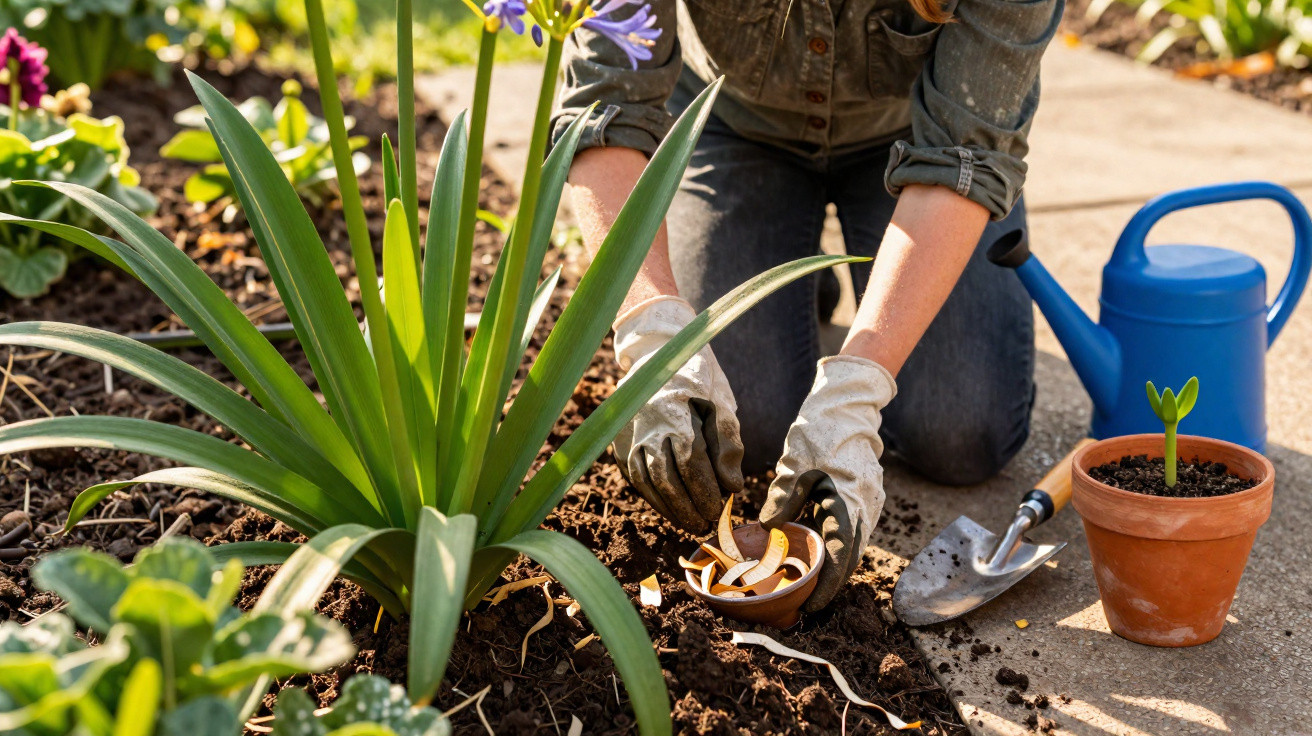
If you pick up a hand fork for a quick tidy-up in March, you can enjoy spectacularly tall flower heads on your Agapanthus in summer – without any chemicals.
Many amateur gardeners see the same problem: plenty of lush leaves, but only a few flower globes on the Agapanthus – or blooms that stay disappointingly small. The cause is often not the variety at all, but mistimed care. In the short window leading up to the end of March, the plant effectively decides whether to pour its energy into foliage or into strong flower stems – and that is exactly where a simple, targeted gardening trick makes the difference.
Why late winter determines flower-stem height
Agapanthus (also known as African lily) gets going very early in the year. As soon as the days lengthen and the soil warms slightly, buds and surface roots wake up. At this point, the plant is essentially setting how powerfully its flowering stems will develop.
Depending on the variety, stems may reach only 30–40 centimetres or rise to an impressive 1.20 metres. Those firework-like flower balls hovering above the leaves do not happen by chance. They depend on how well the plant is supported and directed right at the start of the growth phase.
"Anyone who gives their Agapanthus the right ‘push’ around the start of March directs its energy into sturdy, long flower stems instead of excessive foliage."
Professional ornamental growers use this principle deliberately: the key moment is when the plant comes out of winter dormancy. In most gardens, that is usually the period up to the end of March – although in colder areas it can shift a little later.
The P–K trick: how to get gigantic flower stems on Agapanthus
1. A quick spring clean around the plant
Start with a thorough but brief spring tidy. In March, remove dead and yellowing leaves, old foliage and plant debris. Cut any old flower stems that are still standing right down near ground level. It may look like a small job, but it brings two clear benefits: the plant stops wasting energy on old growth, and you open up space and airflow for fresh shoots.
2. Gentle loosening – the famous “push-start” feeling
Next, loosen the soil around the base. Use a small hand fork and scratch only 3–5 centimetres deep. Crucial point: do not cut into the thick, fleshy roots. The aim is simply to break up the hardened winter surface.
- break the crust so water can soak in properly
- wake up soil organisms
- create fine channels so nutrients reach the active roots directly
This small soil disturbance acts almost like an energy boost: the roots get air again and can take up new nutrients much faster.
3. Phosphorus and potassium instead of a leaf-boosting feed
Now comes the real driver for long flower stems. Rather than using a generic all-purpose fertiliser, you deliberately favour phosphorus (P) and potassium (K). The basic sequence:
- Spread 1–2 handfuls of mature compost or worm compost per plant over the loosened area.
- Sprinkle a thin layer of sieved wood ash on top – it supplies potassium for firm, strong stems.
- Then add a very light dusting of compost so the ash does not blow away.
What to avoid at this stage: strongly nitrogen-heavy feeds. They mainly fuel leaf production. The result is lots of attractive foliage, but weak blooms – or no flowers at all.
"If you give too much nitrogen in March, you only feed the leaves. If you focus on phosphorus and potassium, you feed the flowers."
Finish with a thin organic mulch layer, such as flax or hemp shives, about 2 centimetres deep. A slow, thorough watering carries nutrients into the root zone and helps keep moisture steady.
Banana as a secret weapon from the kitchen
A popular garden hack is chopped banana peel. Cut it into cubes of about 1 centimetre, work it in very shallowly and cover with a little soil. As it breaks down, it releases potassium – ideal for robust stems and flower heads that stand up well.
Agapanthus in pots or in the ground: how to adapt your care
African lily in a pot: spot the lack of space in time
In a pot, Agapanthus can hit its limits quickly. After about three years, many containers are completely filled with roots. The compost can shrink into a hard block, water runs down the sides, and the plant ends up underfed – even though you are watering.
Typical signs:
- watering runs straight out of the drainage holes
- only thin, short flower stems, often under 30 centimetres
- stems bend over with the first stronger gust of wind
If the root ball is not yet fully matted, the P–K programme with compost, wood ash, top-dressing (surfaçage – a fresh layer applied on the surface) and mulch is usually enough. If the pot is basically one solid mass of roots, the only remedy is a slightly larger container with a drainage hole. After repotting, use the same March approach.
Agapanthus in the ground: divide rather than let it choke
In borders, start as soon as the soil is no longer icy cold. Begin with the spring clean, then apply the nutrient package. If the clump gets bigger each year, roots can start pushing up towards the surface – a sign the plant is becoming too crowded.
In that case, dividing in March is worthwhile:
- Dig up the plant and gently free the crown from the soil.
- Split it into several pieces using a sharp spade or knife.
- Each division should have its own roots and 1–2 strong buds.
- Replant the sections, water well, and mulch lightly.
This rejuvenates the planting and ensures fresh, strong flowering shoots can form, rather than the plant producing only a dense cushion of leaves.
What if March has already passed?
If you miss the ideal window, there is no need to write your Agapanthus off. What matters is not the date on the calendar, but the plant’s real “wake-up phase”. As soon as new leaf tips appear and the soil is no longer freezing, you can catch up: loosen lightly, apply a P–K-leaning nutrient mix, mulch thinly and water well.
In pots, new growth often begins slightly earlier than in the ground because the container warms up faster. It is worth checking the centre of the plant regularly. The moment fresh green pushes through, the timing is spot on.
Summer care: keeping the display going throughout your holiday
In summer, Agapanthus thrives in sun with even moisture. In the ground, rainfall is often enough in normal conditions, but you will need to step in during long dry spells. In pots, watering is far more critical: the plant needs regular drinks, but it does not tolerate sitting in water in a saucer. Tip away any excess after a few minutes.
Cut faded stems out completely. That stops seed production and lets the plant rebuild energy. In containers, a liquid feed for flowering plants is also recommended, dosed exactly as the packet instructs. If you find your Agapanthus keeps producing leaves despite good care, reassess the nutrient balance: too much nitrogen, too little potassium – and the flowers quickly disappear.
Practical tips for different regions and gardener types
In cooler areas, the right time window often shifts towards early April. The key is that the soil should no longer be soaking wet and icy cold. In very mild regions, you can begin as early as late February once dormancy has clearly ended.
For gardeners short on time, a simple yearly plan works well:
- once a year in spring: tidy, loosen, apply P–K, mulch
- in summer: water regularly and remove spent stems
- every few years: change the pot or divide clumps
One term that often causes confusion: worm compost (lombricompost) is simply organic waste processed by compost worms. It is very nutrient-rich, gentle on plants, and ideal for surface applications, especially in pots and containers.
If you like to combine garden jobs, build the March trick into your routine: while preparing beds, chitting potatoes or cutting back perennials, give your Agapanthus its targeted power package. The time investment is modest, but the summer impact is far more noticeable: big, stable flower balls that turn any garden seating area into a small stage.

Comments
No comments yet. Be the first to comment!
Leave a Comment