
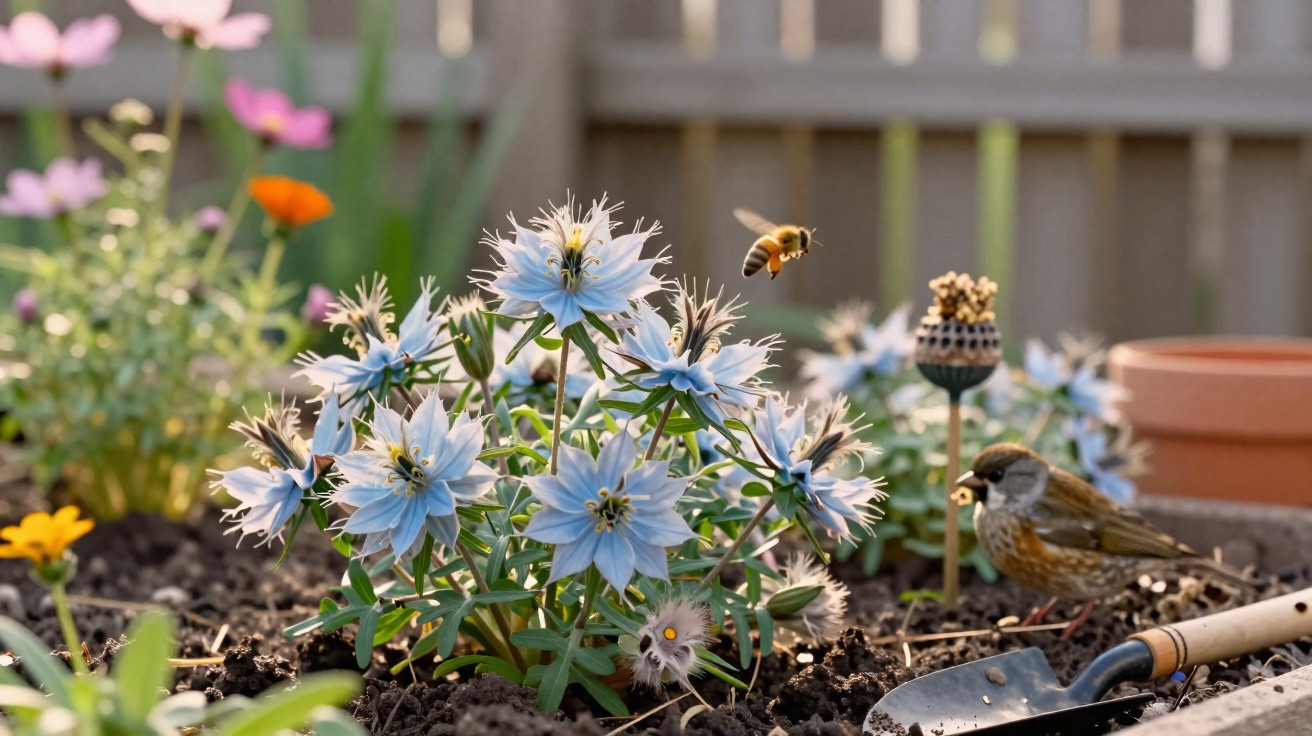
As the first proper spring sunshine returns, borders can suddenly feel bare and unfinished.
In gardens, on balconies and in shared courtyards, plenty of people want planting that looks romantic, costs little and genuinely helps wildlife. One modest annual you can sow as early as March does all of that with minimal effort: it offers food for bees, cover for small birds and asks very little in return.
A delicate flower with a wild, slightly tangled charm
Nigella damascena, the airy annual that looks like a cloud
The plant to make the most of this early-spring window is Nigella damascena, better known as love-in-a-mist. Long associated with cottage gardens, it has come back into favour as more gardeners lean towards looser, naturalistic planting. It can look almost too dainty to earn its space, but it is far more useful than it first appears.
Its leaves are cut so finely they bring to mind fennel fronds or loose green threads. Slender stems rise upright, then seem to melt into a haze of filigree foliage. That floating, feathery effect adds depth and softness, even in a narrow town border or a single pot.
"Love‑in‑a‑mist brings a soft, dreamy texture, then doubles up as a working plant that feeds insects and birds."
The blooms are modest in size yet produced in generous numbers. You will see everything from pale, clear blue through to deep indigo, alongside cultivars in gentle pinks and crisp white. Each flower sits above a distinctive star-like centre and is ringed by a collar of fine leaves. Close up, the detail is intricate; viewed from across the bed, it reads as a relaxed, meadowy wash rather than rigid bedding.
Perfect for relaxed, low‑maintenance planting schemes
Nigella is ideal if you enjoy a planted look that feels slightly untamed and uncomplicated. It sits happily with cottage-style shrubs, herbs and other self-sowers such as poppies and calendula. It also blurs hard edges around paving, fences and raised beds, and makes a handy, soft divider between vegetable rows and paths.
Because it races from seed to flower, you can get results without months of planning or a large spend. One packet goes a long way in a bed and usually still leaves enough for a few containers. It is also popular with florists: both the flowers and the seedpods hold up well in arrangements, so you can cut stems without leaving the garden looking stripped.
Where and how to sow for the best display
Sun and drainage, not rich soil, make the difference
Love-in-a-mist is not fussy about soil fertility, but it does dislike sitting wet. An open, bright position produces sturdier stems and heavier flowering. South- or west-facing beds suit it best, though anywhere with several hours of direct sun will usually do.
If your garden tends to puddle after rain, improve the soil structure before you sow. Mixing in coarse sand or fine gravel helps the ground drain more freely and moves surplus moisture away from the roots.
"Good drainage matters more to nigella than expensive compost or fertiliser."
On naturally lighter soils, you can keep preparation simple. Pull out the worst weeds, rake to a fine, crumbly tilth, and you are generally ready to go. Avoid high-nitrogen feeds: too much lush growth can mean fewer flowers.
Your March action plan: sowing in the ground or in pots
In most temperate areas, March is an excellent time to begin. The soil is starting to warm, while the true summer heat is still some way off, giving young plants time to establish before bud formation begins.
You can sow straight into the place you want the plants to bloom, or start them in small pots and move them later. Direct sowing is particularly good for larger beds and informal drifts along fences or vegetable plots. Pot sowing is practical for balconies and very compact spaces.
- Gently scratch over the top 2–3 cm of soil using a hand fork.
- Sprinkle seed thinly; perfect rows are unnecessary.
- Dust with a very light covering of soil, or press the seed gently onto the surface.
- Water with a fine rose so the seed is not displaced.
Spacing does not need to be precise. If seedlings appear too densely, thin them and replant the extras into empty patches. If you want instant impact, garden centres often offer small nigella plants in spring that can be planted directly into containers.
Water, care and what to expect through the season
Gentle watering beats frequent soaking
After sowing, keep the surface just damp until germination. Strong watering can shift the seed, so use a fine rose or a mist attachment. Once the seedlings reach a few centimetres, ease off watering, particularly in heavier soils.
Once established, nigella tolerates brief dry spells. Persistent damp is a bigger problem than occasionally forgetting to water. A light mulch around the plants-thin compost or fine bark-helps stabilise moisture levels and reduces weeds.
| Stage | What to do | What you see |
|---|---|---|
| Week 1–3 after sowing | Keep surface slightly moist, protect from heavy rain if possible | Tiny feathery seedlings emerge |
| Week 4–8 | Thin crowded clumps, light watering in dry spells | Plants form a soft, green mist |
| Early summer | No feeding needed; stake only in very windy spots | Blue, pink or white flowers appear |
| Late summer | Leave seedpods in place for wildlife and self‑seeding | Decorative pods swell, birds start visiting |
Why bees and birds flock to this unassuming annual
A reliable nectar bar for pollinators
From late spring into summer, each nigella bloom functions as a compact pit stop for insects. Nectar and pollen sit in an accessible central structure, making them easy pickings for bees, hoverflies and small beetles. As new flowers continue to open over many weeks, the plant provides a dependable supply when other plants may be between bursts of bloom.
"Regular nigella patches can boost pollination in nearby crops, from strawberries to courgettes."
Wild bees-including solitary species-are often especially keen on the open flower form. Butterflies may also drop in, particularly where conditions are warm and sheltered. In built-up areas, even one window box can noticeably increase insect activity on a balcony or roof terrace.
Seed‑filled pods that double as a bird feeder
When the petals drop, the plant’s most sculptural phase begins. The spent flower heads inflate into rounded, balloon-like pods with visible veining and spiky tips. Each pod contains chambers packed with small, dark seeds.
If you leave the pods intact outdoors, they become a quiet larder. Finches and other small birds peck at them and extract the seed with remarkable agility. Goldfinches and tits, among others, will revisit established clumps, particularly later in summer when natural food can be scarce in urban areas.
If you like cutting stems, there is a balance to strike. Pods dried for arrangements look striking indoors, but keeping some on the plants means the outdoor bird “restaurant” stays open.
Self‑seeding: the quiet trick that keeps the show going
A near‑automatic repeat performance each year
A major strength of nigella is how readily it self-sows. Seeds that are not eaten or collected drop to the ground and wait for cool, damp conditions before sprouting. In milder districts, some can even germinate before winter, sitting as small rosettes that surge into growth once spring arrives.
This natural loop means you may only need to buy seed once. In following years, seedlings appear where they are happiest. You can control the effect simply: pull seedlings from places you do not want them, and allow preferred clumps to develop.
"With a little tolerance for “happy accidents”, nigella can gradually stitch separate beds and paths into one coherent, wildlife‑rich space."
Simple kit, strong impact
You do not need specialist equipment to begin. A straightforward starter set could be:
- One small packet of Nigella damascena seed (around 2 g covers a typical garden bed).
- A hand fork or small cultivator to loosen the surface.
- Coarse sand for improving heavy, water-holding soils.
- A watering can fitted with a fine rose.
Together, this is a low-cost way to create a border that looks intentional yet operates like a small ecosystem: insects feed, birds forage, and the planting quietly renews itself year after year.
Extra tips, combinations and points to watch
Good partner plants and simple layout ideas
Nigella combines brilliantly with other wildlife-friendly annuals and perennials. Thread it through lavender, salvia or verbena to create layered nectar sources that last across the season. In a vegetable plot, sprinkle it at bed ends or along paths between crops; it softens the practical layout and draws pollinators to the area you most need them.
In pots, pair nigella with trailing lobelia or fine grasses. The airy foliage plays well against broader leaves and helps disguise container rims. Use free-draining compost and do not let saucers stay waterlogged after rain.
Understanding terms and managing small risks
You may hear nigella described as “melliferous”. This simply means it is rich in nectar and attractive to honey-producing insects, and in practice points to a plant that supports a broad mix of pollinators.
A couple of cautions are worth keeping in mind. Parts of Nigella damascena are regarded as mildly toxic if eaten in quantity, so it should not be grown as an edible. Gloves are optional, but it is sensible to wash hands after handling lots of plants-especially for children. Although self-seeding is usually a benefit, it can become over-enthusiastic in very favourable conditions; a quick pass with a hoe in spring is enough to keep numbers in check.
For anyone who wants a garden that feels busy with life without becoming a daily chore, sowing this unpretentious annual in March delivers an unusual mix of texture, colour, and real value for bees and birds, with the plant largely taking care of itself once established.
Comments
No comments yet. Be the first to comment!
Leave a Comment