
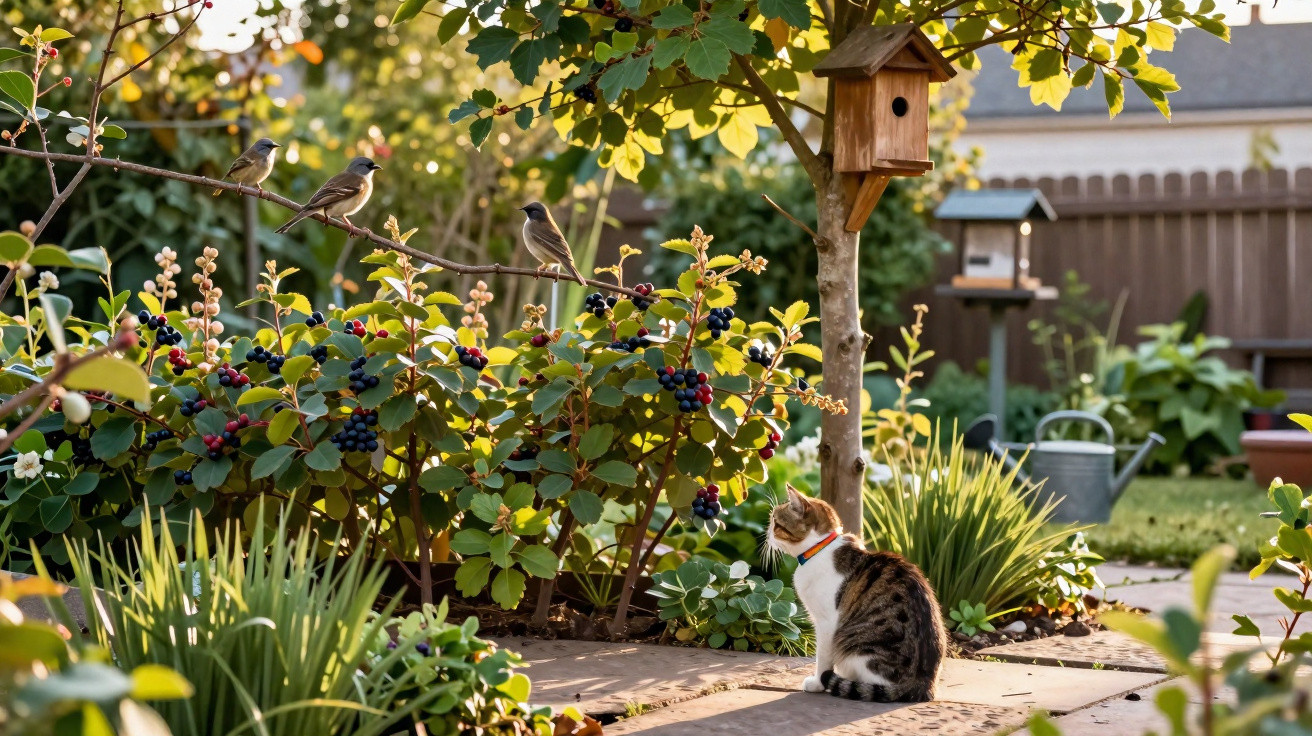
Spring in the garden, birds are singing – and suddenly your own cat is creeping through the flowerbed.
An innocent idyll? Not at all.
Anyone who loves cats while also delighting in every blackbird song knows the uneasy feeling: their soft-pawed favourite proudly returns home with a bird in its mouth. In many gardens, hunting instinct and nature conservation collide head-on. The good news is that a few well-considered measures can make a garden safer for birds without denying your own pet cat its territory.
Why cats pose a danger to songbirds
Domestic cats may appear well fed, relaxed and perfectly cared for, yet their hunting drive remains intact. A full food bowl does not switch off instinct. Cats are especially likely to roam outdoors in spring and early summer, when many species are nesting and feeding their young.
Studies from several countries show that free-roaming cats kill millions of wild animals each year, particularly small birds and mammals. For threatened species, this added pressure can become a serious issue, as habitats are already disappearing and insect populations are declining.
Cats are not “bad” animals – they are simply following their instincts. What matters is whether the garden provides birds with sufficient hiding places and safe nesting sites.
However, many gardens are heavily “tidied”: lawns are cut short, shrubs are scarce, and there are few corners containing leaves or dead wood. This removes precisely the features young birds need to escape a hunter on four paws.
The protected-garden principle: the 3-2-1 rule for greater safety
A bird-friendly garden does not have to look overgrown. The so-called 3-2-1 rule creates a garden that is rich in structure, attractive and safer at the same time.
1. Dense ground cover: protection at ground level
In the lowest layer of the garden, dense, spreading plants are particularly helpful. They give fledglings somewhere to shelter and make it harder for cats to creep up silently.
- Typical ground-cover plants: cranesbill, barrenwort, lady’s mantle, sedges and periwinkle
- Vary the height: do not keep everything short, and deliberately allow some areas to grow
- Leave piles of leaves and a little dead wood as extra refuges
These “green carpets” provide habitat for many insects and small creatures, which in turn are an important food source for birds.
2. Thorny shrubs: a natural protective barrier
In the middle layer of the garden, native shrubs, including thorny varieties, are especially valuable. Birds can move through them, whereas cats find them considerably more uncomfortable.
- Suitable species: hawthorn, blackthorn, wild rose, barberry, hazel and elder
- Avoid trimming hedges into solid walls; instead, let them grow more loosely
- Combine light and shade so that protected places also form within the shrubs
Birds use shrubs like these both for nesting and as escape cover. Once they dart inside, they are almost impossible for a cat to reach.
3. Trees as a safe upper storey
Trees form the third layer. They add height, prevent cats from having an uninterrupted view and offer sturdy locations for nests and nest boxes.
- Fruit trees, rowans, maples and field elms add structure
- Sections of trunk without branches make climbing more difficult for cats
- Link several trees or tall shrubs so birds can move from canopy to canopy
A garden becomes a “fortress for birds” when ground cover, shrubs and trees form a dense protective network through which cats cannot slip everywhere.
Safe nest boxes: small details with a big effect
Nest boxes support many species, particularly where old trees with natural cavities are absent. Without a protection plan, though, they can become easy prey for skilled climbers.
How to hang nest boxes so they are genuinely safe from cats
- Height: hang them around 3 metres above ground level, rather than on window ledges or low posts
- Distance from branches: ensure there are no horizontal branches or wall projections nearby from which a cat could jump
- Direction: ideally face east or south-east so the box does not become too hot
- No perch: the traditional “perch” may look attractive, but it also makes it easier for predators to reach in
- Depth: allow 15 to 20 centimetres between the entrance hole and the base so that no paw can get inside
Important: clean the box only outside the breeding season, and do not inspect it repeatedly. Disturbance increases the risk of parent birds abandoning the brood.
Outdoor access with rules: when cats should stay indoors
The most effective way to protect young birds is to limit outdoor access during particularly critical periods. Many cat owners underestimate how much the time of day affects hunting success.
Sensitive periods for birds – and what owners can do
- Breeding and rearing season: take particular care roughly from March to July
- Avoid dawn and dusk: where possible, keep your cat indoors during the early morning and at dusk
- Short, supervised outings: especially with young cats in spring, introduce more controlled garden time
Anyone using a microchip-controlled cat flap or timer function can manage outdoor access specifically without having to get up each time.
Bright collars and more: technology against surprise attacks
One useful additional measure is a brightly coloured, highly visible collar cover. Special designs in vivid colours and patterns make cats easier for birds to spot. This reduces the element of surprise, allowing many birds to fly away in time.
Important points:
- Use only safety collars with a breakaway release, so the cat cannot get caught anywhere
- Bells often achieve less than expected and may cause stress for the cat
- Introduce new collars gradually so the animal accepts them
It is also possible to make certain parts of the garden deliberately less appealing to cats, especially areas around nesting sites and feeding stations.
Gentle deterrents rather than strict bans
- Scatter coffee grounds or citrus peel in sensitive areas – many cats avoid the smell
- Use plants such as Coleus canina, whose scent deters cats
- Fit climbing-protection rings or guards to tree trunks so they no longer act as “hunting ladders”
The clearer the message to the cat – it is unpleasant here, you may hunt there – the better the balance between caring for animals and protecting nature will work.
More structure, more life: why a “wilder” garden benefits everyone
A garden designed in a more natural way may initially look less neat, but it brings numerous advantages. Birds benefit from more food and secure hiding places, insects find flowers and overwintering sites, and small mammals such as hedgehogs appear more often.
There are practical benefits for people, too: anyone who does not mow every corner short every week saves time and effort. At the same time, dense planting reduces the need for watering during hot summers because it protects the soil from drying out.
Practical examples for an everyday protected garden
- A “wild corner” at the back of the garden, with taller grass, leaf piles and shrubs as shelter
- A mixed hedge strip instead of a concrete or timber privacy fence
- One or two fruit trees with well-protected nest boxes, combined with climbing protection on the trunk
- Clear routes for the cat, for example along walls, with fewer sensitive areas
Those wishing to go a step further can have their cat microchipped and neutered. This limits uncontrolled breeding and reduces territorial fights, which often also decreases the distance cats roam.
Ultimately, the aim is not to ban cats from gardens. They have long been part of everyday life for many people. The difference lies in whether they hunt in a monotonous lawn desert or in a thoughtfully designed protected garden, where shrubs, trees and a few simple measures help far more young birds survive their first summer.





Comments
No comments yet. Be the first to comment!
Leave a Comment