
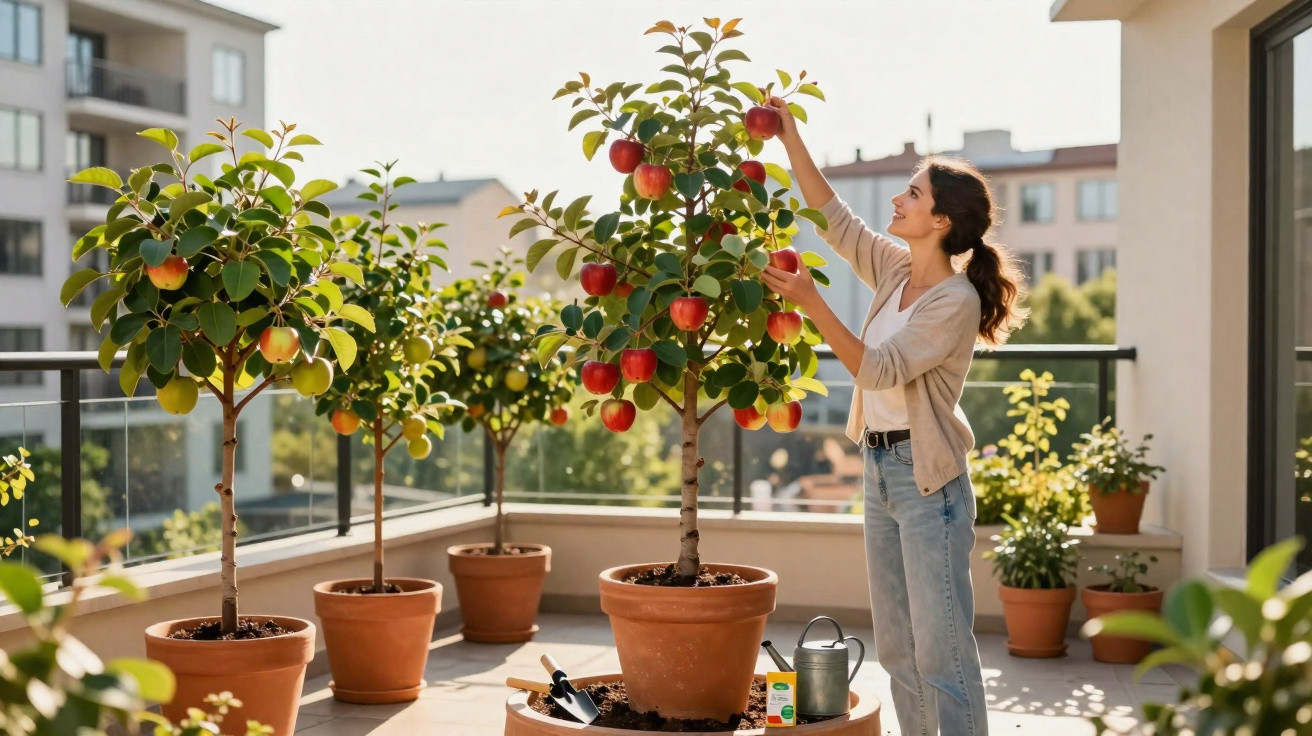
No garden, hardly any room, but keen to grow your own fruit?
One particular type of fruit tree makes it possible – even within just a few square metres.
Anyone living in a city will know the dilemma: balconies are small, courtyards are tight, and the dream of having a fruit garden can feel far away. Yet the desire for fresh, untreated fruit picked just outside the door remains. A distinctive growth habit in fruit trees now makes that wish surprisingly easy to achieve – using a container that needs little more space than a large plant pot.
The upright fruit tree that turns any balcony into a mini fruit garden
How its narrow growth gives urban gardeners entirely new options
The key lies in the so-called columnar form. Rather than producing wide branches in every direction, this fruit tree grows almost entirely upwards. Its trunk forms a slim, dense column lined with very short fruiting shoots.
The fruit grows directly from the trunk – like a “fruit skewer” in the smallest possible space.
Thanks to this vertical structure, the tree takes up barely more room than the footprint of its container. It extends very little to the sides, leaving the balcony free for a table, chairs or more plants. Where a conventional fruit tree would already be pressing against the neighbouring wall, this option is simply a green, fruit-bearing column.
That is precisely why a columnar fruit tree is so appealing for people with limited room: a narrow strip beside the balcony railing is enough to produce a worthwhile fruit harvest.
Fruit varieties particularly well suited to columnar trees
Many nurseries and garden centres now stock specialist columnar varieties. They naturally remain compact while still cropping generously. The most popular choices include:
- Apple: crisp, available in many varieties and comparatively easy to care for
- Pear: juicy and aromatic, ideal for late-season and autumn harvesting
- Cherry (usually in dwarf form): sweet fruit for snacking, perfect for children
- Plum or damson: for fans of cakes and jam
These trees are generally grafted and bred to grow slowly, fruit early and cope with restricted root space. Many amateur gardeners report keeping their columnar trees healthy for years without chemical sprays, provided the position and growing medium are suitable.
Pots instead of garden soil: creating the ideal home for the tree
How large the container really needs to be
In this approach, the pot replaces garden soil, so it must not be too small. A capacity of around 30 to 50 litres is ideal. This is roughly equivalent to a large, knee-high container or a broad terracotta bowl.
This offers two clear advantages:
- The roots have sufficient space to support a strong, stable tree.
- The container remains portable should its position need changing during the year.
For especially exposed balconies, it is better to choose the larger option. Greater volume provides more stability and a more even water supply.
The correct contents: what belongs in the pot
As the tree is not growing in garden soil, its compost must perform every function: storing nutrients, retaining water and supplying air to the roots. A reliable arrangement looks like this:
- At the base: around five centimetres of expanded clay or coarse broken pottery for drainage
- Above that: high-quality potting compost, ideally peat-free and containing an initial feed
- In addition: some mature compost for a long-lasting supply of nutrients
- Optional: a handful of slow-release organic fertiliser, such as horn shavings
- On top: a mulch layer of straw, hemp fibre or pieces of bark
This layered structure lets excess water drain away while preventing it from evaporating immediately. The roots also receive air, helping to prevent rot and waterlogging – two of the most common reasons why potted fruit trees fail.
How to plant a columnar fruit tree correctly
What matters when selecting a young tree
Anyone wanting to enjoy their miniature tree for a long time should choose a robust, already grafted young tree from a reputable supplier. Check for:
- a well-rooted, but not severely pot-bound, rootball
- a smooth trunk without cracks
- several short side shoots – these are where fruit will later develop
Spring is the ideal time for planting. The tree then has the whole growing season to establish roots and adjust to its new position.
Step-by-step planting guide
| Step | What to do |
|---|---|
| 1 | Fill the pot with drainage material, then prepare it with potting compost. |
| 2 | Remove the tree from its nursery container and gently loosen the roots. |
| 3 | Plant it at a depth where the top of the existing rootball sits level with the new compost. |
| 4 | Keep the graft union on the trunk clear; do not cover it with compost. |
| 5 | Firm the compost carefully and water thoroughly until no air pockets remain. |
A thoroughly watered start is crucial. Water settles any gaps and brings the fine root tips into direct contact with the compost, allowing the tree to establish more quickly.
More trees in less space: making use of every centimetre of balcony
How closely columnar trees can be positioned
Because their growth remains so narrow, columnar fruit trees can stand surprisingly close together. In many cases, a gap of around 60 to 80 centimetres is enough, provided the crown does not spread widely.
Even a simple two-metre balcony can easily accommodate three different types of fruit.
This makes it possible to create a personal “fruit corridor” along the railing. Some balcony owners combine apple, pear and cherry trees so that they can harvest repeatedly from early summer through to autumn.
Positioning: sun, wind and neighbouring plants
A bright to sunny location is best, with at least four to five hours of direct light each day helping fruit development. South- and west-facing balconies often provide the best harvests. In very draughty places, a simple trellis or glass balustrade can act as a windbreak. It remains important, however, that the crown receives enough airflow for leaves to dry quickly after rain.
Care without the stress: little effort, great results
Watering, feeding and pruning – what is genuinely necessary
Compost dries out faster in a pot than it does in a garden. During the warmer months, columnar trees need regular watering. A useful rule is to provide more water as soon as the upper layer of compost looks visibly dry. Collected rainwater is ideal.
Some practical tips:
- Test the compost with a finger rather than following a rigid watering schedule.
- On hot days, give smaller amounts in both the morning and evening.
- Renew the mulch layer regularly, as it significantly reduces evaporation.
Pruning is where the major advantage of the columnar form becomes clear. Instead of complex pruning rules, a small intervention is often enough: remove only shoots that project noticeably beyond the column or cross inwards. This keeps the tree slim and encourages well-lit short shoots where the fruit grows.
In many cases, one application of organic fertiliser in spring is sufficient. Replacing the top layer of compost and topping up with fresh growing medium every two to three years also keeps nutrient reserves high in the long term.
When to expect the first harvest
Columnar fruit is an attractive choice for anyone wanting quick results. Compared with traditional standard fruit trees, many specimens produce noticeable quantities just two to three years after planting. Depending on the variety, the first apples, pears or cherries will then hang from the still-slender trunk.
It often takes only a few seasons to go from an empty balcony to your first bowl of home-grown fruit.
Yields increase over the years without the tree becoming a space issue. It gains girth slowly but fundamentally remains an upright column. This leaves enough room for seating, herb planters or flowering plants.
What city dwellers should consider before starting
Weight, frost and pests: three easily overlooked points
Large containers can become very heavy, especially when wet. Anyone using an older balcony should check its maximum load capacity or ask for advice if unsure. It is often enough to place pots directly beside load-bearing walls or pillars.
During winter, roots can freeze more severely than they would in garden soil. Simple insulation around the pot, using coconut mats, bubble wrap or thick horticultural fleece, protects against damage. On exceptionally cold days, a sheltered position close to the house wall will help.
Pests such as aphids and spider mites appear from time to time. Straightforward measures, including rinsing them off, removing them by hand or using products that are safe for beneficial insects, are generally enough. A vigorous tree in a suitable pot is considerably more resilient than an undernourished specimen.
More than a harvest: how columnar fruit changes city living
Enjoyment, sustainability and a piece of nature outside the balcony door
A columnar fruit tree provides more than fruit alone. It brings the seasons visibly and fragrantly to the home: buds in spring, cool shade in summer and colourful foliage in autumn. Children can observe its growth first-hand, while adults appreciate its quiet contrast to a hectic everyday routine.
There is also a financial and environmental benefit. Regular harvesting saves some trips to the supermarket and reduces packaging waste. Many gardeners deliberately use kitchen leftovers such as coffee grounds or eggshells as additions to the growing medium – turning the balcony into a small circular system.
Combined with herb or vegetable planters, this creates an entirely new view of an outdoor space: a bare strip of concrete becomes a functioning, living mini ecosystem, with one slim fruit tree setting the tone – and producing a remarkable amount of fruit.

Comments
No comments yet. Be the first to comment!
Leave a Comment