
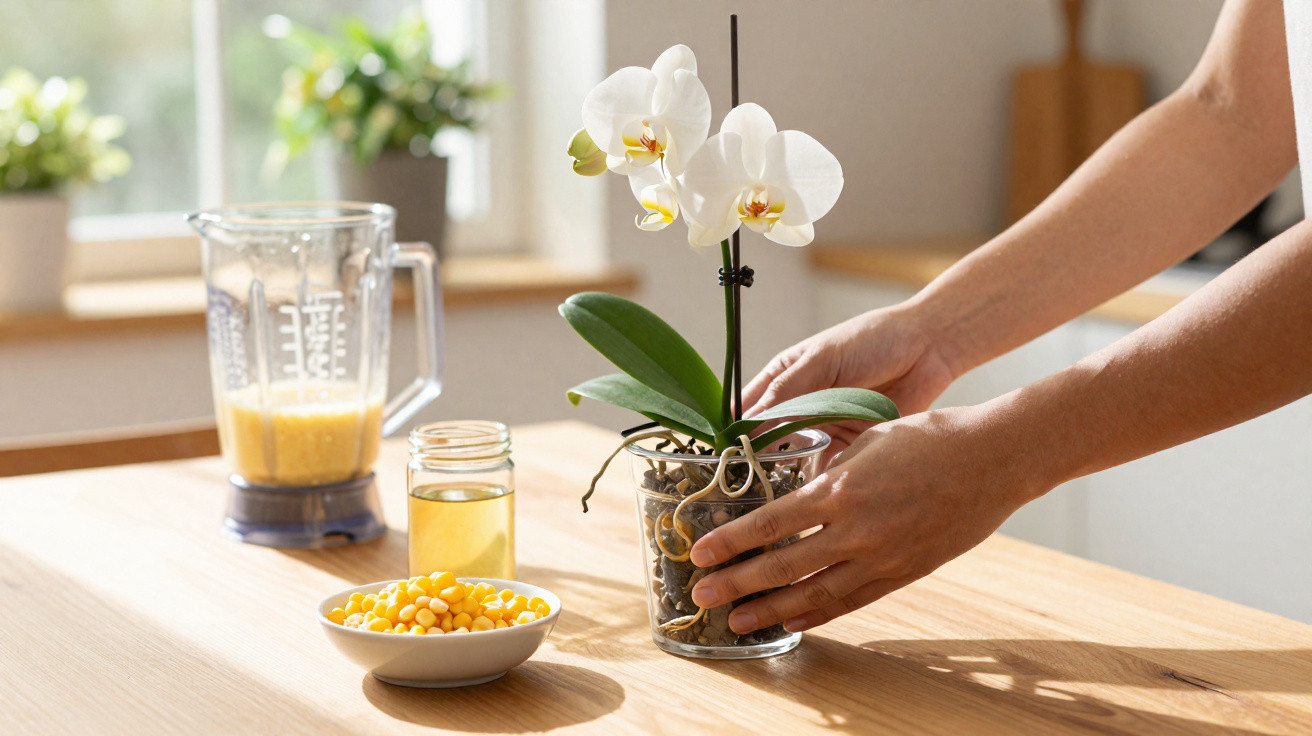
When leaves droop limply on the windowsill, the flowers have long since fallen and the stem is dry, many households simply throw a Phalaenopsis orchid into the general waste. Before putting the pot in the bin, however, it is worth taking a closer look – and, in some cases, trying an unusual remedy involving a saucepan of cooked sweetcorn.
How to tell whether the orchid can still be saved
Before any trick can work, you need to establish whether there is still life inside the plant. The roots are the crucial indicator. In a transparent pot, they can be inspected from the outside; otherwise, carefully ease the root ball out of the pot.
- Healthy roots: green or silvery grey, firm and free from a rotten smell.
- Signs of trouble: brown, soft or hollow roots, plus an unpleasant odour.
- Leaves: may be slightly soft, but should not be completely wrinkled and yellow.
If the roots remain healthy, the orchid is usually just going through a dormant period. Even where the flower spike appears dry, the plant may produce fresh growth later. If much of the root system has rotted, though, a kitchen remedy will not be enough – the plant needs a full emergency treatment.
First aid: repotting properly and choosing the right position
Where rot is present in the pot, repotting is essential. Only then does using cooked sweetcorn stand any chance of helping.
- Carefully remove the plant from its pot.
- Completely clear away the old, compacted growing medium.
- Trim off every brown, soft root using clean scissors.
- Place it in fresh, coarse orchid compost (bark, a little sphagnum moss and, if needed, expanded clay pellets).
- Let the pot drain thoroughly and do not allow water to collect in the outer pot.
Its position is equally important: it should be bright but protected from harsh midday sunshine, such as at an east- or west-facing window behind a light curtain. A difference of around four to six degrees between daytime and night-time temperatures encourages many Phalaenopsis varieties to form new flowers.
“Even the best kitchen trick is useless without a healthy root system – the foundations must be right first.”
What cooked sweetcorn in the pot actually does
Using cooked sweetcorn may initially sound like an internet myth. The thinking behind it is that starch and sugars from the sweetcorn stimulate microbial activity in the pot. This does not mean the orchid itself “drinks” the sweetcorn; rather, microorganisms in the growing medium are given food.
This tiny soil fauna breaks down organic residue and may improve the structure of the compost. A looser medium allows more oxygen to reach the roots. Many hobby gardeners report seeing:
- more richly coloured, active roots;
- firmer, fuller leaves; and
- new flower spikes after several weeks or months.
There are currently no scientific studies on this method. It is based on experiences from homes and amateur gardening. Anyone trying it should keep that in mind: it is an additional experiment, not a miracle cure.
How to make liquid sweetcorn fertiliser
The precise method matters if the experiment is not to go wrong. Salt or seasoning in the cooking water would be fatal to the orchid.
Basic recipe using blended sweetcorn
- around 100 grams of cooked, unsalted sweetcorn kernels
- 1 litre of tap water (left to stand or lukewarm)
Blend the kernels and water very finely, then strain the mixture thoroughly through a fine sieve or, preferably, a coffee filter. The result should be a lightly cloudy liquid with no pieces left in it. Allow it to cool completely before use.
Simple version using cooking water
An even easier option is to use only the cooking water from an unsalted corn on the cob. Once cooled, filter this water very finely too, ensuring that no residue remains. Both versions keep in the fridge for no more than 24 to 48 hours.
“As soon as the smell turns or the liquid smells sour, pour it down the drain – not onto the plant.”
Correct dosage: tiny amounts rather than “plant soup”
The most common mistake is using too much. Pouring excessive amounts of the mixture into the pot mainly feeds bacteria that cause rot.
Experienced hobby gardeners therefore recommend:
- First moisten the growing medium as usual, for example by soaking or watering carefully.
- Then apply only 1 to 2 teaspoons of the sweetcorn solution to the surface of each pot.
- Repeat every three to four weeks, never more often.
- Do not use other homemade fertilisers alongside it, such as rice water or banana peel preparations.
If the pot looks wet and shiny, or water is even sitting in the outer pot, you have used too much. Waterlogging can rot roots in a short time. Another concern is that, if the sweetcorn solution breaks down for too long in warm compost, it can form a sticky, foul-smelling layer – putting the roots at risk of damage.
When you should stop immediately
Several warning signs mean the experiment must be stopped:
- the growing medium feels slimy or sticky;
- there is a noticeable sour or rotten smell;
- leaves suddenly turn yellow and become very limp shortly after application;
- visible mould appears on the surface.
In this situation, the only solution is to replace all of the growing medium, inspect the roots, remove damaged sections and repot the orchid in fresh material. Afterwards, care for it normally with water only for a while, without further experiments.
When the first results may appear
Anyone supporting a Phalaenopsis with the sweetcorn trick needs patience. If it works, the first signs may be visible within two to three weeks:
- old roots turn a deeper green when moistened;
- pale, fresh root tips emerge;
- leaves stand slightly firmer and the pot appears more “alive”.
It can take several weeks to a few months before a new flower spike develops. The plant determines this itself, depending on light, temperature, variety and its general condition. Trying too hard during this period and constantly testing further home remedies is more likely to weaken the orchid.
How the sweetcorn trick fits sensibly into orchid care
This yellow liquid is not a substitute for balanced fertiliser; at most, it can be a supplement. Over the long term, an orchid needs:
- an airy growing medium that does not become compacted;
- a consistent water supply, but never waterlogged conditions;
- sufficient light without scorching; and
- where necessary, a specialist orchid fertiliser at a very weak concentration.
Many gardeners find it best to use sweetcorn liquid only during “crisis periods”: when a once vigorous plant has been weakened by a care mistake but still has healthy roots. Once the orchid appears stable again, they return to straightforward, regular care.
Risks, borderline cases and practical tips
Anyone who tends to overwater should take particular care. In very wet compost, the added starch can act like fertiliser on a waterlogged lawn: everything goes off balance. In very warm homes or during summer, decomposition happens more quickly and the risk of rot increases. In cooler rooms, the process slows down, but surface mould becomes more likely.
As a guide, it may be helpful to test the sweetcorn liquid first on a less cherished or already weakened plant. If you own several Phalaenopsis orchids, choose one as a “guinea pig” and record the changes: photograph the root area, note the date of application and record the light conditions. This makes it easier to judge realistically whether the method works in your own home.
“The yellow leftover from the saucepan does not replace basic orchid-care knowledge – but in individual cases, it can tip the balance before an apparently lost plant ends up in the bin for good.”



Comments
No comments yet. Be the first to comment!
Leave a Comment