
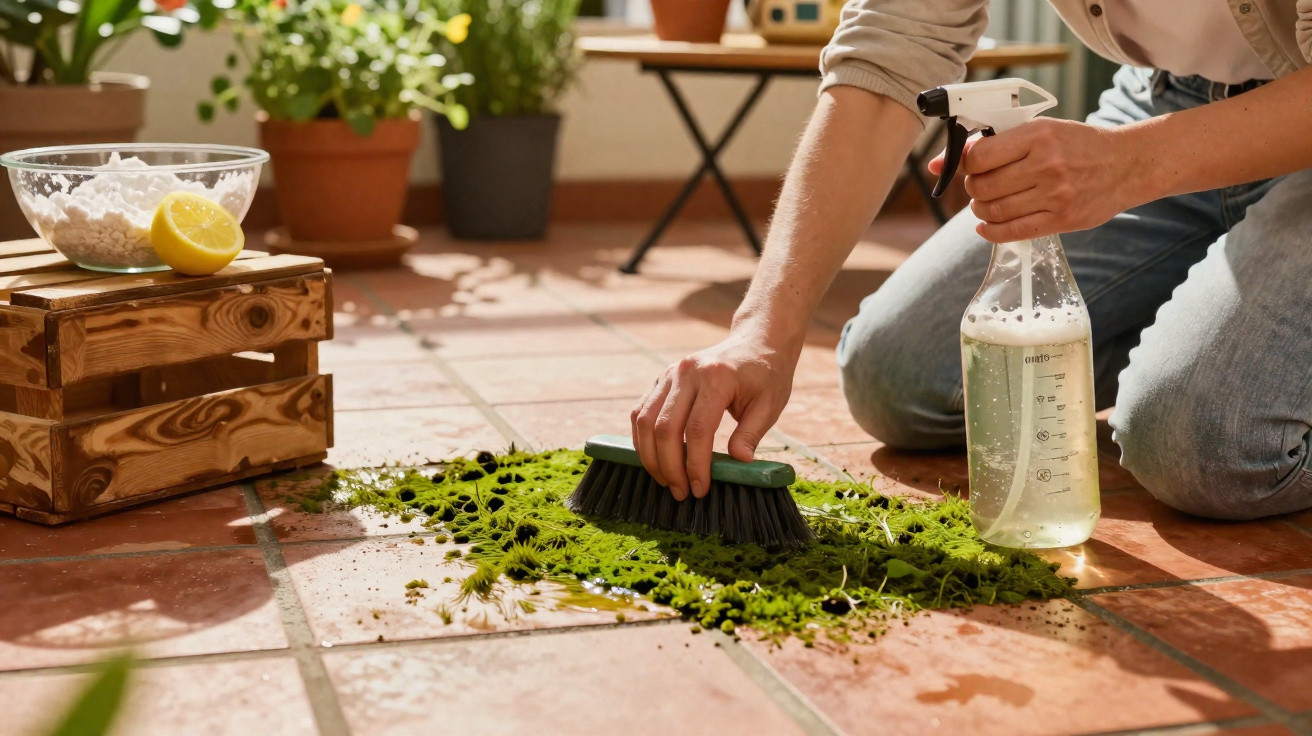
Many homeowners face the same issue in spring: over the winter, moss, algae and lichens have taken hold, leaving the ground slippery and unattractive. Rather than reaching for harsh chemicals, you can remove the growth with a straightforward kitchen household remedy – without scrubbing until you are exhausted.
Why moss and algae spread so quickly on patios
After months of rain, snow and storms, many patios are left damp and slow to dry. These are precisely the conditions that green growth loves: constant moisture, little sunlight and a little dirt give moss and algae the ideal starting point.
- Timber, tiles and natural stone are especially prone to retaining water.
- Cracks and joints collect soil, leaves and dust.
- Damp, shaded locations encourage spores to develop and germinate.
- The coating looks dirty and patchy, becoming increasingly slippery over time.
Anyone hurrying across the patio on rainy days often only realises in spring just how far the green film has spread. Once children, older people or pets are walking there, the growth becomes a genuine safety hazard.
Why chlorine bleach is a problem on patios
Many people instinctively use strong chlorine bleach to “disinfect” the growth. At first, the result can look convincing: the surface becomes lighter and the green coating disappears temporarily. However, this comes at a considerable cost.
“Chlorine-based cleaners attack materials, harm the environment and health – and are legally problematic in many outdoor areas.”
Common disadvantages of chlorine on patios
- Joint mortar and porous stone can crumble more quickly.
- Timber may weather unevenly and become brittle.
- Chlorine-contaminated wastewater can run into soil, flowerbeds or gutters.
- Plants, soil organisms and small animals nearby can die.
- The pungent smell lingers in the air and on fabrics for a long time.
Many countries have strict rules governing biocides in private gardens. On paved surfaces connected to the drainage system, their use is sometimes entirely or largely prohibited. Using chlorine bleach carelessly can therefore damage more than just your patio; it may also lead to problems with the environmental authorities.
The surprising alternative: potato water instead of harsh chemicals
A tip that has been circulating among gardening experts for some time sounds almost too simple at first: water left from boiling potatoes works as a natural moss killer – and costs nothing extra.
“Hot potato water combines thermal shock and plant starch – the growth dies off without you having to scrub.”
How the effect works in detail
When potatoes are cooked, starch is released into the water. This mixture has two effects:
- Thermal shock: The boiling water, at around 100°C, meets the cold, dry patio surface. The cells of moss, algae and lichens effectively burst.
- Starch film: As it cools and dries, the starch forms a thin film over the plant remains. It covers the plants’ “breathing openings” and deprives them of the basis they need to survive.
The growth then dries out, turns dark brown to black and can be removed easily – in most cases, a broom or a quick pass with a brush is enough.
Step by step: how to use potato water on your patio
Prepare the patio
Thoroughly sweep away loose leaves, twigs and coarse dirt. The less debris left on the surface, the better the mixture can reach the growth.Boil the potatoes
Cook potatoes in a sufficiently large pan of water as you normally would. Avoid adding salt where possible, as high salt concentrations can be unsuitable for some materials and nearby plants.Allow the patio to dry
The surface should be as dry as possible before application. Plan the treatment for a period without rain.Apply the water carefully
Slowly and evenly pour the still-boiling water over the affected areas. Wear closed footwear and watch out for splashes to prevent scalding.Leave it to work
Do not begin scrubbing straight after application. The mixture should be left for at least 20 minutes, preferably much longer. Many users simply allow it to cool and dry completely.Loosen the growth
After 24 to 48 hours, the green growth will have changed noticeably: it will appear dull, dark and crumbly. You can then use a broom or stiff brush to help loosen it and sweep away the remains.
Which surfaces are suitable for this trick – and which are not?
In principle, this method can be used on many common patio surfaces. However, there are a few points to bear in mind.
| Surface | Suitability | Note |
|---|---|---|
| Concrete and stone paving slabs | Well suited | Resistant to heat and ideal for this use. |
| Ceramic or porcelain tiles | Usually suitable | Keep an eye on grout and avoid extreme temperature shocks during frost. |
| Timber decking boards | Use with caution | Do not allow water to stand, and let the timber dry thoroughly afterwards. |
| Coated floors | Test first | Check a small corner first to see whether the coating changes. |
For very delicate natural stones, such as some limestones, it is worth testing the method in an inconspicuous area. The starch itself is harmless, but the heat can encourage fine stress cracks in certain stone types if they are already damaged.
Natural alternatives when there are no potatoes on the hob
If you do not have cooking water available, or would like to supplement the method, there are other gentle household remedies frequently recommended by gardening experts:
- Bicarbonate of soda or baking powder: Applied as a solution, it changes conditions on the surface so that many mosses can no longer grow well.
- Black soap with a little washing-up liquid: The fats loosen dirt and deposits, making the surface noticeably cleaner after brushing.
- Household spirit with an acidic component: When diluted, it loosens limescale and dirt layers, but it should never be used on sensitive natural stone.
With every option, it is important to allow the solution to work briefly before using a brush. Professionals give at least 20 minutes as a rough guideline, although often longer.
How to prevent new green growth over the long term
Anyone repeating the same procedure every year will eventually ask: is there not an easier long-term solution? Moss can hardly be prevented completely, but you can slow its return considerably.
Practical measures for less growth
- Direct water away effectively: Check the slope and drainage. Moss grows fastest where puddles remain.
- Sweep regularly: Leaves, soil and dust add nutrients to the surface. A quick sweep every few weeks can make a major difference.
- Maintain the joints: Refill washed-out joints and do not allow cracks and gaps to become completely filled with soil.
- Hydrophobic sealant: Special products form a thin protective coating that causes water to bead off, making new growth more difficult to establish.
Moving container plants slightly away from the ground surface and removing thick rugs or mats during winter also takes away further favourite spots for green growth.
Risks, precautions and sensible combinations
Although it is natural, using boiling water is not entirely risk-free. Scalding can happen more quickly than expected, particularly when pets or children are playing nearby. Wear sturdy footwear and long trousers, and work carefully without rushing.
Many balcony and patio owners combine the methods: first, they treat the area with hot potato water, then tackle isolated spots with a brush and a mild cleaner. This removes even stubborn patches without requiring aggressive biocides.
The effect of starch is also interesting in joints: the film often settles particularly well there, helping to keep moss away for longer. Treating the patio in this way for a second time in late summer means entering winter with much cleaner joints.
To understand why moss in particular seems so persistent, it helps to consider how it lives: unlike higher plants, it has no deep-reaching roots and instead clings flat to the surface. It is therefore highly sensitive to changes directly at the surface – which is exactly where the combination of heat and a starch film takes effect.
For people who value a nature-friendly garden, this approach is especially suitable: it uses resources already available in the kitchen, reduces the use of harsh active substances and protects small animals, soil life and plants around the patio – while also creating a safe, clean spot for the first coffee outdoors.



Comments
No comments yet. Be the first to comment!
Leave a Comment