
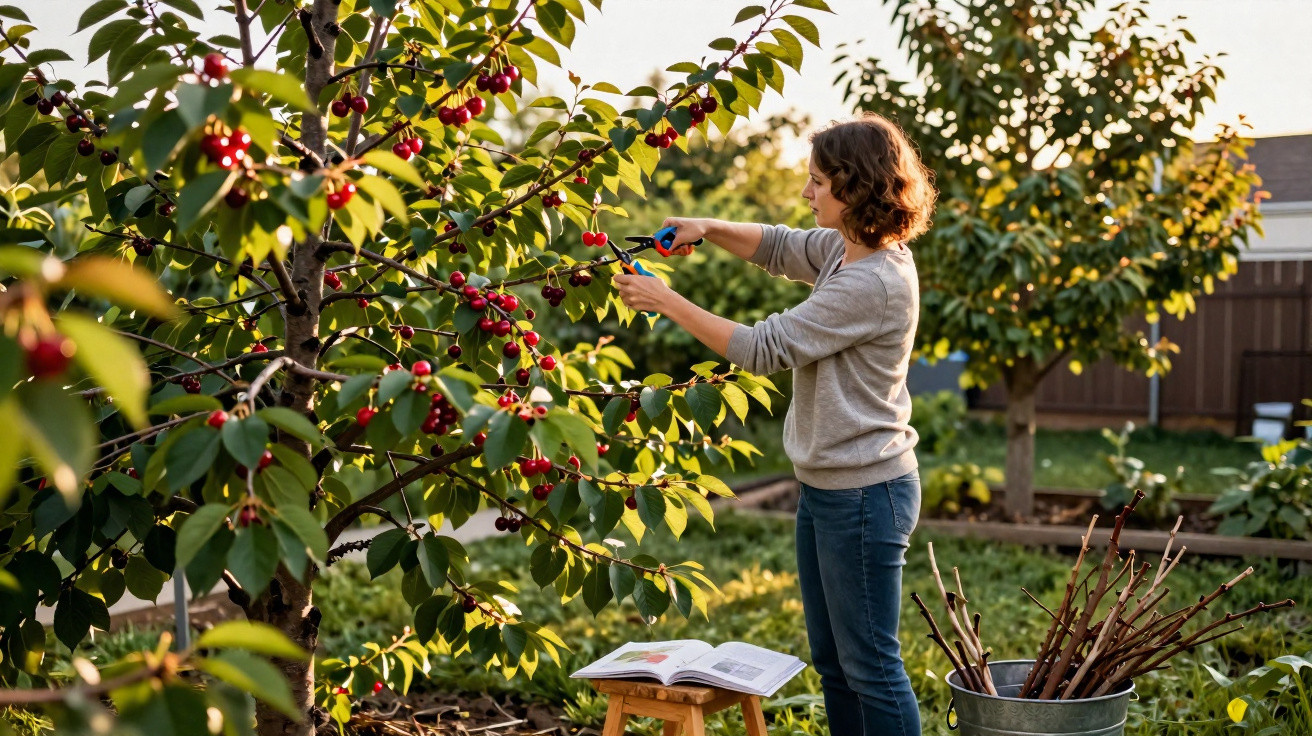
A neighbour’s tip was all it took to turn things around.
Many garden owners know this exact disappointment: you carefully tend your tree, feed and water it, and watch every bud – yet harvest time brings only a few pitiful fruits among the branches. That was the experience of one amateur gardener whose cherry tree looked impressive but produced virtually nothing. Only when an experienced neighbour showed him where and how to prune did the following year’s harvest increase dramatically.
Why a healthy cherry tree can still produce very little fruit
When excessive wood growth shuts out the flowers
Dense, vigorous growth may initially seem like proof that a tree is healthy. Thick branches, countless shoots and masses of leaves – what could possibly be wrong? This is precisely where the issue lies: the tree puts all its energy into producing wood and foliage rather than flowers and fruit.
Nutrients and the tree’s sap are directed mainly towards vigorously growing shoots. Flower buds, which later develop into cherries, lose out as a result. The outcome is an imposing tree but empty bowls at harvest time.
Anyone who lets their cherry tree grow “however it wants” often unknowingly raises a green giant rather than a fruit tree.
Lack of light inside the canopy reduces the cherry harvest
The second major obstacle is insufficient sunlight within the centre of the canopy. The core of a completely overgrown tree remains in almost permanent shade, yet this is where many potential fruiting shoots are located.
Without direct sunlight, considerably fewer flower buds form. The tree responds as though it is in energy-saving mode: it holds back, flowers fail to appear or develop weakly. Nutrients alone are therefore not enough – light is just as essential for fruit production as good soil.
The neighbour’s advice: ruthlessly remove energy-draining shoots
These shoots should be removed first
The turning point came when the neighbour looked into the cherry tree and immediately spotted the “energy thieves”: water shoots, also commonly called gourmands or greedy shoots in fruit growing.
Typical characteristics of these shoots include:
- they grow vertically upwards like little whips
- they appear mainly on thick scaffold branches or on the trunk
- they often have smooth, relatively pale bark
- they grow extremely vigorously within a single season
- they produce hardly any flowers and therefore no cherries
These shoots consume huge amounts of nutrients while giving very little back. They take away what the fruiting branches need for flowers and fruit.
How to prune properly without weakening the tree
To ensure that the tree uses its energy productively again, these upright shoots must be removed completely. The way the cut is made is crucial.
Always cut water shoots off directly at their base – leaving no stub or “hook”, and cutting as close to the branch as possible.
Use a very sharp cutting tool, such as high-quality secateurs or small loppers. A clean, smooth cut heals more quickly, reduces the risk of disease and fungal infection, and helps prevent new, even stronger water shoots from emerging immediately from the same spot.
Crossing branches: a risk to bark, health and yield
When branches rub each other raw
The neighbour then pointed out another problem area: branches that cross or rub against one another. As the wind moves them, these areas constantly chafe, damaging the bark and creating entry points for fungi and bacteria.
The rule is simple: where two branches permanently obstruct each other, only one should remain. Remove the weaker branch or the one growing in the less favourable direction. Usually, this means taking out the branch pointing inwards towards the trunk, or the noticeably thinner one.
This not only lowers the risk of disease but also makes the entire canopy clearer and more open.
More air, more sunshine and more insects within the canopy
Removing crossing and inward-growing branches creates an open, bright central area in the tree. Gardeners often say that you should be able to “throw a hat through it” – in other words, there must be sufficient space inside.
This offers several benefits:
- sunlight can reach fruiting branches in the inner canopy
- wood dries more quickly after rain, reducing fungal infection
- pollinators such as bees and bumblebees can access every flower more easily
- fruit in the centre develops better and is less likely to remain small
An airy canopy is like a light shaft: warmth, sunshine and insects have a direct route to the flowers.
The right time: when cherry trees are best pruned
Why drastic winter pruning can be problematic
Pome fruits such as apples and pears generally tolerate hard winter pruning fairly well. Cherry trees are different. They are more sensitive to large wounds during the cold season. This often leads to gummosis: a thick, amber-coloured substance that oozes from injuries.
This gummosis weakens the tree over a prolonged period. It indicates that the tree is under stress and is struggling to deal with the wound.
For cherry trees, the following approach has proved effective:
- carry out larger pruning jobs immediately after harvest
- make smaller corrections carefully in spring or late summer
- avoid drastic pruning during the depths of winter
Clean tools reduce the risk of disease
Before every cut, tools should be clean and ideally disinfected. A cloth moistened with alcohol or surgical spirit is enough to remove bacteria and fungal spores from the blade.
If you prune several trees one after another, clean the tool between plants. This prevents you from unknowingly transferring diseases from one fruit tree to another.
For thick branches, applying a wound sealant may be useful, such as tree resin or a balm based on clay minerals. On a vigorous tree, thinner cuts usually heal quickly without any additional treatment.
What happened in spring after the pruning treatment
From a worrying green mass to a flowering wonder
The change was obvious in the spring after this decisive pruning: the cherry tree still put on strong growth, but many of its new buds were now flower buds. Sunlight reached areas that had previously been dark, while the canopy looked lighter and more open.
During flowering, the whole tree suddenly hummed with activity. Bees could reach the centre of the canopy without obstruction. The numerous flowers developed into substantially more set fruit than in previous years.
The same tree that had once produced only a few cherries was barely recognisable after its targeted pruning treatment.
The three key rules for a consistently good cherry harvest
To stop the tree slipping back into its old habits, a few straightforward principles should be checked briefly every year:
- consistently remove strong upright shoots
- thin out crossing or rubbing branches
- cut out dead, diseased or inward-growing wood
Anyone who follows these points regularly keeps their cherry tree balanced: enough wood for stability, but sufficient light and energy for flowers and fruit.
Useful additional tips for cherry trees in the home garden
Location, growth habit and variety selection
Alongside pruning, both the location and variety matter. Cherry trees prefer a bright, ideally fully sunny position and free-draining soil without waterlogging. Those with only a small garden are better off choosing less vigorous varieties or columnar forms, which are easier to keep under control.
Whether a variety is self-fertile or needs a second tree for pollination also affects the harvest. With some sweet cherries, planting a second tree nearby is worthwhile so that the flowers can pollinate one another.
How to avoid pruning mistakes
Common cherry-pruning errors are easy to avoid once you know a few warning signs:
- do not cut everything back hard every year – make smaller corrections more often instead
- do not leave long stubs that may later rot
- do not remove all horizontal fruiting branches – they are the foundation of a good yield
- after heavy pruning, pay particular attention to new water shoots the following year
Those who observe their cherry tree and gradually learn how it responds to individual measures will, over time, develop a good instinct for where pruning is useful and where it is not. In this way, a frustrating green tree can gradually become a reliable source of plump, sweet red cherries.



Comments
No comments yet. Be the first to comment!
Leave a Comment