
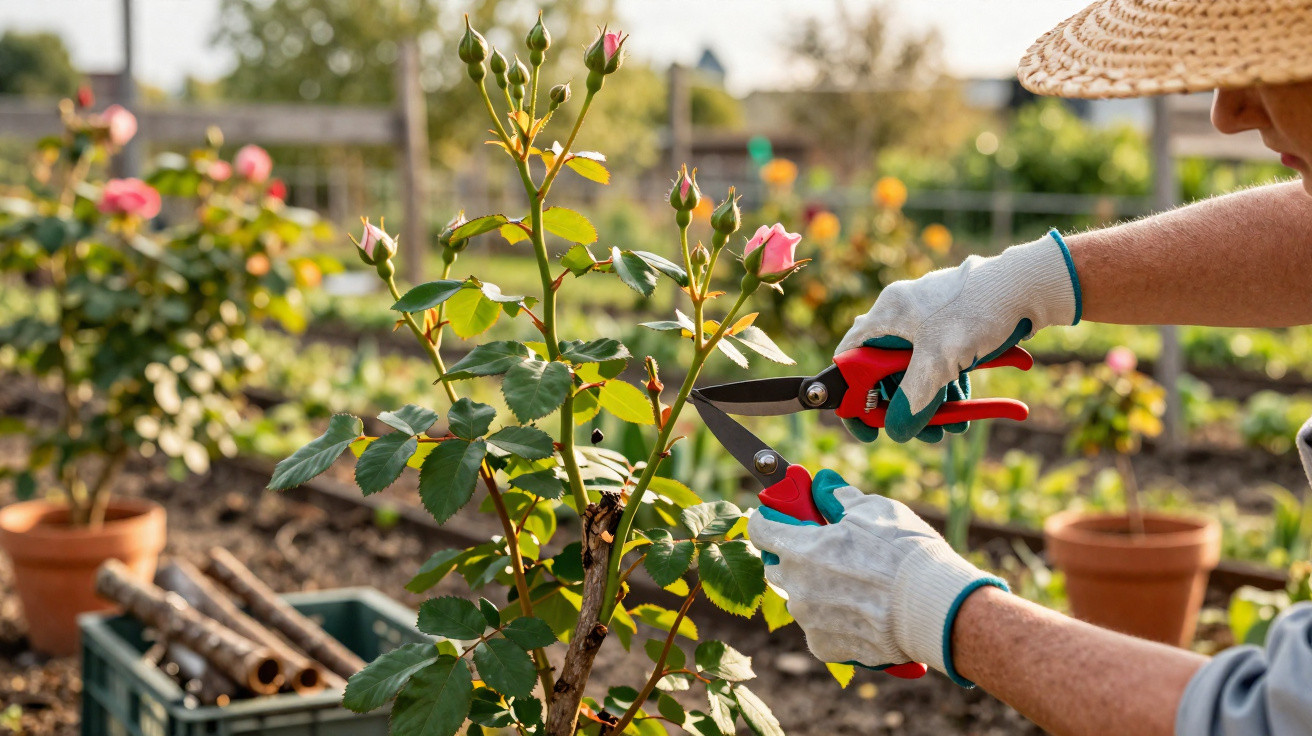
A seasoned nursery grower demonstrates a straightforward approach that completely changes how you look at your secateurs. If you take a few minutes before the first cut and genuinely “read” the plant, you can expect noticeably more flowers in summer, sturdier shoots and a far healthier shrub.
Why the usual rose pruning so often disappoints
Every spring, the routine in countless gardens is much the same: clear away old leaves, cut everything back hard, job done. It feels efficient, but with roses it rarely delivers good results. Many bushes respond with weak new growth, bare patches, or a tangle of thin shoots that produce hardly any worthwhile blooms.
The cause is nearly always instinctive pruning. Stems get shortened too much or all to the same height, without considering the plant’s individual growth habit. The shrub may look “tidy” afterwards, yet it loses energy reserves and its natural framework.
"If you treat roses like hedges, you’ll eventually get hedges - but not the queen of flowers."
Cutting back too severely forces the plant to restart from just a few remaining buds, which drains a huge amount of energy. On the other hand, cutting too lightly or randomly leaves behind a muddle of weak, crossing stems. The centre stays damp, fungal diseases find ideal conditions, and the flowers end up poorly positioned.
The professional method: look first, then cut
The nursery grower’s core principle is this: roses aren’t something you simply “get through” - they are something you read. Before the blades touch anything, you scan the entire plant, from the crown at the base right up to the tips.
The focus is on three questions:
- Which shoots are strong, healthy and well placed?
- Where is there old, dead or clearly weakened wood?
- What shape and height should the shrub have later on?
The aim is not to remove as much wood as possible, but to build a clear, airy framework. An open centre lets light and air reach into the plant. That lowers the risk of fungal problems and encourages robust new shoots in the right places.
"The rule is: keep strong wood, remove weak and dead wood consistently - not the other way round."
In the end, you keep only a few well-spaced main canes that will support the plant. These are shortened precisely, always just above an outward-facing bud. That way, new growth develops away from the centre rather than into it.
The right time in spring
Timing matters almost as much as technique. If you prune during hard frost, newly exposed cuts can be damaged and young buds may be killed off. If you leave it very late, you can lose flowering potential because the shrub has already invested energy in growth that you then remove.
A reliable guide is this: once the buds are clearly swelling, taking on a slight green tinge, and your area is no longer expecting sharp night frosts, the window has opened. That often falls between late winter and early spring.
If small leaves have already appeared, it’s not a disaster. In that case, simply keep the pruning a little gentler. Roses tolerate more than many people assume - provided the cuts are made with intent.
Step by step: how to tackle a rose bush
Before you start shaping, clear the shrub methodically. The nursery grower advises working from the biggest decisions to the finest adjustments.
Order of cuts
- Remove any dead, blackened or badly damaged shoots completely.
- Cut out very thin, spindly twigs that would scarcely carry flowers.
- Thin crossing and rubbing branches, especially in the middle of the bush.
- For shrub roses, select three to five strong main shoots and take out the rest.
- Shorten these main shoots to the appropriate length - always above an outward-pointing bud.
The cut surface should be clean and smooth. Sharp, clean tools prevent crushing and reduce the chance of infection. Make the cut on a slight angle so water runs off; there’s no need for extreme slopes.
The right height depends on vigour
This is where the professional approach clearly differs from the common tip to “cut everything to one uniform height”. Strong, young roses can handle a harder cut. With them, you often leave 20 to 30 centimetres, depending on the variety and growth type. Weaker plants should be reduced less so there is enough leaf area left to sustain them.
"Every rose has its own character. If you crop them all to the same height, you take away their personality."
Some nursery growers even describe it as a conversation with the plant: the gardener doesn’t force it, but guides its growth. That is exactly the difference between mechanical cutting and skilled pruning.
Common mistakes you can avoid from now on
Many issues in the rose bed come from repeated errors during spring pruning. Three show up especially often:
- Random shortening without considering the shape: the shrub may look “tidy”, but it regrows in a disorganised way and stays congested inside.
- Too much respect for old wood: heavily aged, thick canes are left in place even though they produce few young flowering shoots.
- Cutting right on the bud: if you cut too close below the bud, it can dry out. A small safety margin of about 1 centimetre is sensible.
Another classic problem is blunt or dirty secateurs. They tear the wood rather than slicing it cleanly. Fungi and bacteria can enter easily through ragged wounds. A quick check and a few strokes with a sharpening stone before pruning day are well worth it.
How to give your roses a boost after pruning
Pruning on its own isn’t the whole job. The plant now has open wounds, starts forming new shoots, and needs water and nutrients to cope.
- In dry weather, water thoroughly rather than giving frequent small amounts.
- Work mature compost or an organic rose fertiliser into the soil around the root zone.
- Add a thin layer of mulch to retain moisture and slow down weeds.
In the weeks that follow, it pays to watch the new shoots closely. If they emerge strong, healthy and even, you’ve struck the right balance. If individual shoots look noticeably weak or grow awkwardly, you can fine-tune by pruning them back or removing them entirely.
What terms like “aged” and “young wood” really mean
When professionals talk about aged wood, they mean canes that are many years old, thick, often rough or cracked, and no longer produce many young side shoots. These parts may still give a few flowers, but they take up space and light that vigorous young growth needs. The remedy is a bold cut back to a younger, well-positioned branch or close to the base.
Young wood, by contrast, is smooth, often slightly glossy, and carries many dormant buds. Particularly with bedding roses, the most floriferous shoots often come from wood that is two to three years old. The skill lies in encouraging that material - and not accidentally removing it.
Practical examples for different types of roses
Shrub roses and bedding roses benefit most from this method because their final shape depends heavily on the basic framework. With them, an open centre produces a compact yet airy bush that flowers from bottom to top.
Climbing roses are handled a little differently: the long, load-bearing main canes remain and are only lightly thinned. The emphasis is on renewing the side flowering laterals and shortening them with purpose. The same order still applies: remove dead and rubbing growth first, then take your time to consider the shape.
Why this “conversational” approach pays off in the long run
Once you start properly observing your roses, you usually never prune the old way again. Your perspective shifts from “How do I make this look neat quickly?” to “How do I support this plant so it can perform well with minimal stress?”
With the nursery grower’s method, the workload often falls over the years. Healthy, well-structured shrubs need fewer corrective cuts, cope better with fungal disease, and naturally develop balanced forms. Many gardeners report noticeably more flowers and far less frustration at the rose bed after just one season.
"A few minutes of observation before the first cut can change an entire season in the rose garden."


Comments
No comments yet. Be the first to comment!
Leave a Comment