
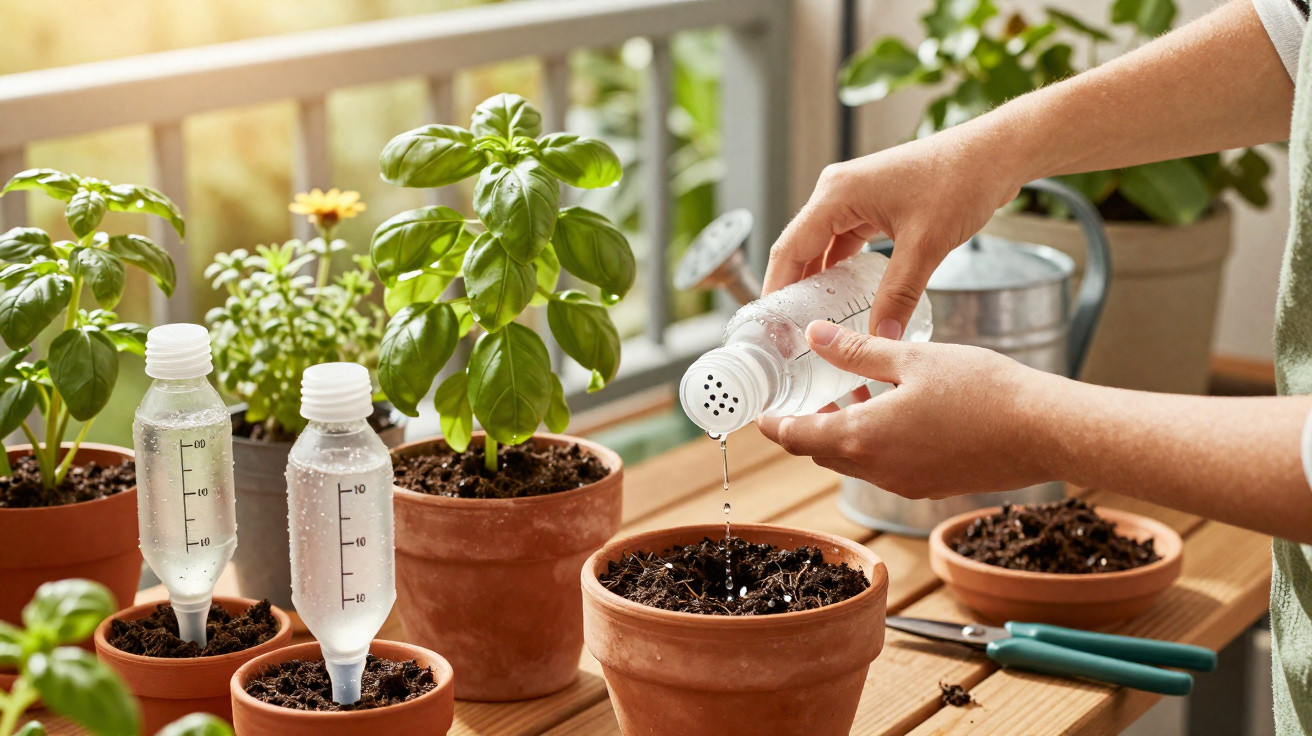
Turning a PET bottle into a straightforward drip irrigation system is a practical way to keep potted plants damp for longer. This approach is particularly handy for anyone growing plants indoors or on balconies who cannot water them very often, acting as a back-up during hot spells, hectic routines, or short absences.
How does drip irrigation with a PET bottle work?
The bottle serves as a small reservoir, releasing water gradually through tiny holes due to gravity and the pressure inside the bottle. In this way, the growing medium stays lightly moist for longer, rather than being soaked all at once.
In most set-ups, the bottle is partly buried or positioned close to the stem, with the holes directed towards the root area. That makes water use more efficient, cuts evaporation losses, and reduces plant stress during short periods without watering.
How do you set up PET bottle irrigation step by step?
To rig up a self-watering pot, it helps to pick a bottle that matches the pot size and to test the flow rate. Medium pots usually work well with bottles between 500 ml and 1.5 litres, while very small containers often do not respond well to this method.
The basic process is simple and needs only a few items:
- Wash the bottle thoroughly and remove any drink or product residue.
- Make 2 to 6 small holes near the neck or on the lower side using a heated needle or a thin nail.
- Fill with clean water, screw the cap on tightly, and keep it firmly closed.
- Bury the bottle part-way with the neck pointing downwards, near the inner edge of the pot.
- Adjust the placement so the holes sit completely within the growing medium.
If the bottle empties too quickly or the soil becomes waterlogged, it is worth repeating the process with fewer holes or smaller openings. It can also help to pair the set-up with a freer-draining growing medium, reducing waste and lowering the risk of fungal issues at the roots.
Which pots, plants and growing media work best with PET bottle irrigation?
Medium-sized pots with good depth and drainage holes tend to perform best, especially in very hot conditions. Tropical foliage plants and culinary herbs that like steady moisture often benefit most from continuous dripping.
By contrast, very small pots, containers without drainage, and species that need to dry out fully between waterings-such as many succulents and cacti-can suffer from excess water. In these situations, the risk of root rot increases, even when the holes in the bottle are small.
How can you test the flow rate and make better use of water?
Before leaving the system unattended for one or two days, it is sensible to run a flow test to see how long the bottle takes to empty. Checking the growing medium’s moisture with your finger over the course of several hours helps you fine-tune the method for the weather, the plant type, and the pot size.
A well-balanced growing medium-one that drains well but still retains some moisture-usually distributes the dripped water more evenly, without creating puddles. Used this way, PET bottle irrigation becomes a practical helper for reducing evaporation losses and keeping roots active, as long as you watch how each plant responds during the first few days.
Comments
No comments yet. Be the first to comment!
Leave a Comment