
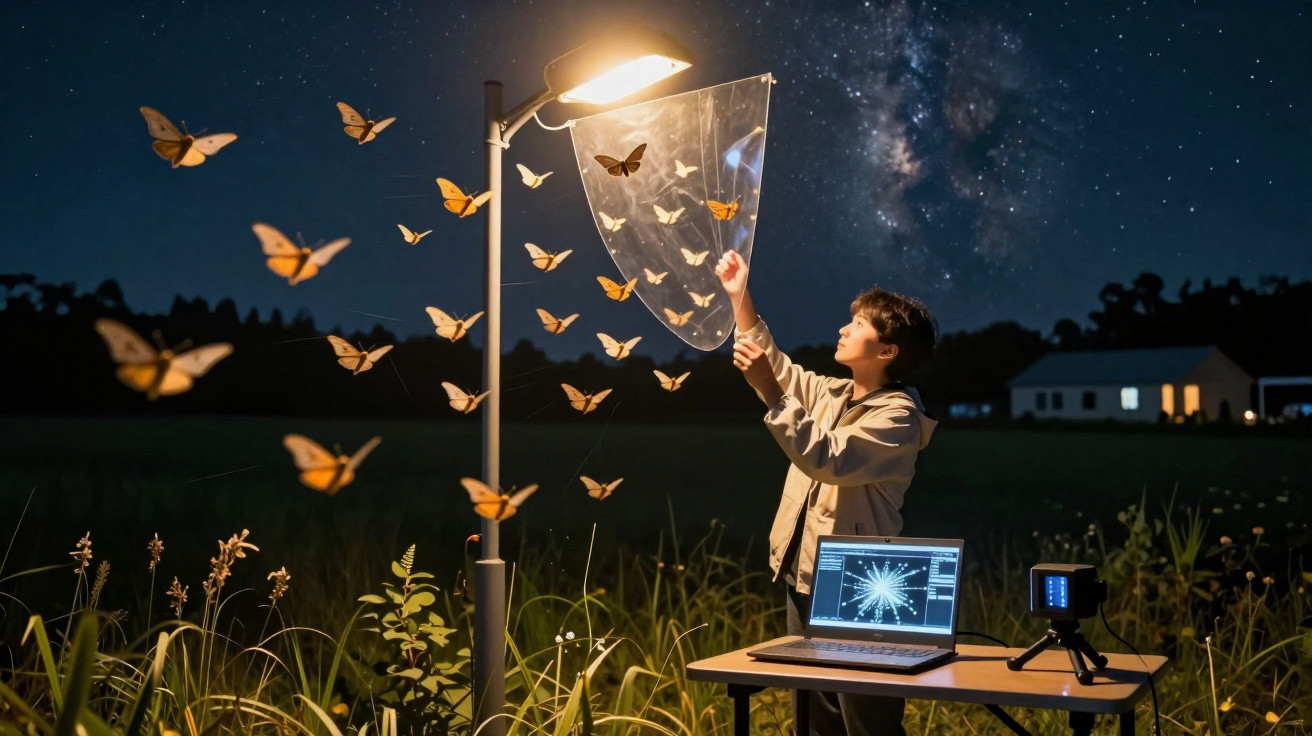
For much of their evolutionary history, moths have found their way through the night using the moon and stars. Now, however, that celestial guide is increasingly obscured by streetlamps, illuminated buildings and vehicle headlights.
This widespread artificial lighting does more than disorientate moths: it alters their movement, feeding and ability to locate partners, creating consequences that spread through whole ecosystems.
Researchers are working to establish precisely how present-day lighting changes moth behaviour, and why the issue is more significant than many people might assume.
A new study at the University of Oldenburg in Germany is intended to reveal these less visible impacts of light pollution.
Its purpose is to translate the results into practical measures that protect insects which need darkness to survive.
Streetlights confuse moths
Moths are under considerable pressure around the world. Artificial illumination in urban areas interrupts natural darkness, influencing how these insects travel, feed and breed.
Numerous moth species rely on moonlight and starlight during long nocturnal journeys. Bright streetlights can disrupt this navigation, leaving moths disorientated and causing them to expend energy flying around lamps rather than looking for food or mates.
Although scientists have investigated this problem for many years, important uncertainties remain. Which forms of light are most disorientating? How are moth movements affected by cloud cover, weather and the phases of the moon? Above all, what effect does artificial light have on mating success?
The new Lightstar project has been established to address these questions. It is headed by Dr. Jacqueline Degen, a biologist at the University of Oldenburg.
Moths support ecosystems
Moths are often ignored by people, but they play an essential part in nature. At night, they pollinate crops as well as wild plants.
They are also an important food source for bats and birds. Consequently, declining moth populations cause difficulties throughout entire ecosystems.
Insect numbers are continuing to fall globally, with light pollution contributing to that reduction. The researchers are concentrating particularly on two species: the privet hawk moth and the elephant hawk moth.
Each species covers long distances and navigates by moonlight. A rising moon additionally indicates the appropriate time to mate.
Dr. Degen considers that artificial lighting interferes with male moths’ orientation, making it far more difficult for them to find mates.
Tracking moths in 3D
To investigate this theory, Dr. Degen and her colleagues are creating a new three-dimensional tracking system. It will record moth flight routes with a high level of accuracy.
“We will attach a responder that is as small as possible to the moth’s back,” she said. “Then, with the help of a specially built drone, we will be able to track its flight trajectory and altitude over hundreds of meters (several hundred feet) for the first time ever.”
Designing the responder presents the main difficulty. It needs to be exceptionally lightweight while also remaining detectable at night in natural outdoor environments.
“Grasslands are often damp at night,” said Dr. Degen. “Dew on plants can create strong, uncontrolled reflections that will likely be difficult to distinguish from the relevant transponder signals.”
The researchers intend to create new responders and analytical techniques capable of operating in genuine nocturnal conditions. Eventually, the technology may also be used to monitor very small insect species.
Simulating streetlights at night
The Lightstar project extends beyond laboratory work, with extensive field trials forming a central part of the research.
“We will release male moths out in the open, about 100 meters away from the females,” said Dr. Degen. “When the males fly off in search of the females we will simulate street lighting along the route, with the moon in the background.”
These trials will assess how moths react to the combined effects of moonlight, streetlights, cloud, wind, flight duration and altitude. The aim is to determine how artificial lighting modifies natural movement patterns while moths search for mates.
Protecting insects after dark
“Our research can contribute to the development of effective strategies to counteract insect decline caused by light pollution,” said Dr. Degen.
The results may inform public policy and urban planning. Straightforward steps could already benefit moths, including placing streetlights lower or limiting lighting close to natural habitats.
Minor design adjustments could safeguard moth flight routes without leaving cities in darkness.
By learning how light transforms the night, scientists are moving nearer to protecting the insects that unobtrusively sustain ecosystems.





Comments
No comments yet. Be the first to comment!
Leave a Comment