
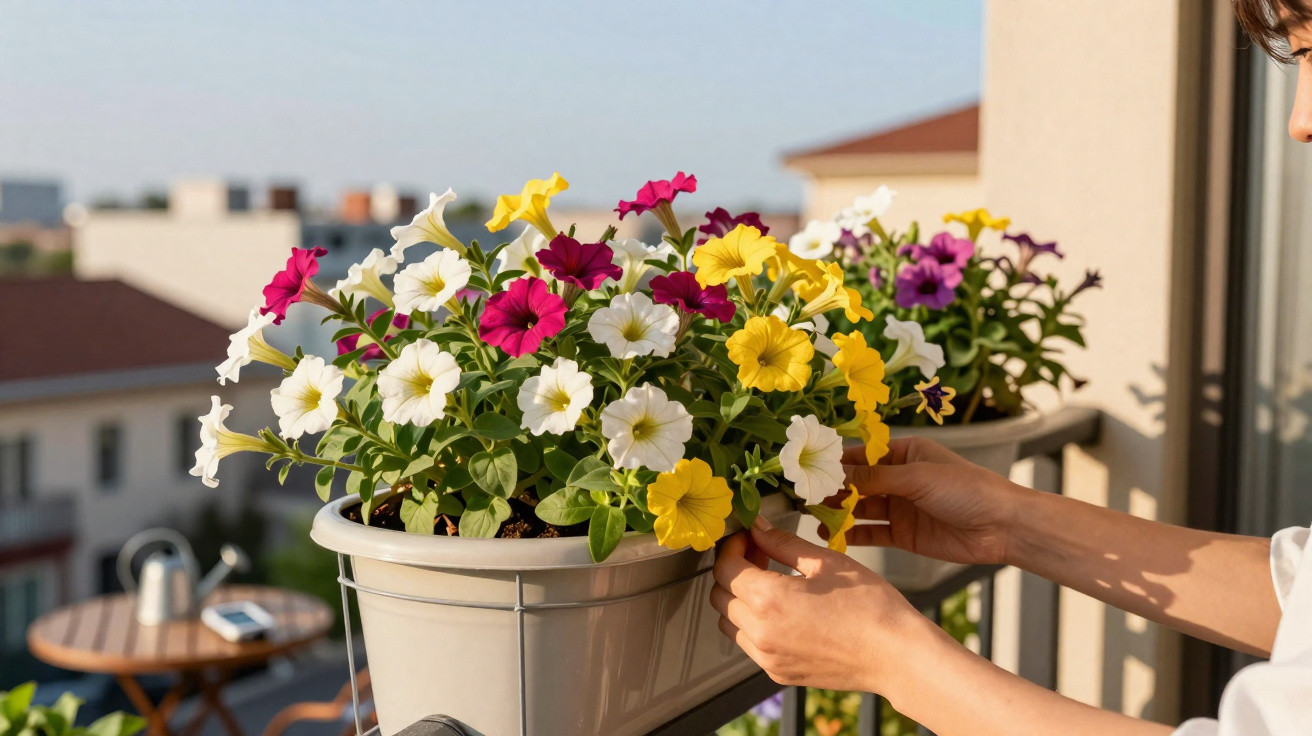
Calibrachoa is particularly appealing for anyone with limited room, as it thrives in pots while producing a remarkable number of small flowers. Low-growing with a trailing habit, it can create a colourful cascade over window boxes and hanging containers, filling the sides rather than taking up valuable balcony walking space.
Why does calibrachoa work so well on small balconies?
This plant generally stays compact, producing stems that spread outwards or spill over the edge of the container. Certain varieties reach roughly 10 to 50 centimetres in both height and spread, while their trailing form makes effective use of vertical areas, balcony rails and hanging supports.
What do the flowers of this plant, known as the mini petunia, look like?
Its small, trumpet-shaped blooms closely resemble petunias, which explains the name “mini petunia”. Botanically, however, calibrachoa belongs to its own genus within the Solanaceae family. Varieties are available in pink, violet, yellow, red and orange, as well as in a range of two-tone colour combinations.
Given sufficient light, the plant can keep flowering for an extended period, producing such a dense display of colour that it almost conceals some of the foliage. To make the most of its trailing growth, the following containers are especially suitable:
- hanging pots placed near walls and railings;
- window boxes fitted to the balcony rail;
- tall pots that allow the stems to trail down their sides;
- containers shared with upright-growing plants.
How much sun does calibrachoa need for abundant flowering?
A sunny spot is essential for abundant flowering. The pot should be kept somewhere bright and, ideally, sheltered from very strong winds. On a balcony that receives several hours of direct sunshine, the plant has more favourable conditions for producing fresh buds throughout the season.
How should you care for the plant without waterlogging its roots?
Calibrachoa favours a fertile, free-draining growing medium. Although it needs moisture as it grows, water must not remain around the roots. The container therefore requires effective drainage holes and a porous compost that lets excess water escape.
Care is easier when you assess the compost itself rather than watering according to a fixed timetable. To keep the plant compact and growing well, pay attention to a few key points:
- water once the surface of the compost starts to dry out;
- do not leave saucers continually filled with water;
- use a light growing medium with good drainage;
- position the pot somewhere sunny and sheltered;
- trim overly long shoots when necessary to restore its compact shape.
Why does calibrachoa make such effective use of limited balcony space?
Its compact size combined with trailing growth means the plant can be placed in areas that would otherwise remain unused. Rather than needing a large flower bed or a wide pot on the floor, calibrachoa can grow in a narrow window box, with its stems spilling beyond it to create volume without obstructing the way through.
The main point is not to mistake its small size for an ability to cope with every condition. To produce its characteristic mass of flowers, the plant chiefly needs light, drainage and balanced watering. Once these three requirements are met, a single pot can fill a substantial part of a balcony with flowering stems without requiring the room taken up by a large shrub.


Comments
No comments yet. Be the first to comment!
Leave a Comment