
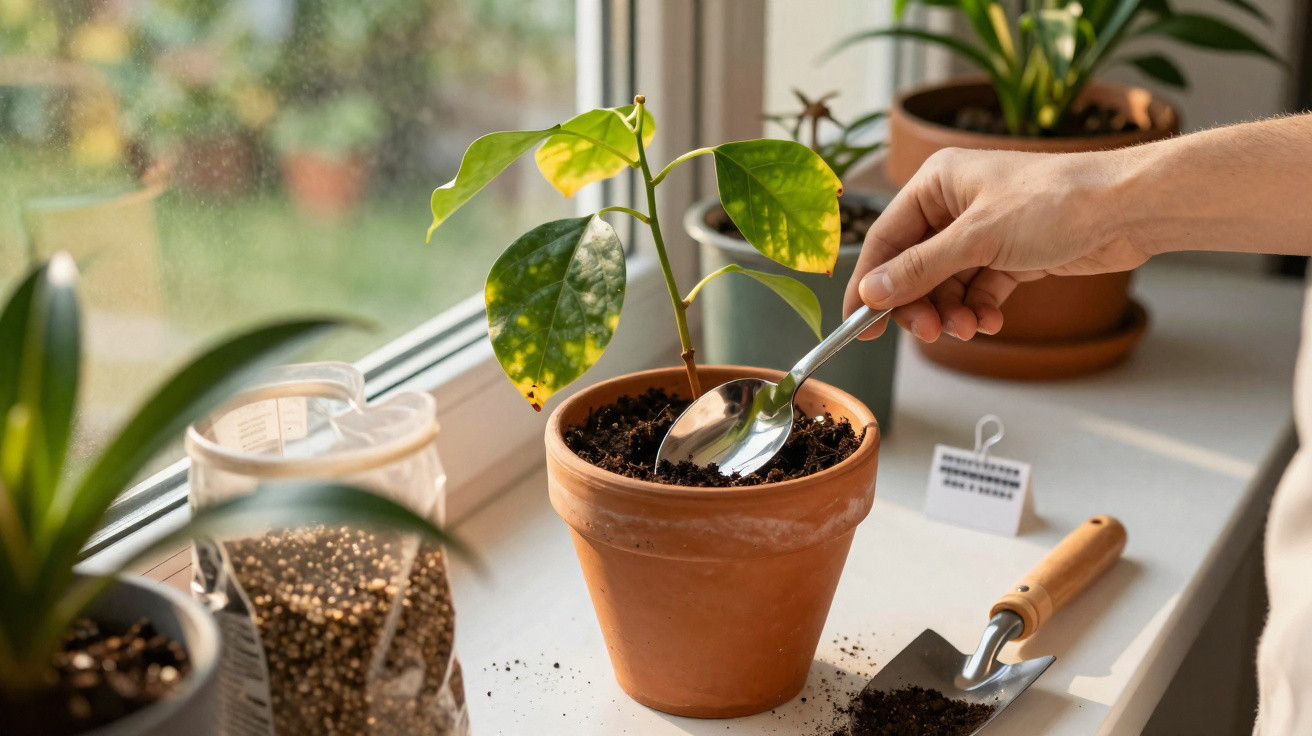
Anyone seeing a spoon in a plant pot for the first time could easily assume it has been forgotten there or is simply an odd decorative touch. Yet the spoon pushed into the growing medium is part of a small gardening craze circulating through forums, Facebook groups and office-window plant displays. The premise is that an ordinary metal spoon can make potted plants more vigorous, more resilient and somewhat better protected – without fertiliser pellets or chemicals.
Where the metal spoon in a flowerpot trend comes from
Metal objects in containers are not entirely new. For years, many gardeners have placed a few copper coins at the bottom of a pot, either to improve drainage or discourage slugs. Others use wire baskets to stop voles reaching the roots. The inserted spoon follows the same improvised gardening principle: repurposing everyday items to make a slight difference to the pot’s microclimate and soil.
The method sounds almost absurdly straightforward. Clean an old metal spoon and push either its handle or bowl into the compost. The important point is that bare metal must touch the growing medium. Painted or coated items are unsuitable, as they do not react with the soil and may not remain durable over time.
Experienced houseplant enthusiasts advise against trying this trick in very small containers, such as seedling pots or delicate miniature succulents. In these, the spoon takes up too much room, may compress roots or interfere with how water is distributed through the pot.
What a metal spoon can actually do for plants
A modest mineral source in depleted compost
Nutrient reserves are quickly used up in enclosed pots. If a plant is rarely repotted and seldom fed, the compost can eventually become exhausted. Supporters of the spoon trick expect the metal to release minute quantities of minerals over time when moisture is present.
“The spoon does not replace fertiliser, but is intended to enrich the growing medium very slightly over the long term – a quiet supporting player rather than a miracle cure.”
With stainless steel or aluminium, however, this leaching happens only to a very limited extent. There are no scientific studies demonstrating noticeable growth boosts from a single spoon. Instead, many amateur gardeners describe subtler changes: fewer yellow leaves and slightly more even growth, especially in older container plants that have remained in the same pot for years.
A physical obstacle for small pests
The spoon’s physical presence provides a second, more tangible benefit. It covers part of the soil surface close to the base of the plant. Anyone who has dealt with fungus gnats, ants or other small crawling pests in a pot knows that they favour loose, easily accessible compost. A piece of metal in their path makes access less convenient.
Its shine may also play a part: some insects and crawling creatures avoid reflective surfaces. Particularly on balconies, where aphids, ants and similar pests can quickly move from pot to pot, many see the spoon as a small, pollutant-free obstruction. It does not replace pest control, but may shift the balance slightly in the plant’s favour.
How to use the spoon trick correctly
To ensure this improvised idea does not become a risk to the plant, it is worth taking a careful approach. The method can be used in a few simple steps.
- Choose a suitable spoon: Ideally, use an old stainless-steel spoon with no paint, engraving filler or coating.
- Clean it thoroughly: Washing-up liquid and hot water are sufficient, provided that all grease and food residue are completely removed.
- Place it correctly in the pot: Insert it nearer the edge rather than directly beside the stem, leaving the roots enough space.
- Consider the depth: Push it far enough into the compost for the spoon to be fully surrounded by growing medium; the handle may protrude slightly.
- Use only one per pot: One spoon is entirely enough, even in larger containers. More metal does not automatically produce a greater effect.
Many plant lovers first try the idea with ornamental plants: ficus, monstera, geraniums or balcony petunias. Some are more cautious with herbs and edible crops, as they do not know exactly how much metal might ultimately end up in edible parts of the plant.
What the spoon cannot do
The trend relies heavily on social-media photographs and before-and-after stories. Some videos make the spoon appear to be a secret growth elixir. A closer look soon shows that other factors play the leading role in almost every case: light, watering habits, pot size and compost quality.
“Without good growing medium, an appropriate position and regular repotting, every spoon remains only a nice extra in the soil.”
A spoon will not loosen compacted, old potting compost on its own. Nor will it eliminate waterlogging. Waterlogging usually results from the lack of a drainage layer or from pots without drainage holes. The spoon sits higher up in the growing medium and cannot simply make excess water disappear.
The same applies to serious pest issues. A heavy infestation of fungus gnats, spider mites or scale insects requires targeted action: yellow sticky traps, layers of horticultural sand, pruning and, where necessary, biological treatments. At most, the spoon offers marginal support; it is not a replacement for treatment.
Who may genuinely benefit from a spoon in the pot
This trick suits people who already enjoy experimenting with household objects and closely observing their plants’ leaves. Those who inspect their pots regularly will soon notice whether anything changes – or whether it does not.
The experiment may be particularly interesting:
- for long-standing houseplants that rarely receive fresh compost;
- in balcony planters exposed to strong sunlight and containing only a limited amount of growing medium;
- for container plants in winter quarters that are susceptible to fungus gnats;
- for people who want to use as little chemical treatment as possible on their balcony.
Anyone unsure can set up a small comparison test: use two plants that are as alike as possible, with the same size, compost and position. Put a clean spoon in one pot and leave the other without one. Over several weeks, compare growth, leaf colour and any pests. This can reveal whether the metal object benefits your own plants.
Risks, limits and useful additions
Although stainless steel is generally harmless, possible side effects are worth considering. In very small containers, a spoon can restrict root development or divert watering water, leaving some root areas too wet and others too dry. Anyone growing plants with particularly sensitive root balls, such as orchids or rare tropical species, would be better avoiding the metal trick.
Metals such as copper or brass develop a patina over time. While this often looks decorative, it alters the chemical surface. It is not ideal for edible plants, as no one can accurately estimate which traces may pass into the harvest. Stainless steel remains the safest option here – and even cautious gardeners tend to use it mainly in pots containing ornamental plants.
The spoon only becomes genuinely useful as one element of good overall plant care. Several measures have a much greater influence on plant health:
- Fresh compost every one to three years – depending on the species.
- A free-draining mix of potting compost, mineral materials such as perlite, and a clean drainage layer at the bottom of the pot.
- Watering according to need rather than the calendar, topping up only once the upper layer of compost has dried out.
- Checking the position: give light-loving plants more light, while shade-preferring varieties need less direct sun.
Once these basics are under control, the spoon in the compost can be tried as a minor refinement. The plants will already have a stable foundation, and the metal trick can then serve only as a small, almost invisible bonus in the background.
Ultimately, the trend is an appealing example of how creatively balcony gardeners and houseplant enthusiasts use simple resources. A discarded spoon does not go into the bin, but instead becomes part of a miniature ecosystem in a flowerpot – with limited but potentially interesting benefits for anyone who enjoys a little experimentation.

Comments
No comments yet. Be the first to comment!
Leave a Comment