
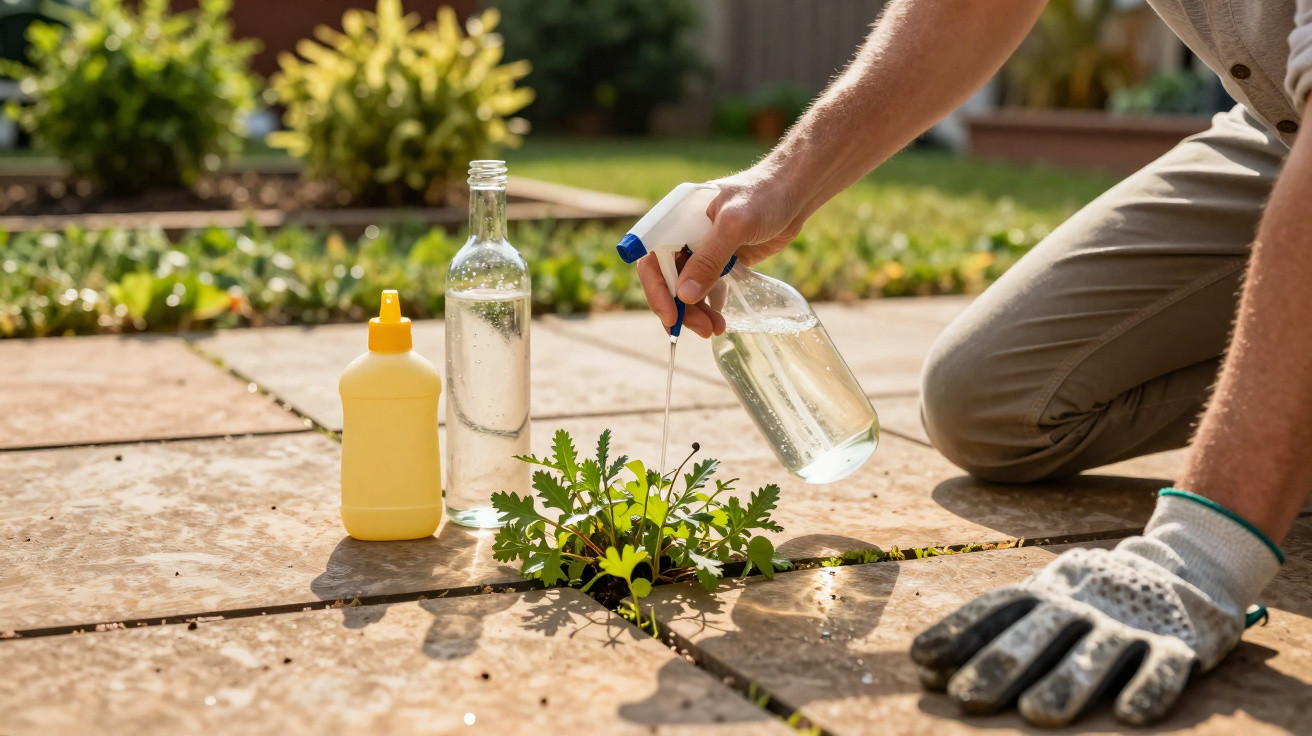
Many people instinctively reach for vinegar or pricey specialist products from the DIY shop. Yet there’s a humble kitchen staple that can work far more effectively against stubborn weeds in paving joints - while being kinder to both your wallet and the environment, provided you use it correctly.
Why a splash of washing-up liquid in the garden becomes a game-changer
How surfactants break through a plant’s protective layer
Washing-up liquid is best known as a grease-buster for pans and plates. Outdoors, however, it plays a very different part. The key is its surfactants - cleaning agents that help water and oils mix.
Leaves are coated in a thin, waxy film that makes water bead and run off. This coating protects the plant and causes many sprays to simply slide away. Washing-up liquid is designed to overcome exactly that kind of barrier.
"The surfactants in washing-up liquid break down the water-repellent waxy layer on leaves and make them properly vulnerable to mixtures of water, acetic acid and the like."
When a solution containing washing-up liquid hits a leaf, it clings better and penetrates more effectively. The plant quickly loses its ability to retain moisture, dries out, and dies noticeably faster. This approach can be surprisingly effective on paths, gravel areas and lawn edges - without dousing the entire garden in harsh products.
The basic recipe: simple, low-cost, and mixed in minutes
For many situations, a straightforward blend is all you need, and it can be made in a couple of minutes. You’ll only require water, a small amount of washing-up liquid, and (optionally) everyday household vinegar.
- 1 litre of water (cold or lukewarm)
- 1 tablespoon of washing-up liquid (ideally fragrance-free; an eco option is best)
- if needed: 1 cup of household vinegar (approx. 250 ml) to boost the effect
Add the ingredients one after another to a clean spray bottle, then give it a brief shake until everything is evenly combined. That’s it.
A dry, sunny day is ideal for application. Spray the target plants thoroughly, focusing especially on the upper leaf surfaces. Sunshine helps the water evaporate more quickly, the plant dehydrates, and results can appear soon afterwards.
"Many hobby gardeners report that the first discolouration and wilting are often visible after just a few hours."
Compared with many off-the-shelf products, the benefits are obvious: the mixture costs only a few pence, creates very little packaging waste, and can be made on the spot whenever new shoots appear.
What vinegar on its own can’t do
Why straight vinegar treatments often disappoint
Vinegar has long been a go-to remedy for weeds in paving joints. The acid attacks the leaf cells and effectively scorches them. It can look like a quick win - green shoots turn brown, collapse, and seem to vanish.
That’s also where the catch lies: while the visible growth dies back, the roots often remain largely unaffected in the soil. Before long, the plant sends up fresh growth again. If you rely on vinegar alone, you may find yourself repeating the process week after week.
When washing-up liquid is included, the solution adheres more reliably, soaks in more intensely, and is more likely to reach lower plant tissue. This makes a real difference on larger areas and with well-established, deep-rooted weeds. The workload drops, and the gap between treatments typically becomes much longer.
Stronger or gentler options - depending on the problem area
Not every surface needs the strongest possible mix. You can tweak the recipe to suit the situation:
| Situation | Recommended mixture | Note |
|---|---|---|
| Fresh, delicate shoots in joints | 1 litre of water + 1 tbsp mild washing-up liquid | A gentler option, ideal for routine control |
| Stubborn mats in gravel paths | 1 litre of water + 1 cup of vinegar + 1–2 tsp washing-up liquid | More punch, but spray precisely |
| Areas where nothing should grow (e.g. under wheelie bins) | Vinegar–water mix with a little washing-up liquid; some people add a little salt | Use very sparingly, as soil can be damaged long term |
The higher the vinegar content, the faster plants tend to respond. At the same time, the strain on soil organisms and nearby garden plants increases. If you want long-term enjoyment from your garden, it’s wiser to increase the strength gradually until you find the right dose, rather than jumping straight to the harshest version.
Safe use: where washing-up liquid mixes are off-limits
Spray with precision, rather than misting the whole garden
As convenient as this solution is, it shouldn’t be used indiscriminately. It doesn’t just affect unwanted growth - it will damage almost any soft green plant it touches. Roses, perennials, young veg plants and grass can all be just as sensitive.
A few straightforward rules help prevent accidental harm:
- Spray only onto the unwanted plants; do not mist it into the air.
- Wait for calm conditions or only a light breeze so droplets aren’t blown around.
- Completely avoid flower beds, the veg patch and lawn areas.
- Rinse sprayers and containers thoroughly after use, so residues can’t reach other plants.
Using too much washing-up liquid can also alter soil structure, especially on small areas with a thin humus layer. Water may soak in less well, and soil life such as earthworms and micro-organisms can suffer.
"The mixture is best suited to mineral zones: paving, patios, steps, kerbs, gravel paths."
If you add salt to any recipe, be aware that it washes out very slowly and can suppress soil life for a long time. That may be acceptable on driveways or under fixed structures, but close to bed edges or lawns it can cause lasting problems.
Practical routines for a consistently tidy outdoor space
Consistency beats a radical one-off
Rather than going over the entire outdoor area twice a year with an aggressive mix, a different approach usually works better: start early and keep it targeted. As soon as the first green tips appear between stones or in gravel, the mild mixture - with little or no vinegar - is often enough.
If you check joints, edging stones and steps every few weeks, you can keep growth under control before it forms dense mats. In many cases, a quick pull with a joint scraper, paired with a few targeted sprays on especially persistent spots, does the job.
This way, far fewer active substances build up in the ground, while the surfaces still look neat. For many hobby gardeners, the once-dreaded job of “cleaning the joints” becomes a quick in-between task that takes little more time than watering potted plants.
Combining natural helpers sensibly
Washing-up liquid mixtures don’t have to work alone. In many gardens, a combination of gentler methods makes the most sense:
- a joint scraper or knife for thick roots and deep cracks
- hot water (for example from the kettle) for tiny shoots near entrances
- a washing-up liquid–vinegar–water mix for areas where mechanical work is difficult
- jointing sand or jointing mortar to make regrowth harder
If you look closely, you’ll soon notice that not every green plant between stones is an enemy. Some low, cushion-forming plants can be left in place at the edges to create a more natural, lively feel. The spray bottle can then be saved for the spots that genuinely get in the way.
What’s behind terms like surfactants, microfauna and more
When washing-up liquid in the garden is discussed, technical terms often crop up. Understanding them makes it easier to judge what’s happening. Surfactants are substances that reduce the surface tension of water. That helps droplets spread instead of forming beads that roll off. This is exactly what you’re exploiting: the solution creeps across the leaf, works into tiny gaps, and stays in place for longer.
Microfauna refers to tiny animals living in the soil - springtails, mites, miniature worms or larvae. They break down dead plant material and help build fertile humus. If these helpers are repeatedly exposed to high concentrations of vinegar, salt or surfactants, their populations shrink, and the soil can lose its vitality over time.
Used selectively, in moderation, and mainly on stone and gravel areas, washing-up liquid can deliver the best of this household aid - without holding back your garden soil in the long run. In that way, the garden stays tidy, practical and full of life.




Comments
No comments yet. Be the first to comment!
Leave a Comment