
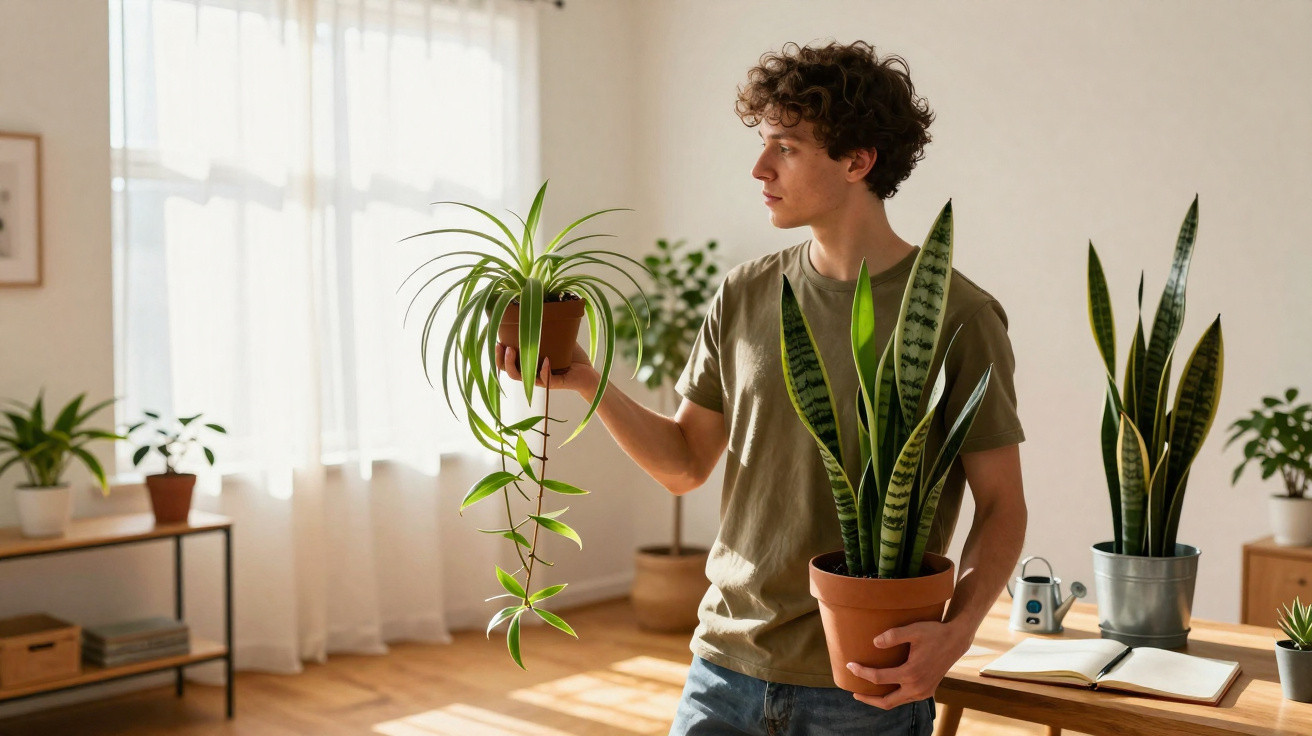
Anyone looking for an undemanding houseplant usually ends up choosing between two staples: the spider plant and the snake plant, often called mother-in-law’s tongue. Both have a reputation for being tough, both are said to improve indoor air quality - yet botanically and practically they’re two very different characters. If you’re short on time, have pets at home, or deal with tricky light levels, it’s worth understanding exactly how they differ.
What fundamentally sets spider plant and snake plant apart
Although both species sit within the same plant family (Asparagaceae), that’s where most similarities stop. The spider plant (Chlorophytum comosum) originates from tropical and southern parts of Africa and is adapted to warm, relatively humid conditions. It grows as a tufted rosette of leaves, sending out long, arching foliage and producing small offsets on thin runners.
Snake plant (Dracaena trifasciata, formerly Sansevieria trifasciata) comes from West Africa, including areas such as Nigeria and the Congo. It has evolved to cope with dry spells. Its leaves rise upright, are thick, firm and sword-shaped. Those rigid blades are exactly why it picked up nicknames such as “mother-in-law’s tongue”.
Spider plant = a tropical trailing performer that makes lots of plantlets.
Snake plant = a drought-tolerant “leaf cactus” for the minimalist-care crowd.
Even within the same family, the two have taken very different evolutionary paths over millions of years. So if you assume “same family” means “same care”, you’re likely to be proven wrong - often with yellowing leaves or roots starting to rot.
What these plants actually look like
The most obvious difference is visible immediately: their growth habit. A spider plant forms a dense, rosette-like clump, with long, flexible leaves that spill outwards and down. The overall effect is like a small green fountain. The foliage is often bicoloured, typically green edges with a white or pale yellow stripe through the centre.
Snake plant, by contrast, looks almost architectural. Stiff leaves stand upright, emerging directly from an underground rhizome. Depending on the variety, they can be just a few centimetres long or grow to well over a metre. A dark green base colour with lighter, grey-green horizontal banding is common. Some cultivars show golden-yellow margins, while others appear nearly silvery.
| Feature | Spider plant | Snake plant |
|---|---|---|
| Leaf shape | Long, arching, grass-like leaves | Rigid, upright, sword-like leaves |
| Growth form | Cascading rosette, ideal for hanging | Vertical clumps, ideal for narrow corners |
| Leaf texture | Soft, pliable | Thick, succulent-like |
| Propagation | Plantlets on long runners | Rhizome division or leaf cuttings |
| Flowers | Small white flowers, fairly common | Rare greenish-white flower spikes |
If you love easy propagation, the choice is straightforward: spider plants routinely produce little “baby plants” on stems, which you can simply place in water or pot into compost. Snake plant takes more effort: you either split the root system or cut leaves into sections and insert them into growing medium. With variegated forms, leaf cuttings can also cause the patterning to disappear - a frequent frustration for collectors.
Care: who likes water and who needs dryness
The biggest point where people slip up is care - especially watering. Spider plants prefer consistently, lightly moist compost. If the pot dries out completely, they often respond quickly with limp leaves and brown tips. In many homes, watering about once a week works well, and in summer it may need to be slightly more frequent depending on the spot.
Snake plant works almost the other way round. Those fleshy leaves store water much like a succulent. Let the compost dry out fully before you water again. If you add water every week out of habit, you’re inviting root rot. In a typical flat or house, watering every two to six weeks is often enough, and in winter sometimes even less.
The key care differences at a glance
- Watering: Spider plant prefers steady moisture; snake plant does best with dry periods.
- Light: Both manage in bright, indirect light, but snake plant tolerates shade even better.
- Humidity: Spider plant appreciates slightly higher humidity, for example from occasional misting. Snake plant is fine with normal indoor air.
- Feeding: Feed spider plant roughly once a month during active growth; snake plant usually only needs a light feed once per quarter.
- Repotting: Spider plants grow quickly and often want more room annually. Snake plant is unbothered and can stay in the same pot for several years.
Temperature matters too. Spider plants are happiest at around 18 to 24 °C. Once temperatures drop below about 10 °C, the leaves can start to suffer. Snake plant copes with a wider range and is generally comfortable in rooms of roughly 13 to 30 °C, provided it isn’t kept permanently cold.
Which plant suits which home?
Spider plant is a classic for hanging pots, shelving and plant stands. Its trailing habit fills empty corners and adds a sense of movement to a room. If you enjoy giving plants away or multiplying your collection, the constant supply of offsets is a real advantage. It tends to suit people who don’t mind regular watering and a bit of routine care - ideal for family kitchens, bright living rooms or offices with daylight.
Snake plant shines where many other plants struggle. Narrow hallways, dimmer corners, bedrooms without much direct sun - it remains remarkably steady there. For frequent travellers, busy professionals, or habitual “forgetters”, it’s close to a safety net in houseplant form.
If you enjoy watering, choose a spider plant.
If you constantly forget to water, snake plant is the safer bet.
It’s also worth considering the styling effect. Spider plants read as softer, more playful, almost retro. Snake plant, on the other hand, fits beautifully into modern, minimalist or industrial interiors. Its crisp lines can feel more like a design object than a “traditional” potted plant.
Health, air-cleaning and safety at home
Both plants frequently appear on lists of air-purifying houseplants. NASA studies, in particular, suggest that snake plant may have strong potential to filter certain pollutants such as formaldehyde or benzene. In real life, no houseplant replaces proper ventilation, but they can still contribute a little to a nicer indoor environment.
One factor many people overlook: both spider plant and snake plant contain substances that can be unpleasant for pets and small children if chewed. In most cases it results “only” in gastrointestinal irritation such as vomiting or diarrhoea, but it’s still sensible to keep the plants out of reach of dogs, cats and crawling toddlers.
Practical tips for living with both types day to day
If you can’t choose, you don’t have to - both species are perfectly happy living side by side. The key is to place them intentionally:
- Put the spider plant near a bright window with a sheer curtain - the bathroom or kitchen can work well, where humidity tends to be higher.
- Place the snake plant in the hallway, bedroom or office, where it can cope with lower light and drier air.
Watering habits are another common sticking point. Many people make the mistake of watering every plant on the same day and giving them the same amount. If you keep both a spider plant and a snake plant, it helps to adopt two clearly different watering routines. A simple trick is to use two watering cans: one labelled “often” and one labelled “rarely”.
If you go a bit deeper, you’ll quickly encounter terms like “rhizome” and “stolons”. Put simply: the snake plant’s rhizome is a storage organ in the soil that repeatedly sends up new leaves. The spider plant’s stolons are above-ground runners that carry the small plantlets. Once you understand these structures, it becomes obvious why propagation works so differently for each.
Combinations can be particularly effective, too. In a large room divider, for example, you can let spider plants trail from the upper section while placing snake plants in individual pots below to add structure. That creates height layering and visual depth without the care routine becoming unmanageable.
If you’re searching for a first “beginner plant”, be honest about your day-to-day life: if you like misting, watering and keeping an eye on growth, start with a spider plant. If you don’t fully trust yourself with consistency, begin with snake plant - it forgives almost everything, except too much water.

Comments
No comments yet. Be the first to comment!
Leave a Comment