
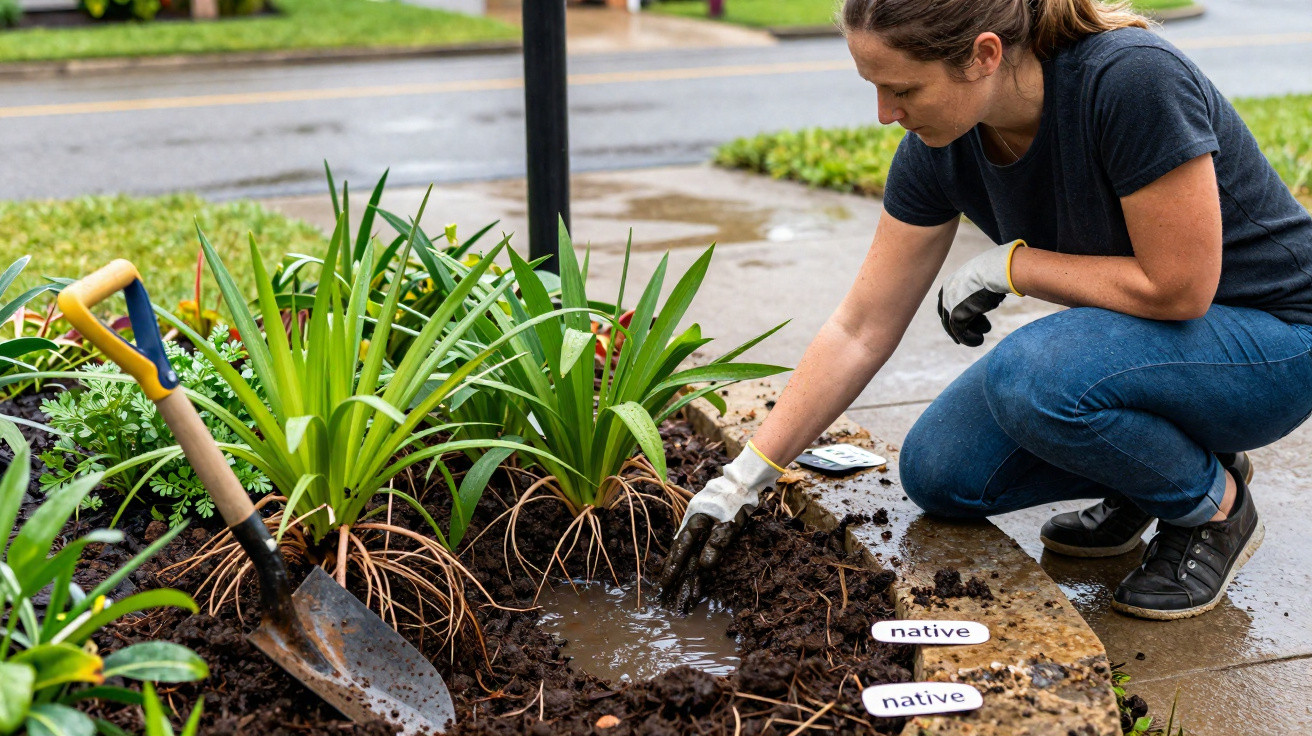
Whenever there was a heavy downpour, she would watch water run off the roof, cut across the back garden and spill into a fast-moving stream along the pavement. Her answer was to dig a shallow hollow in the garden and turn it into a rain garden - a planted bed designed to hold that water briefly and let it soak into the ground.
How did she come up with the idea of digging out part of the garden?
The issue began with the home’s hard, impermeable surfaces. The roof, a concreted side passage and the outdoor paving channelled almost all the rainfall to the same spot, sending it quickly towards the street. Rather than installing larger drains, she chose to create an area where some of that volume could sit for a few hours.
She located the hollow along the natural path of the surface flow, but kept it well away from the foundations and boundary walls. The idea follows the same principle as a bed intended to capture and infiltrate rainwater before it overwhelms kerbs and storm drains.
- Water from the guttering was redirected into the bed;
- The base was kept level to spread the incoming volume;
- Stones were placed at the inlet to break the force of the rush of water;
- An outlet was left in place for any surplus;
- The structure was positioned away from the house walls.
What happened when the first heavy storm arrived?
As the rain fell, the hollow filled gradually, rather than immediately spilling onto the pavement. Water pooled for a short time and then vanished as it moved down through the soil layers, showing that the bed was not meant to be a permanent pond, but a temporary holding area.
How did she prepare the soil to cope with so much water?
The original ground was compacted and took in rain slowly. To improve drainage, she replaced some of the soil with a freer-draining mix of sand, soil and organic matter. The depth was kept to just a few centimetres - enough to store water without leaving a hazardous excavation in the garden.
There was no single formula for the build, because the size depends on the roof area and how readily the ground can absorb water. Before planting, she watched how long it took for pooled water to disappear and then made a few adjustments:
- Loosened the compacted soil at the bottom of the hollow;
- Added free-draining soil without overdoing the compost;
- Protected the inlet with gravel and larger stones;
- Shaped gentle edges to prevent erosion;
- Kept a safe route for overflow.
Why did she choose native plants with deep roots?
The plants needed to cope with both waterlogged ground after storms and dry spells between rain events. Deep roots helped open channels for infiltration, stabilised the soil, and turned the hollow into a bed that blended with the rest of the garden.
Did the small change really reduce water on the pavement?
Rainwater runoff did not disappear entirely, but it began reaching the street more slowly and in a smaller volume. In moderate rainfall, much of the water that used to rush past the gate stayed on the property instead. During intense storms, the emergency outlet carried the excess away without forcing it back towards the house.
The area still needed leaves clearing, the inlet kept tidy and the plants monitored, but upkeep stayed straightforward. Much like using small spaces to create residential garden beds, the change proved that a few square metres of permeable ground can help manage stormwater flow and ease pressure on the street’s drainage.






Comments
No comments yet. Be the first to comment!
Leave a Comment