
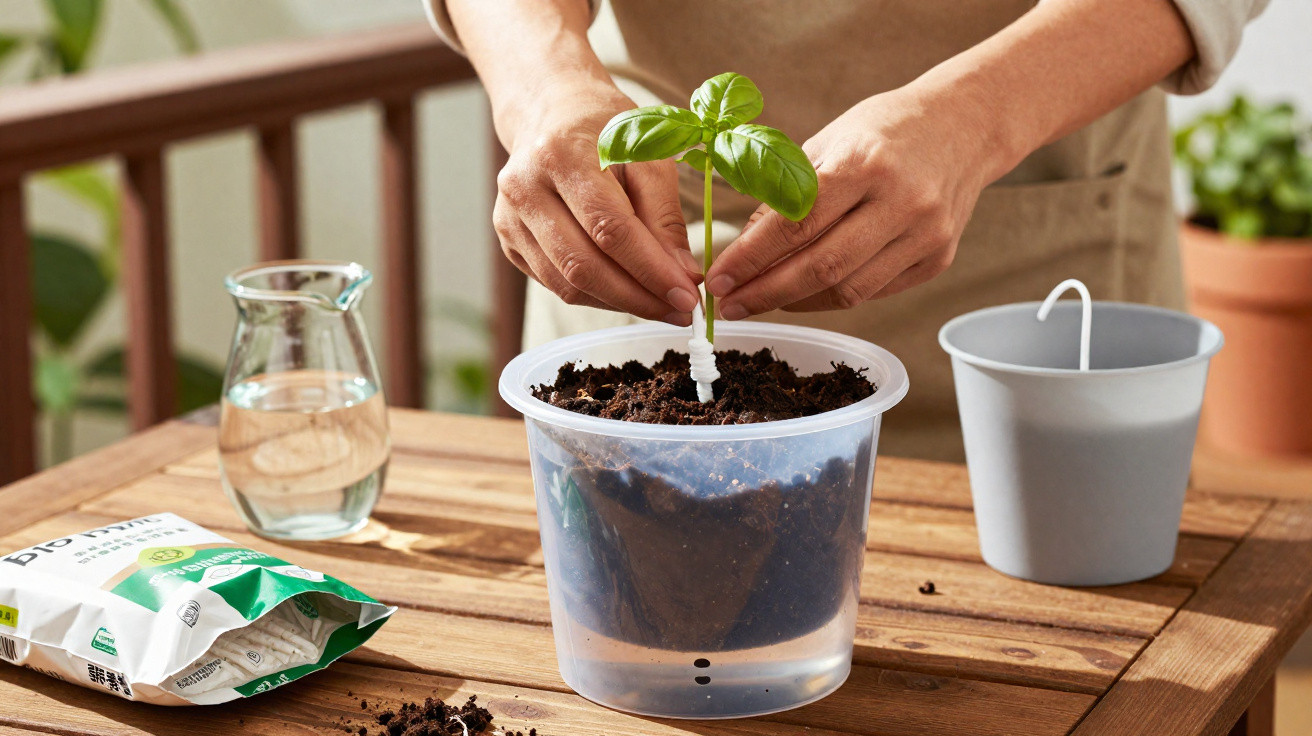
A self-watering pot with a wick keeps the water reservoir separate from the growing medium, using capillary action to move moisture gradually towards the roots. This arrangement can use a wick made from absorbent material to draw water from the lower reservoir into the growing medium.
How does the wick carry water to the growing medium?
The underlying principle is capillary action, a phenomenon that allows water to travel through the narrow spaces within certain materials. In a self-watering pot, the wick creates a link between the reservoir and the growing medium, gradually drawing water upwards.
This does not mean that the wick mechanically pumps water. The volume transferred is influenced by the material chosen, its contact with the growing medium and the surrounding conditions. For this reason, the setup must ensure that the wick maintains proper contact with both the water and the growing medium.
What makes a self-watering pot work?
The reservoir must be kept apart from most of the growing medium, so that the entire material is not continually in direct contact with water. The wick passes through this division, providing the route by which moisture reaches the planting area.
Some systems instead use a column of growing medium that performs a role similar to a wick. In either arrangement, the purpose is to allow water stored below to reach the growing material gradually.
How do you make a self-watering pot with a wick?
Use two containers: one should serve as the reservoir, while the other holds the growing medium. Make an opening for the wick, keeping one end in contact with the water in the reservoir and placing the other within the growing medium.
Next, fill the upper container with growing medium and position the plant. Before relying on the system regularly, moisten the growing medium to help establish contact between the wick and the material. Refill the reservoir without allowing the water level to reach most of the growing medium directly.
Which plants should not use this system?
A self-watering pot is not suitable for every species. Plants that favour drier conditions, or need the growing medium to dry out between watering, may struggle when moisture is supplied continuously from underneath.
It is also important to monitor the plant's response after assembling the pot. If the growing medium stays too wet, refill the reservoir less often or adjust the system. A self-watering pot with a wick therefore works best for plants that can tolerate more consistent moisture, provided the system is sized according to the species' water requirements.
Comments
No comments yet. Be the first to comment!
Leave a Comment